Red Terror (Edexcel GCSE History): Revision Notes
📚Revision Notes
Red Terror (1966-76)
What was the Red Terror?
The Red Terror was a period of extreme violence and chaos that spread across China during the Cultural Revolution. As Red Guard violence expanded throughout the country, the government began to collapse, leading to widespread terror and anarchy. The term "Red Terror" refers to the use of extreme violence to achieve socialist revolutionary goals, and it became a defining characteristic of this dark period in Chinese history.
Note
The Red Terror represented a complete breakdown of law and order in China, where violence became the primary tool for political change and social control.
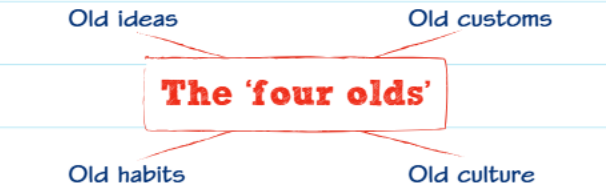
The "Four Olds" campaign
In August 1966, Lin Biao launched the "Four Olds" campaign at a mass rally, which became the foundation for much of the Red Terror that followed. This campaign targeted traditional aspects of Chinese culture that were seen as obstacles to the revolution and sources of oppression for the poor.
The Central Cultural Revolution Group instructed Red Guard groups across China to attack these "Four Olds" wherever they discovered them. Anyone who read traditional books, sang old songs, or practised religion became targets for persecution. Many Red Guard groups used terror tactics to attack authority figures they encountered, creating an atmosphere of fear and violence throughout society.
Note
The Four Olds consisted of:
- Old ideas - traditional philosophical and political thoughts
- Old customs - traditional practices and ceremonies
- Old habits - traditional ways of living and behaving
- Old culture - traditional arts, literature, and cultural expressions
Attacks on people
The Red Terror quickly transformed from cultural attacks into direct violence against individuals. Mao actively encouraged these attacks, and local police forces were forbidden from intervening, giving the Red Guards complete freedom to act.
Targeting specific groups
Red Guards, easily recognisable in their uniforms and carrying copies of Mao's "Little Red Book", systematically targeted several groups across China's towns and cities:
- Intellectuals and educated people faced particularly harsh treatment, being forced to confess to imaginary crimes and endure public humiliation
- Communist Party officials who were accused of following capitalist ideas or opposing Mao's ideology were verbally and physically attacked
- Wealthy individuals and business owners became targets for their perceived class status
Methods of persecution
The Red Guards employed various humiliation techniques as part of their terror campaign. Intellectuals and Party officials were often forced to perform degrading tasks like sweeping streets and cleaning public toilets. Physical violence was commonplace, with many victims suffering beatings and torture. The psychological pressure was so intense that numerous people targeted for persecution chose to end their own lives rather than continue enduring the humiliation.
Important
Critical Impact: The psychological warfare employed by Red Guards was often more devastating than physical violence, leading many victims to suicide rather than enduring continued persecution.
Scale of violence
The death toll from Red Guard violence reached devastating levels. Several hundred thousand people were killed by Red Guards during this period, while police forces were prevented from stopping these murders. The Red Guards continued their violent campaigns with complete impunity, creating a reign of terror across Chinese society.
Cultural destruction
The Red Terror extended beyond violence against people to include systematic destruction of China's cultural heritage and personal possessions.
Attacks on cultural sites
Red Guards launched widespread assaults on museums, destroying ancient books, artwork, and historical artefacts. Religious buildings including temples and shrines became particular targets for destruction. In some extreme cases, Red Guards even raided the tombs of ancient Chinese emperors, desecrating human remains as symbols of the old order they sought to eliminate.
Example
Example of Cultural Destruction
Red Guards would systematically enter museums and:
- Burn ancient books and manuscripts
- Smash artwork and pottery
- Destroy religious statues and symbols
- Replace traditional displays with Mao portraits
Some groups even desecrated imperial tombs, viewing them as symbols of China's "feudal past."
Destruction of homes and possessions
The terror reached into people's private lives as Red Guards broke into homes, destroying books, traditional furniture, and religious items. Hundreds of thousands of families lost their homes and possessions during these raids, leaving many people destitute and homeless.
Transformation of urban spaces
Red Guards systematically changed the visual landscape of Chinese cities, replacing traditional artwork and decorations with portraits of Mao. Street names were changed to reflect revolutionary slogans, and even individuals adopted revolutionary names to demonstrate their loyalty to the new order.
Government breakdown and anarchy
By early 1967, the Red Terror had created such chaos that governmental authority effectively collapsed in many areas of China.
Collapse of Party control
Red Guards successfully overthrew established Communist Party authorities in numerous towns and cities across China. Some provinces saw their entire Party governments removed by Red Guard action, creating a power vacuum that led to further instability.
Important
Government Collapse: By 1967, the Chinese Communist Party had lost effective control over large portions of the country, creating a state of anarchy that would persist for years.
Conflicts between Red Guard groups
Rather than creating unity, the Red Guards' seizure of power led to internal conflicts. Different Red Guard groups began fighting each other for control, with each claiming to be the true representatives of Mao's revolution. This infighting meant that no effective government existed in many areas, leading to complete anarchy.
Rural and industrial conflicts
The chaos extended beyond urban areas into the countryside, where Red Guards clashed with peasants over land ownership and farming practices. Industrial workers also became involved in conflicts, particularly when Red Guards tried to remove factory managers, disrupting production and creating economic problems.
Economic consequences
All of these conflicts and the general state of anarchy severely damaged China's economic productivity during this period. The breakdown of normal government functions, combined with constant violence and disruption, made it impossible to maintain regular economic activity.
Timeline of key events
- August 1966: Lin Biao launches the "Four Olds" campaign at a mass rally
- Late 1966: Red Guard violence spreads across China's cities and towns
- Early 1967: Red Guards overthrow CCP authorities in multiple provinces
- 1967-1970: Period of most intense Red Guard conflicts and government breakdown
- 1966-1976: Red Terror continues throughout the Cultural Revolution period
Summary
Key Points to Remember:
- The Red Terror began with Lin Biao's "Four Olds" campaign in August 1966, targeting traditional Chinese culture
- Red Guards used extreme violence against intellectuals, Party officials, and wealthy people, killing hundreds of thousands
- Cultural destruction included attacks on museums, temples, and private homes, destroying China's historical heritage
- By 1967, Red Guard violence had caused complete government breakdown and anarchy in many areas of China
- The Red Terror created lasting damage to Chinese society, economy, and culture that extended throughout the Cultural Revolution period