Winding down (Edexcel GCSE History): Revision Notes
📚Revision Notes
Winding down of the Cultural Revolution (1968-1976)
Overview
By the late 1960s, Mao Zedong began implementing various strategies to bring the chaotic Cultural Revolution to a gradual end. This process involved dismantling the Red Guards, working with experienced officials like Zhou Enlai to rebuild the Chinese Communist Party (CCP), and eventually allowing previously purged leaders to return to government positions.
Note
The winding down of the Cultural Revolution was not a sudden end but rather a carefully orchestrated process that took nearly eight years to complete. This gradual approach allowed Mao to maintain control while slowly restoring order to Chinese society.

Ending the Red Guards movement
The challenge to Mao's authority
By 1967, the radical Red Guard groups had become increasingly difficult to control and were challenging central Party authority. This posed a direct threat to Mao's own leadership position, forcing him to take decisive action to regain control.
Important
The Red Guards had grown so powerful and uncontrollable that they began threatening the very leadership that had created them. This ironic situation forced Mao to choose between maintaining the revolutionary fervour and preserving his own authority.
Mao's three-stage approach
Mao employed different strategies to systematically break up the Red Guards:
Example
Mao's Three-Stage Strategy for Dismantling the Red Guards
Stage 1 - Spring 1968: Mao initially ordered the Red Guards to demobilise themselves, hoping they would voluntarily disband. However, this approach largely failed as many groups refused to comply.
Stage 2 - August 1968: When voluntary demobilisation failed, Mao deployed the People's Liberation Army (PLA) to forcibly break up Red Guard groups. This decisive action came after serious violence erupted at Beijing University, demonstrating that the situation had become uncontrollable.
Stage 3 - December 1968: The introduction of the "Up to the mountains and down to the villages" campaign provided a systematic solution to remove young Red Guards from urban areas entirely.
The rural re-education campaign
The "Up to the mountains and down to the villages" campaign became a crucial tool for ending the Cultural Revolution's urban chaos. This policy required millions of young people to move to the countryside for re-education, supposedly to learn discipline and proper revolutionary values from peasants.
The campaign had several important consequences:
- More than 17 million young people were relocated between 1968 and 1976
- Most participants never returned to their original cities
- Urban unemployment decreased significantly
- It effectively removed the main source of Cultural Revolution violence from cities
Note
Mao justified this policy by claiming that Red Guard violence demonstrated students' need for proper discipline and re-education in revolutionary principles. This rural campaign served multiple purposes: removing troublesome youth from cities, addressing urban unemployment, and providing cheap labour for agricultural development.
Zhou Enlai's growing influence
Rebuilding the Communist Party
With Lin Biao and Deng Xiaoping having been purged earlier, Mao increasingly relied on Zhou Enlai to help rebuild the damaged Chinese Communist Party structure. Zhou had managed to survive the Cultural Revolution by carefully avoiding direct criticism of Mao while not actively supporting its most extreme measures.
Rehabilitating purged officials
After Lin Biao's death in 1971, Zhou Enlai began the important work of bringing experienced officials back into government:
- Zhou successfully argued for the rehabilitation of officials who had been purged during the Cultural Revolution
- Between 1972-73, he reinstated approximately 700 senior CCP officials
- About 150 senior military leaders were also allowed to return to their positions
- This restoration was crucial because these officials had the experience and knowledge needed to run the government effectively
Zhou's approach was pragmatic - he recognised that the country needed experienced administrators to function properly, regardless of their previous political troubles.
Deng Xiaoping's return to power
Initial rehabilitation
Zhou Enlai had consistently argued that both Liu Shaoqi and Deng Xiaoping should be allowed to return to the CCP after their purging. While Mao and Lin Biao initially refused this request, circumstances changed after Lin Biao's death in 1971.
Gradual restoration of authority
Example
Deng Xiaoping's Staged Return to Power
March 1973: Deng was allowed to rejoin the Chinese Communist Party
August 1973: He regained many of his former powers and became a member of the Politburo
1975: Deng was appointed to senior Party roles and effectively became China's main leader
Significance of Deng's return
Deng's rehabilitation had important long-term consequences for China. His governmental experience and practical approach to leadership provided stability as the Cultural Revolution wound down. Both Zhou Enlai and Mao recognised that Deng's administrative skills would be valuable for rebuilding China's political and economic systems.
Timeline of key events
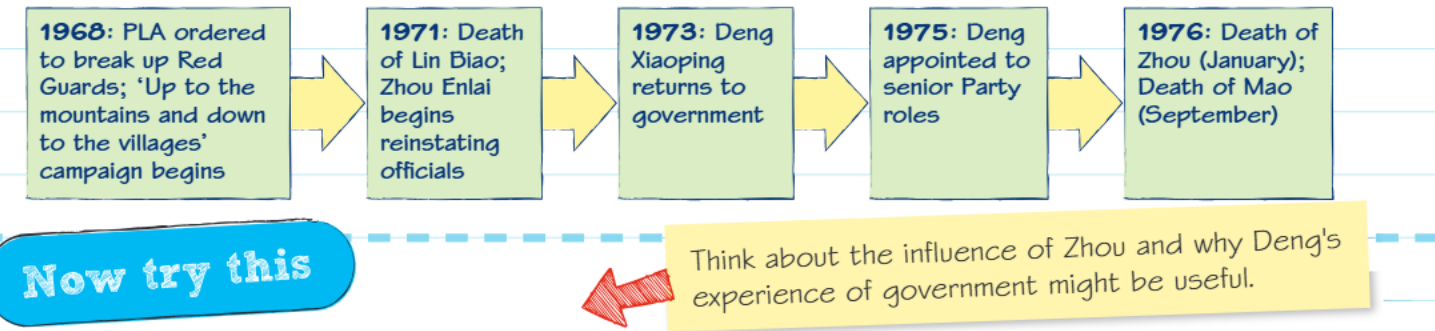
The restoration of order followed a clear chronological pattern:
- 1969: PLA formally ordered to break up remaining Red Guards; rural campaign begins
- 1971: Lin Biao's death; Zhou Enlai starts rehabilitating officials
- 1973: Deng Xiaoping returns to government
- 1975: Deng appointed to senior Party roles
- 1976: Deaths of Zhou Enlai (January) and Mao Zedong (September)
The end of an era
By 1976, the Cultural Revolution had effectively ended, though it was not officially declared over until after Mao's death. The combination of disbanding the Red Guards, rehabilitating experienced officials, and gradually restoring normal government functions marked the transition from revolutionary chaos back to more conventional Communist Party rule.
Important
The winding down process demonstrated both Mao's ability to regain control when his authority was threatened and his recognition that China needed experienced administrators to function effectively. This period set the stage for China's later economic reforms under Deng Xiaoping's leadership.
Summary
Key Points to Remember:
- Mao used a three-stage approach to end the Red Guards: voluntary demobilisation, military force, and rural re-education campaigns
- Over 17 million young people were sent to the countryside between 1968-1976, with most never returning to cities
- Zhou Enlai played a crucial role in rebuilding the CCP by rehabilitating about 700 senior officials and 150 military leaders after 1971
- Deng Xiaoping's gradual return to power (1973-1975) provided experienced leadership as the Cultural Revolution ended
- The period 1968-1976 marked the transition from revolutionary chaos back to more conventional Communist Party governance