The Great Plague, 1665 (Edexcel GCSE History): Revision Notes
📚Revision Notes
The Great Plague, 1665
Overview of the outbreak
The Great Plague that struck England in 1665 was the most significant outbreak of plague the country had experienced since the devastating Black Death over 300 years earlier. This epidemic provided historians with valuable insights into how medical understanding and responses to disease had developed during the Renaissance period.
Note
This plague outbreak occurred during a period of significant social and political change in England, just five years after the restoration of the monarchy under King Charles II. The government's response would demonstrate how much administrative capabilities had developed since mediaeval times.

Understanding the causes
During the Great Plague, people's understanding of what caused the disease remained remarkably similar to beliefs held during the Black Death centuries earlier. However, there were some subtle differences in how the population viewed the spread of this deadly illness.
The most widely accepted explanation for the plague's cause was the miasma theory - the belief that "bad air" or poisonous vapours carried the disease. This theory dominated medical thinking and influenced how people tried to protect themselves from infection.
Some people still believed that an imbalance in the four humours (blood, phlegm, yellow bile, and black bile) made individuals more susceptible to catching the plague. However, this explanation was becoming less popular compared to earlier outbreaks.
Important
Significant Medical Development
More people had begun to understand that the disease could spread from person to person through direct contact. This recognition marked a significant development in medical understanding, even though the exact mechanism of transmission was not yet fully comprehended.
Treatment approaches during the epidemic
Medical treatments for the Great Plague showed both continuity with past practices and some innovative new approaches. Since most plague victims were placed in quarantine, detailed information about treatment effectiveness was limited, but several methods were commonly employed.
Note
The quarantine measures meant that much of what we know about treatments comes from written accounts rather than systematic medical observation, limiting our understanding of which methods were actually effective.
Traditional herbal remedies remained popular, prepared both in homes by families and by apothecaries who sold medicines. Many people also sought help from "quack" doctors - unqualified practitioners who claimed to have special cures for the disease.
New treatment theories
One significant development was the theory of transference, where people attempted to "transfer" the disease to other living creatures, particularly birds like chickens. This represented a new approach to treating illness that hadn't been widely used during the Black Death.
Example
Treatment Example: Theory of Transference
Patients would hold live chickens or other birds close to plague buboes (swollen lymph nodes), believing the disease would transfer from the human to the animal. When the bird died, people thought this proved the treatment was working by drawing the plague out of the patient's body.
Another new treatment method involved trying to sweat the disease out of the body. Patients were wrapped in thick blankets and placed near fires, based on the belief that sweating could expel the plague from their system.
Plague doctor protective measures
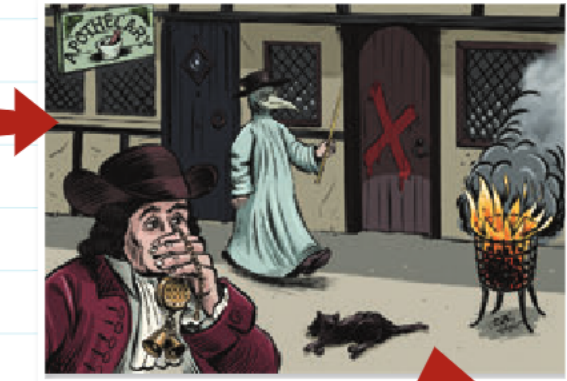
Medical practitioners developed elaborate protective costumes to prevent catching the disease while treating patients. These distinctive outfits included special masks shaped like bird beaks, which were filled with sweet-smelling herbs designed to ward off miasma. The entire costume was waxed to prevent anything from the patient being absorbed into the doctor's clothing.
Government response and prevention efforts
The response to the 1665 Great Plague demonstrated a much more organised and comprehensive approach compared to the government's reaction during the Black Death in 1348. King Charles II ordered local councils to implement strict measures to control the spread of disease.
Important
Revolutionary Government Approach
Unlike the largely uncoordinated response to the Black Death, the 1665 outbreak saw centralised government authority taking direct control of public health measures across England. This marked a fundamental shift in how authorities viewed their responsibility for public health.
Public health measures
Theatre and entertainment venues were immediately closed and large public gatherings were banned to prevent crowds from spreading the infection. This showed an understanding that the disease could spread through human contact.
Mass killing of domestic animals was ordered, as dogs and cats were believed to carry the disease. This measure reflected the limited understanding of how plague actually spreads through fleas and rats.
Example
Public Health Measure: Street Cleaning
Street cleaning programs were implemented regularly to remove waste and debris that might contribute to the spread of disease, following miasma theory principles. Workers were employed to sweep streets daily and remove garbage that was thought to create "bad air."
Burning barrels of tar in the streets was practised, as people believed the smoke would purify the air and prevent miasma from spreading.
Dealing with the dead
The government organised daily collection of corpses by special carts, ensuring that dead bodies were quickly removed from homes and streets. These bodies were then buried in specially designated mass graves to prevent further contamination.
Quarantine measures
Household quarantine was strictly enforced - if anyone in a household caught the plague, the entire family was sealed into their home for 40 days or taken to a special pest house. This represented one of the most significant advances in public health policy.
Days of fasting and public prayer were officially ordered, reflecting the continued belief that divine intervention played a role in disease outbreaks.
Timeline of key events
- 1665: The Great Plague outbreak begins in England
- 1665: King Charles II orders local councils to implement preventive measures
- 1665: Mass quarantine measures and public health policies implemented
- 1665: Plague reaches its peak during summer months
- 1666: Outbreak gradually subsides
Comparing responses: Black Death vs Great Plague
The contrast between responses to these two major plague outbreaks reveals significant developments in medical and governmental approaches to disease control. While the basic understanding of causes remained similar, the 1665 response showed much greater organisation and systematic implementation of prevention measures.
Important
Key Historical Development
The government's more active role in 1665 demonstrated an evolution in thinking about public health responsibility. Rather than leaving communities to cope independently, central authority took charge of coordinating prevention efforts across different areas.
Treatment methods showed both continuity and innovation, with traditional herbal remedies continuing alongside new approaches like the theory of transference and systematic sweating treatments.
Summary
Key Points to Remember:
- The Great Plague of 1665 was England's first major plague outbreak since the Black Death over 300 years earlier
- People's beliefs about causes remained largely unchanged, with miasma theory being the most popular explanation
- Government response was much more organised and comprehensive than during the Black Death
- New treatment approaches emerged, including the theory of transference and systematic sweating methods
- Quarantine measures and public health policies showed significant advancement in disease control strategies