Transmission of ideas (Edexcel GCSE History): Revision Notes
📚Revision Notes
Transmission of ideas during the Medical Renaissance (c1500-c1700)
The Renaissance period brought revolutionary changes to how medical knowledge was shared and spread across Europe. Two key developments transformed the way scientific and medical ideas were transmitted: the invention of the printing press and the establishment of the Royal Society.
The development of the printing press
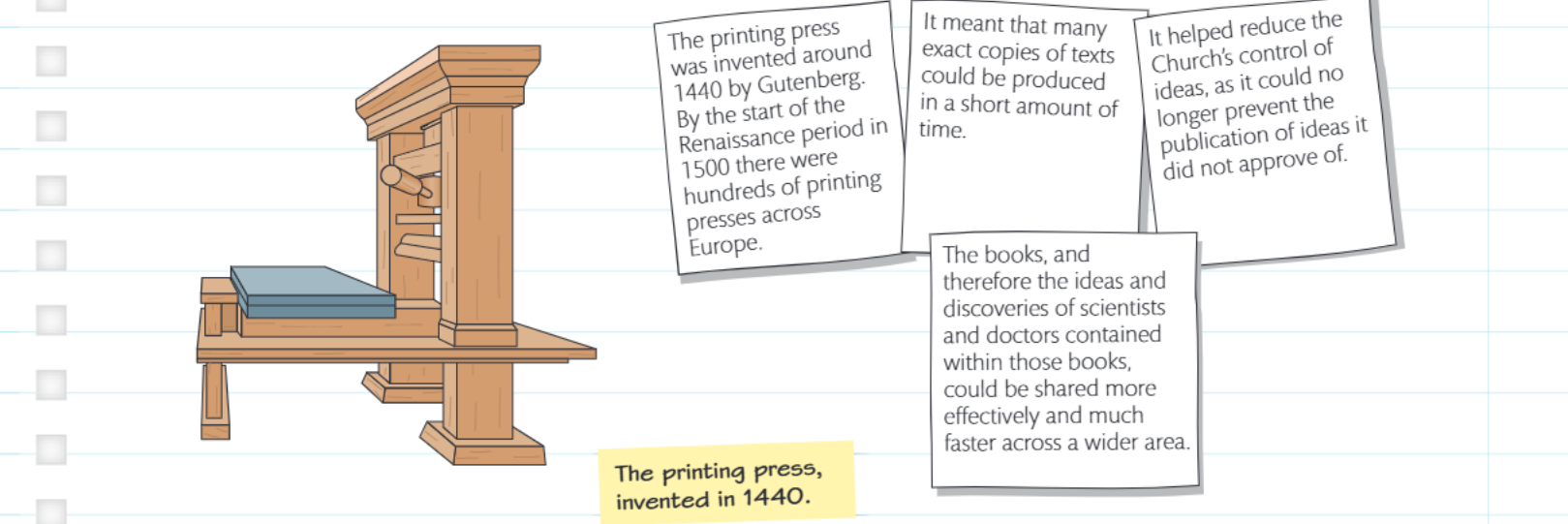
The invention of the printing press around 1440 by Johannes Gutenberg marked a turning point in the history of medical knowledge sharing. This revolutionary technology fundamentally changed how information was distributed across Europe.
Note
The printing press was arguably one of the most significant technological innovations in human history, with far-reaching effects that extended well beyond medicine into education, religion, and politics.
Impact on medical knowledge
Before the printing press, medical texts had to be copied by hand, which was time-consuming, expensive, and prone to errors. The printing press solved these problems by allowing many exact copies of texts to be produced quickly and affordably. By the start of the Renaissance period in 1500, hundreds of printing presses were operating across Europe.
This technological breakthrough had several important consequences for medicine:
- Faster knowledge sharing: Medical discoveries and ideas from scientists and doctors could now be shared much more effectively across wider geographical areas
- Reduced Church control: The printing press helped weaken the Church's monopoly over ideas and publications, as it could no longer easily prevent the publication of ideas it disapproved of
- Standardization: Exact copies meant that medical knowledge remained consistent as it spread, reducing the errors that occurred during hand-copying
Important
The standardisation of medical texts was crucial - for the first time in history, a doctor in London could be certain they were reading exactly the same information as a colleague in Rome or Paris.
The setting up of the Royal Society
The Royal Society represented another crucial development in the transmission of scientific and medical ideas during the Renaissance period. This organisation aimed to advance scientific understanding through systematic experimentation and knowledge sharing.

Purpose and methods
The Royal Society was established to develop scientific understanding by carrying out and recording experimental results. Rather than simply accepting traditional theories, members were encouraged to test ideas through practical experimentation and share their findings with other scientists and doctors.
Note
This represented a fundamental shift from mediaeval approaches to medicine, which relied heavily on ancient texts and religious doctrine rather than direct observation and testing.
The Philosophical Transactions journal
From 1665, the Royal Society published a groundbreaking journal called Philosophical Transactions. This publication allowed scientists to share their work and ideas in a formal, organised way. The journal meant that doctors and scientists could study each other's research, challenge existing theories, and build upon previous discoveries. This collaborative approach helped confirm or disprove medical theories, and news of important findings could spread quickly throughout the medical community.
Important
Philosophical Transactions was the world's first scientific journal and established the foundation for modern scientific publishing and peer review processes that we still use today.
Royal support and credibility
Charles II granted the Royal Society a royal charter, giving the organisation official recognition and credibility. The king's personal interest in science and his approval of the society helped establish its reputation and authority in the scientific community.
Timeline of key events
- c1440: Johannes Gutenberg invents the printing press
- 1500: Hundreds of printing presses operating across Europe
- 1665: Royal Society begins publishing Philosophical Transactions
- Late 1600s: Charles II grants royal charter to the Royal Society
Summary
Key Points to Remember:
- The printing press (invented c1440) revolutionised medical knowledge sharing by enabling mass production of exact copies and reducing Church control over ideas
- By 1500, hundreds of printing presses across Europe were helping spread medical knowledge faster than ever before
- The Royal Society promoted scientific experimentation and systematic sharing of results rather than relying on traditional theories
- Philosophical Transactions (from 1665) was the first major scientific journal, allowing doctors and scientists to build on each other's work
- Royal support gave scientific organisations credibility and helped establish new approaches to medical research