William Harvey (Edexcel GCSE History): Revision Notes
📚Revision Notes
William Harvey and the discovery of blood circulation


Who was William Harvey?
William Harvey (1578-1657) was one of the most significant figures of the Medical Renaissance. He revolutionised understanding of how the human body works, particularly the circulatory system. Harvey was influenced by earlier Renaissance anatomists like Vesalius and went on to inspire many future medical practitioners, including Thomas Sydenham.
Note
Harvey's work marked a crucial turning point in medical history, bridging the gap between ancient medical traditions and modern scientific medicine.
Harvey's background and career
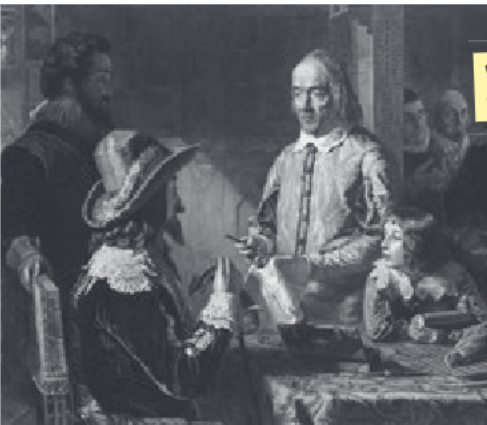
Harvey received an excellent education that prepared him for his groundbreaking discoveries. He studied medicine first at Cambridge University, then continued his studies at the University of Padua in Italy, which was known for its advanced medical teaching.
When Harvey returned to England, he became a lecturer in anatomy at the College of Physicians in London. His prestigious career included serving as one of King James I's personal doctors. Harvey also performed public dissections, which were important educational events during this period.
Note
The University of Padua was particularly renowned for its progressive approach to anatomy and medical education, making it an ideal place for Harvey to develop his scientific thinking.
Harvey's revolutionary approach to medicine
Harvey represented a new way of thinking about medical knowledge. Rather than simply accepting what was written in ancient textbooks, Harvey believed doctors should observe patients directly and record their symptoms carefully. This approach of observation and experimentation would become fundamental to modern medicine.
Important
Harvey's emphasis on direct observation and experimentation over ancient authority marked a fundamental shift in medical methodology that would influence all future medical research.
Discovering blood circulation
Harvey's most famous achievement was discovering how blood actually moves around the human body. This discovery challenged beliefs that had been accepted for over a thousand years.
Challenging Galen's theories
For centuries, doctors had followed the teachings of Galen, an ancient Greek physician. Galen believed that blood flowed towards the heart and was absorbed into the body. However, Harvey decided to investigate Vesalius' theory that blood might actually flow away from the heart.
Important
Common Misconception Alert: For over 1,000 years, the medical world accepted Galen's incorrect theory that blood was consumed by the body rather than circulated through it. Harvey's willingness to question this established "fact" was revolutionary for its time.
Harvey's experimental method
Harvey used dissection and careful observation to test these theories. He examined dissected bodies and used mechanical pumps to understand how blood moved. Through these experiments, Harvey proved that Vesalius was correct - blood flowed away from the heart, not towards it.
Example
Harvey's Scientific Process:
Step 1: Question existing theory - Why did Galen's blood absorption theory seem incomplete?
Step 2: Form hypothesis - Test Vesalius' theory that blood flows away from the heart
Step 3: Design experiments - Use dissection and mechanical pump models to trace blood flow
Step 4: Observe and record - Document how blood actually moved through arteries and veins
Step 5: Draw conclusions - Blood circulates in a complete system powered by the heart
Harvey made several crucial discoveries:
- Blood could not be produced by the liver and absorbed by the body, as Galen had claimed
- Arteries and veins were part of one connected system
- Blood was pumped around the entire body by the heart
- The heart worked like a mechanical pump
Publishing his findings
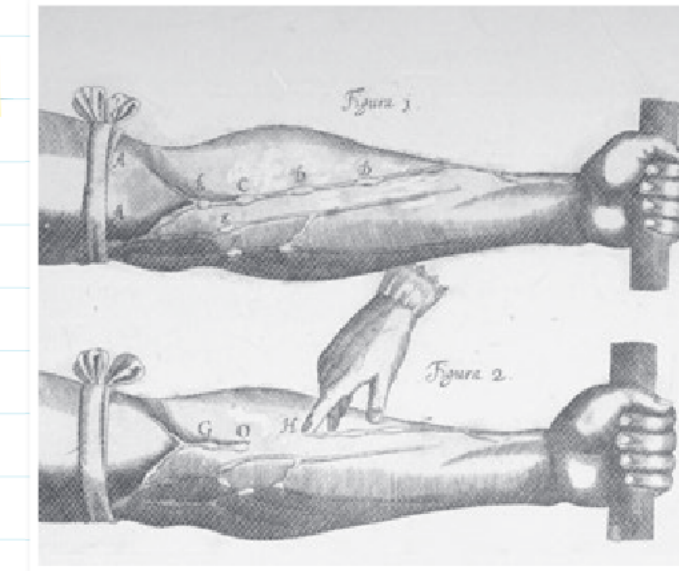
In 1628, Harvey published his discoveries in a book called "An Anatomical Account of the Motion of the Heart and Blood in Animals." This publication contained detailed diagrams showing how blood circulation worked, helping other doctors understand his theories.
Note
Harvey's book was written in Latin, the scholarly language of the time, ensuring it could be read by educated physicians across Europe. The detailed anatomical diagrams were crucial for helping other doctors visualise and understand his revolutionary concepts.
The importance of Harvey's work
Harvey's discoveries had enormous significance for the development of medicine:
Challenging ancient authorities: Harvey proved that some of Galen's theories were incorrect, which encouraged other doctors to question traditional medical knowledge rather than accepting it blindly.
Improving medical knowledge: By 1700, Harvey's understanding of blood circulation was being taught in medical schools across Europe. This meant doctors had a much better understanding of how the human body actually functioned.
Inspiring scientific method: As a royal physician, Harvey's work gained significant publicity and credibility. His emphasis on observation and experimentation inspired other medical researchers to adopt similar scientific methods.
Encouraging further research: Harvey's discoveries raised many new questions about how the body worked, which motivated other researchers to conduct their own experiments and investigations.
Important
Harvey's work didn't just change one medical theory - it fundamentally transformed how medical knowledge was created and validated, establishing the foundation for evidence-based medicine.
Timeline of Harvey's life and work
- 1578 - William Harvey born
- Late 1590s - Studies medicine at Cambridge University
- Early 1600s - Continues studies at University of Padua
- 1610s - Becomes lecturer at College of Physicians, London
- 1620s - Serves as doctor to King James I
- 1628 - Publishes "An Anatomical Account of the Motion of the Heart and Blood in Animals"
- 1657 - Harvey dies
Summary
Key Points to Remember:
-
William Harvey (1578-1657) discovered blood circulation - proving that blood flows away from the heart around the body, not towards it as Galen had taught
-
He used scientific methods - observation, dissection, and experimentation rather than just relying on ancient textbooks
-
Published in 1628 - his book "An Anatomical Account of the Motion of the Heart and Blood in Animals" spread his discoveries across Europe
-
Challenged traditional authority - Harvey proved that some of Galen's thousand-year-old theories were wrong, encouraging others to question established medical knowledge
-
Inspired future research - his scientific approach and discoveries motivated other doctors to conduct their own experiments and investigations