Jenner and vaccination (Edexcel GCSE History): Revision Notes
📚Revision Notes
Jenner and vaccination

The smallpox crisis
During the 18th century, smallpox posed one of the greatest threats to human life, particularly for children. This devastating disease claimed more young lives than any other illness of the time. The disease spread rapidly from person to person, leaving survivors with significant scarring and often permanent disability. Thousands of adults also perished from smallpox, and those who survived were frequently left with lasting physical reminders of their ordeal.
Note
The scale of smallpox's impact cannot be overstated - entire communities could be devastated by outbreaks, and the fear of the disease shaped daily life in the 18th century. Parents lived in constant worry about their children's survival.
Edward Jenner's background
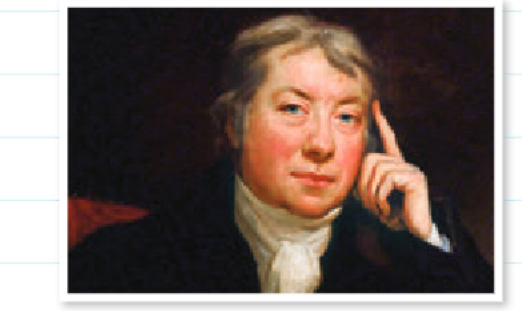
Edward Jenner emerged as a key figure in medical history through his groundbreaking work on preventing smallpox. Born in 1749, Jenner received his medical training in London, where he studied to become both a surgeon and an apothecary. After completing his education, he chose to return to his home county of Gloucestershire, where he established himself as a general practitioner at St. George's Hospital. It was in this rural setting that Jenner would make his remarkable discovery that would change medicine forever.
Note
Jenner's rural practice was crucial to his discovery. Working closely with farm workers and livestock gave him unique insights into the relationship between human and animal diseases that city-based doctors would never have observed.
The development of vaccination
Early attempts at prevention
Before Jenner's breakthrough, medical professionals had already been experimenting with disease prevention since the 1720s. Doctors practised a technique called inoculation, which involved deliberately infecting people with a mild form of smallpox. While this method could provide some protection, it remained dangerous and expensive, making it accessible only to wealthy families who could afford the treatment.
Important
Key distinction: Inoculation used actual smallpox material and carried significant risk of death, while Jenner's vaccination used the much safer cowpox material. This was a revolutionary improvement in safety.
Jenner's scientific observations
What set Jenner apart was his systematic approach to gathering evidence. He carefully observed and documented the outcomes of smallpox inoculations, paying particular attention to both successful cases and failures. During his practice, he regularly treated patients suffering from cowpox, a much milder disease affecting farm workers. Crucially, Jenner noticed that individuals who had contracted cowpox seemed to be naturally protected against smallpox infection.
Scientific experimentation
In the 1790s, Jenner decided to test his theory using proper scientific methods. He conducted careful experiments, methodically observing and recording all results. His approach involved deliberately infecting local people with cowpox, then attempting to infect them with smallpox. Remarkably, none of the cowpox-infected individuals developed smallpox, providing strong evidence for his theory.
Example
Jenner's Experimental Method:
- Hypothesis Formation: Observed that milkmaids with cowpox didn't catch smallpox
- Data Collection: Systematically recorded outcomes of inoculation attempts
- Controlled Testing: Infected volunteers with cowpox, then exposed them to smallpox
- Result Documentation: Carefully recorded that cowpox-infected individuals remained healthy
- Replication: Repeated experiments to confirm results
This demonstrated the power of the scientific method in medicine.
Publication challenges and breakthrough
When Jenner attempted to share his findings with the scientific community in 1798, the Royal Society rejected his research for publication. Undeterred by this setback, Jenner chose to fund the publication himself, producing "An Enquiry into the Causes and Effects of the Variola Vaccine". This work included detailed instructions that allowed other medical professionals to replicate his vaccination technique.
Growing acceptance
By 1800, approximately 100,000 people worldwide had received vaccinations, demonstrating the rapid spread of Jenner's method. However, acceptance in Britain took more time to develop. The establishment of the Royal Jennerian Society in 1802 helped promote vaccination, and by 1804, over 12,000 British people had been vaccinated. The government eventually recognised vaccination's importance, offering free vaccinations to those with lower incomes in 1840, and making vaccination compulsory in 1853.
The significance of Jenner's work
Jenner's contribution to medicine extended far beyond simply saving lives from smallpox. His work demonstrated that scientific methods could effectively combat disease, even when the underlying mechanisms remained unclear. Jenner himself did not understand exactly why vaccination worked, but his evidence-based approach proved its effectiveness. The connection between cowpox and smallpox was unique, which meant his discovery did not immediately lead to vaccines for other diseases. Nevertheless, his methodology established important principles for future medical research.
Important
Revolutionary Impact: Jenner's work proved that diseases could be prevented through scientific intervention, fundamentally changing how medicine approached public health. This laid the groundwork for all future vaccine development and demonstrated the power of systematic observation and experimentation in medical practice.
Opposition to Jenner's work
Despite its effectiveness, vaccination faced considerable resistance from various groups in society. Many people felt uncomfortable with the idea of deliberately introducing an animal disease into humans, viewing it as unnatural or morally wrong. Religious objections arose from those who believed that interfering with disease represented opposition to divine will. The medical profession itself was divided, as some doctors worried about losing income when the government began providing free vaccinations. Additionally, some medical practitioners failed to perform vaccinations correctly, leading to ineffective results that undermined public confidence in the procedure.
Note
The opposition to vaccination reveals how challenging it can be to introduce new medical practices, even when they're proven effective. Similar resistance patterns can be seen throughout medical history when established practices are challenged by new evidence.
Timeline of vaccination development
- 1749: Edward Jenner born
- 1720s: Doctors begin using smallpox inoculation
- 1790s: Jenner conducts scientific experiments with cowpox
- 1798: Royal Society refuses to publish Jenner's work; he self-publishes his findings
- 1800: Around 100,000 people worldwide have been vaccinated
- 1802: Royal Jennerian Society established to promote vaccination
- 1804: Over 12,000 people vaccinated in Britain
- 1840: Government provides free vaccinations for those with lower incomes
- 1853: Vaccination becomes compulsory in Britain
- 1979: World Health Organisation announces complete eradication of smallpox
Summary
Key Points to Remember:
-
Edward Jenner pioneered vaccination by observing that cowpox infection prevented smallpox, using scientific methods to test and prove his theory
-
His work saved millions of lives and demonstrated the power of evidence-based medicine, even though he didn't understand the scientific reasons behind vaccination's success
-
Jenner faced significant opposition from people who thought vaccination was unnatural, religiously wrong, or economically threatening to doctors
-
The development of vaccination was gradual, taking over 50 years from Jenner's discovery to become compulsory in Britain, and nearly 200 years to completely eradicate smallpox worldwide
-
Jenner's systematic approach to collecting evidence and conducting experiments established important principles for future medical research and disease prevention