Medicine in the early 20th century (Edexcel GCSE History): Revision Notes
📚Revision Notes
Medicine in the early 20th century
Introduction
The early 1900s marked a crucial period in medical history, with three groundbreaking developments that would transform healthcare during the First World War. These advances in X-rays, blood transfusions, and aseptic surgery became essential tools for treating wounded soldiers and saving countless lives.
X-rays - seeing inside the body
The discovery
In 1895, German scientist Wilhelm Röntgen made an accidental but revolutionary discovery. While experimenting with a test tube covered in black paper, he noticed that mysterious rays could pass through many materials, including human flesh, but not bone. He placed his hand between the tube and a screen, creating the world's first X-ray image.
Early applications and problems
Röntgen's discovery quickly led to the establishment of radiology departments in hospitals. Doctors could now diagnose broken bones and locate embedded objects without surgery. However, early X-ray technology came with serious challenges:
Note
Limitations of Early X-ray Technology:
- Long exposure times: Photography was still developing, so patients had to remain perfectly still for extended periods
- Dangerous radiation levels: High doses of radiation caused severe burns and hair loss in both patients and medical staff
- Heavy equipment: The large, cumbersome machines were difficult to transport and position
Important
These limitations would prove particularly challenging in battlefield conditions during World War I.
Blood transfusions - the gift of life
Early attempts and failures
Blood transfusions weren't new to the 20th century. During the 1600s, doctors had experimented with transferring blood from animals to humans, but these attempts almost always ended in death. The reason for these failures remained a mystery for centuries.
James Blundell's breakthrough
Between 1818 and 1829, British obstetrician James Blundell pioneered the first successful human-to-human blood transfusions. He developed innovative techniques and specialised equipment, but significant problems persisted:
- Blood had to be transferred directly from donor to patient, as storage wasn't possible
- Only about half of all patients survived the procedure
- The reasons for success or failure remained unclear
The blood group revolution
The mystery was finally solved in the early 1900s by Austrian scientist Karl Landsteiner. In 1901, he discovered three distinct blood groups, and by 1902, his colleagues had identified a fourth. This groundbreaking research revealed that transfusions only worked safely between people with compatible blood types.
Important
This discovery transformed blood transfusions from a desperate last resort into a reliable medical procedure, making it invaluable for treating wounded soldiers who had lost large amounts of blood.
Aseptic surgery - the clean revolution
Building on Lister's work
Thanks to Joseph Lister's pioneering work with antiseptics in the 1860s, the medical community had learned the importance of killing germs. By 1900, hospitals had moved beyond simply using antiseptics to adopting full aseptic conditions - preventing germs from entering the operating environment in the first place.
Creating sterile operating conditions
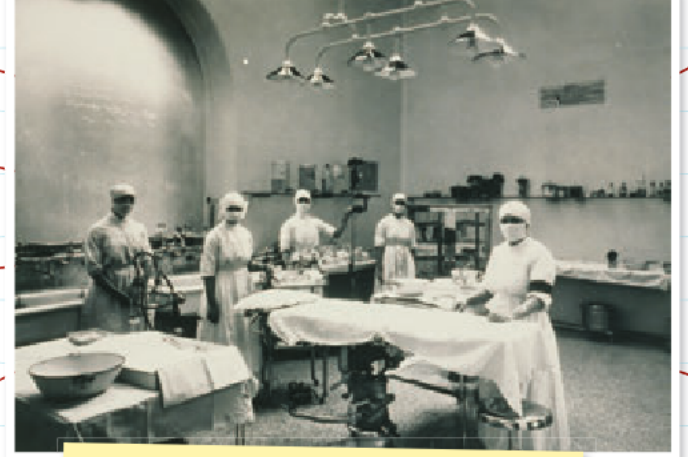
Operating theatres underwent a complete transformation to maintain cleanliness:
Note
Aseptic Operating Procedures:
- Thorough cleaning: Operating rooms and wards were meticulously cleaned and disinfected
- Sterilized clothing: All surgical garments were properly sterilised before use
- Surface protection: Sterilised cloths covered all surfaces and equipment
- Personal protection: Surgeons and nurses wore masks to prevent breathing infections into wounds
Key technological advances
Several innovations made aseptic surgery more effective:
- Steam sterilisation (1878): Robert Koch developed a steam steriliser for surgical instruments, and by 1897, all surgical equipment was being sterilised using this method
- Rubber gloves (1890): Medical professionals began wearing rubber gloves to prevent germs from passing from their hands to wounds or instruments
The image above shows a typical operating theatre at St Bartholomew's Hospital, London around 1920, demonstrating how these aseptic principles were put into practice.
Timeline of key developments
- 1878: Robert Koch develops steam steriliser for surgical instruments
- 1890: Introduction of rubber gloves in surgery
- 1895: Wilhelm Röntgen discovers X-rays
- 1897: All surgical equipment routinely sterilised
- 1900: Aseptic surgery well established in hospitals
- 1901: Karl Landsteiner discovers first three blood groups
- 1902: Fourth blood group discovered
Summary
Key Points to Remember:
- Three major medical advances in the early 20th century were X-rays, blood transfusions, and aseptic surgery - all crucial for treating war injuries
- X-rays revolutionised diagnosis by allowing doctors to see inside the body, though early equipment had serious limitations with radiation exposure and portability
- Blood transfusions became safer after Landsteiner's discovery of blood groups in 1901-1902, solving the mystery of why some transfusions failed
- Aseptic surgery prevented infections through complete sterilisation of equipment, clothing, and operating environments
- These developments saved countless lives during World War I by providing better treatment for wounded soldiers