RAMC and FANY (Edexcel GCSE History): Revision Notes
📚Revision Notes
RAMC and FANY
Medical organisation on the Western Front
The Western Front presented unprecedented challenges for medical care. With thousands of casualties occurring miles away from established hospitals and medical facilities, the British Army needed to develop an entirely new system of battlefield medicine. This medical revolution would transform how wounded soldiers were treated and evacuated from the front lines.
The Royal Army Medical Corps (RAMC)
The RAMC formed the backbone of British medical services on the Western Front. Initially, all medical personnel serving in the trenches and battlefield hospitals were professional members of this military medical organisation. The corps was responsible for establishing and maintaining the entire medical evacuation system that would save thousands of lives throughout the war.
However, as the scale of casualties became apparent, the RAMC alone could not provide sufficient medical coverage. The organisation recognised that additional support was desperately needed, particularly for frontline medical assistance and ambulance services. This realisation led to a significant expansion of medical personnel through volunteer recruitment.
Note
The overwhelming scale of casualties during WWI meant that even a well-established military medical corps like the RAMC required significant support from civilian volunteers to cope with the unprecedented demand for medical services.
Volunteer medical support
The enormous demand for medical services meant that volunteer organisations became essential partners in caring for the wounded. These volunteers were primarily recruited to provide crucial frontline support, filling gaps that the overstretched RAMC could not cover alone. Many volunteers took on dangerous roles, driving ambulances to collect wounded soldiers from the most hazardous areas near the front lines.
The volunteers also played vital roles in providing emergency first aid and ensuring that wounded soldiers received immediate care before being passed along the evacuation chain. Their contribution was particularly important in the cooking and cleaning duties that kept medical facilities functioning effectively under extremely difficult conditions.
Important
Volunteers often worked in extremely dangerous conditions, with ambulance drivers regularly venturing into areas under enemy fire to rescue wounded soldiers. Their courage and dedication were essential to the success of the entire medical evacuation system.
The chain of evacuation system
The British medical services developed a sophisticated four-stage evacuation system that moved wounded soldiers progressively away from the front lines to more secure and better-equipped medical facilities. This systematic approach ensured that soldiers received appropriate levels of care based on the severity of their injuries.
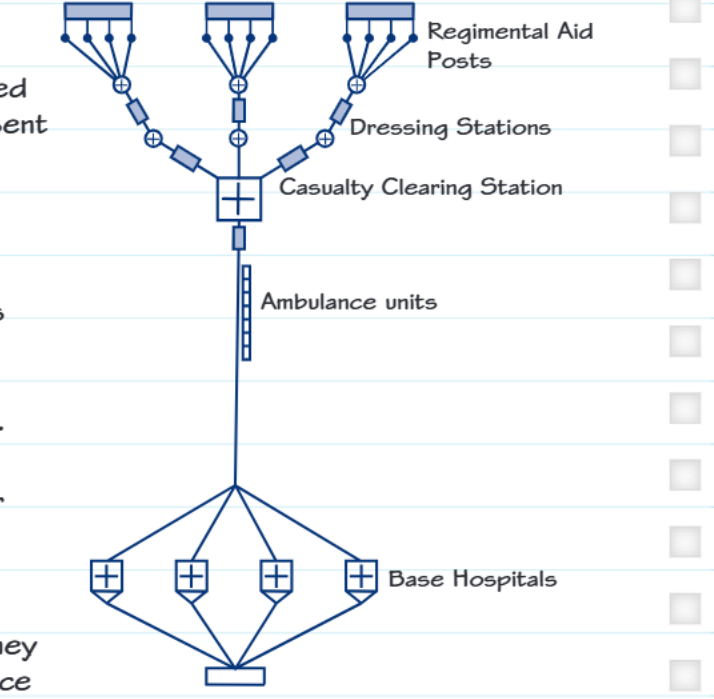
Stage 1: Regimental Aid Posts
Example
Stage 1: Regimental Aid Posts
Location: Dangerously close to the front lines Staffed by: Regimental Medical Officers and stretcher bearers Primary function: Immediate first aid and triage decisions Key challenge: Operating under enemy fire while providing basic emergency care
Regimental Aid Posts represented the first point of medical contact for wounded soldiers. Located dangerously close to the front lines, these posts were staffed by Regimental Medical Officers who worked alongside stretcher bearers to provide immediate first aid. The primary function was to administer basic emergency care and make quick decisions about which soldiers needed immediate evacuation to the next stage of treatment.
These posts operated under extremely hazardous conditions, often within range of enemy fire. The medical officers had to work quickly to stabilise the most seriously wounded while sending those with minor injuries back to their units after basic treatment.
Stage 2: Dressing Stations
Example
Stage 2: Dressing Stations
Location: Approximately one mile behind front lines Operated by: Field Ambulances (RAMC mobile medical units) Facilities: Derelict buildings, abandoned dugouts, or temporary tents Staffing: Medical officers, orderlies, stretcher bearers, and (from 1915) trained nurses Capacity: Could accommodate wounded for up to a week
Field Ambulances, which were actually mobile medical units operated by the RAMC, established Dressing Stations approximately one mile behind the front lines. These facilities were typically housed in derelict buildings, abandoned dugouts, or temporary tents, depending on what shelter was available.
Dressing Stations were staffed by medical officers, orderlies, and stretcher bearers. From 1915 onwards, some trained nurses were also deployed to these forwards positions. The stations could accommodate wounded soldiers for up to a week, providing more comprehensive treatment than the basic first aid available at Regimental Aid Posts. Medical staff could properly clean and dress wounds, provide pain relief, and monitor patients for signs of infection or complications.
Stage 3: Casualty Clearing Stations
Example
Stage 3: Casualty Clearing Stations
Location: Several miles from front lines in secure areas Facilities: Large, well-equipped buildings capable of advanced procedures Staffing: Experienced doctors and trained nurses Specialisation: Life-threatening injuries with realistic survival chances Key role: Emergency surgeries, intensive care, and infection control (until March 1918)
Casualty Clearing Stations became the most critical component of the evacuation chain for seriously wounded soldiers. These larger, better-equipped facilities were positioned several miles from the front lines in more secure locations, often occupying substantial buildings that could accommodate advanced medical procedures.
Staffed by experienced doctors and trained nurses, these stations prioritised treating soldiers with life-threatening injuries who still had a realistic chance of survival. The medical teams performed emergency surgeries, treated severe wounds, and provided intensive care that could mean the difference between life and death.
Until March 1918, Casualty Clearing Stations served as the primary centres for combating infection, which was one of the leading causes of death among wounded soldiers. The stations implemented strict hygiene protocols and used the latest antiseptic techniques to prevent wounds from becoming infected.
Stage 4: Base Hospitals
Example
Stage 4: Base Hospitals
Location: Near coastal ports for supply and evacuation access Staffing: Most experienced medical staff and specialist doctors Function: Advanced treatments for specific injury types Outcomes: Recovery for return to service OR evacuation to Britain for extended care
Base Hospitals represented the final stage of the evacuation chain, located near coastal ports where they could receive supplies and evacuate patients. These hospitals employed the most experienced medical staff and specialised doctors who could provide advanced treatments for specific types of injuries.
Patients who recovered sufficiently at Base Hospitals might eventually return to active service, while those requiring extended treatment or rehabilitation could be transported by ship to hospitals in Britain for further care.
Underground hospital at Arras
One of the most remarkable medical facilities on the Western Front was the underground hospital at Arras, also known as Thompson's Cave. This innovative facility demonstrated how military engineers and medical personnel adapted to the unique challenges of trench warfare.
Built within tunnel systems beneath the front lines, this underground hospital provided medical care in relative safety from enemy artillery and shellfire. The facility was surprisingly comprehensive, featuring space for 700 beds, a fully equipped operating theatre, and even a mortuary for soldiers who could not be saved.
Note
Thompson's Cave: A Medical Innovation
This underground hospital was remarkably advanced for its time and location, featuring modern amenities including running water and electricity. Its proximity to the fighting meant that seriously wounded soldiers could receive immediate, high-quality medical care without the dangerous delays of evacuation to rear areas.
The hospital was supplied with running water and electricity, making it one of the most advanced medical facilities available to frontline troops. Its proximity to the fighting meant that seriously wounded soldiers could receive life-saving treatment without the delays inherent in evacuation to rear areas.
Transport challenges in the evacuation chain
Moving wounded soldiers through the evacuation chain presented enormous logistical challenges that often determined whether injured men survived their wounds. The difficult terrain of the Western Front, with its mud, shell holes, and destroyed infrastructure, made patient transport extremely hazardous and time-consuming.
Important
Critical Transport Limitations
The lack of proper transport infrastructure meant that many wounded soldiers died not from their injuries, but from the delays and difficulties in getting them to appropriate medical care. Transport challenges often proved more deadly than the wounds themselves.
In many areas, the only viable transport options were stretcher bearers carrying wounded soldiers on foot, or horse-drawn waggons that could navigate rough ground. These methods were slow and exposed both patients and medical personnel to enemy fire during the dangerous journey from front-line aid posts to treatment facilities.
The destruction of roads and railway lines by constant artillery bombardment further complicated evacuation efforts. Many pre-existing transport routes were completely unusable, forcing medical teams to find alternative paths through dangerous terrain while carrying seriously injured soldiers.
Initially, the medical services lacked sufficient motor ambulances, which would have provided faster and safer patient transport. Recognising this critical shortage, a public appeal in Britain successfully raised funds for 512 motor ambulances. These vehicles revolutionised patient evacuation where roads remained passable, significantly reducing transport times and improving survival rates for seriously wounded soldiers.
Important
Ongoing Dangers During Evacuation
The constant artillery fire and shelling created additional hazards for evacuation teams. Medical personnel and stretcher bearers had to navigate through ongoing bombardments while carrying wounded soldiers, making every evacuation mission a potentially life-threatening operation for both patients and their rescuers.
Remember!
Summary
Key Points to Remember:
- The RAMC initially provided all medical personnel but later relied heavily on volunteers to meet the enormous demand for frontline medical support
- The four-stage evacuation chain (Regimental Aid Posts → Dressing Stations → Casualty Clearing Stations → Base Hospitals) systematically moved wounded soldiers from dangerous front-line areas to increasingly secure and well-equipped medical facilities
- The underground hospital at Arras (Thompson's Cave) provided innovative medical care with 700 beds, operating theatres, and modern facilities despite being located beneath the front lines
- Transport challenges including difficult terrain, destroyed infrastructure, and enemy fire made patient evacuation extremely dangerous and often determined survival rates
- Public fundraising in Britain provided 512 motor ambulances that significantly improved evacuation speed and patient survival when roads were passable