The Western Front - the trenches (Edexcel GCSE History): Revision Notes
📚Revision Notes
The Western Front - the trenches
Formation of the Western Front
The Western Front emerged in August 1914 when Britain declared war on Germany on 4th August and immediately sent troops to northern France. The initial plan was to halt the German advance as they pushed through Belgium towards Paris. However, by the end of 1914, the nature of warfare had dramatically changed from mobile fighting to a static defensive line.
Note
This transformation from mobile to static warfare was one of the most significant developments of World War I. What began as traditional military campaigns involving rapid troop movements quickly evolved into a deadlocked system of defensive positions that would persist for years.
This transformation occurred when the fighting became restricted to a continuous line of trenches that stretched approximately 400 miles from the English Channel in the north all the way to Switzerland in the south. This massive defensive line became known as the Western Front and would define the character of World War I for the next four years.
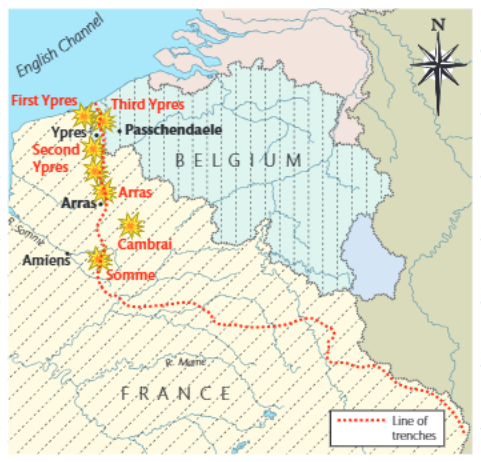
Major battles of the Western Front
First Battle of Ypres (October-November 1914)
The British forces managed to maintain their hold on the strategically important town of Ypres, which was crucial for controlling access to the English Channel ports. Although the British succeeded in preventing German capture of this vital position, the Germans still managed to gain significant ground during this engagement.
Second Battle of Ypres (April-May 1915)
Example
Historical Significance: First Use of Chemical Warfare
The Second Battle of Ypres marked a terrifying escalation in military technology:
- Innovation: First use of chlorine gas as a weapon
- Tactical Impact: Created panic and confusion among Allied forces
- Long-term Consequences: Led to the development of gas masks and retaliatory chemical weapons
- Territorial Result: Germans achieved only minimal gains around Ypres despite this new advantage
The Somme (July-November 1916)
The Battle of the Somme became notorious for producing extraordinarily high casualty rates on both sides of the conflict. Despite the massive loss of life, this engagement saw the introduction of two important new military strategies by British forces: the creeping barrage technique and the first operational use of tanks in warfare. Unfortunately, these innovations had limited immediate impact on the battle's outcome.
Arras (April-May 1917)
In April 1917, approximately 24,000 British troops launched a major offensive against German positions near the town of Arras. The primary objective was to break through enemy lines and capture strategic territory. While the attack showed initial promise, it ultimately ended with minimal territorial gains and resulted in heavy casualties for British forces.
Third Battle of Ypres (July-November 1917)
Important
The Third Battle of Ypres demonstrates how environmental conditions could completely undermine military strategies. The intense bombardment intended to support the advance actually created waterlogged conditions that made movement nearly impossible, with many soldiers drowning in the muddy terrain.
British commanders employed a creeping barrage strategy to achieve small advances and break out of the Ypres Salient. However, the intense bombardment left the battlefield waterlogged and turned the terrain into a muddy quagmire, making movement extremely difficult and causing many soldiers to drown in the conditions.
Cambrai (November-December 1917)
Example
Military Innovation: Large-Scale Tank Warfare
The Battle of Cambrai represented a breakthrough in military technology:
- First: Large-scale deployment of tank warfare in military history
- Initial Success: Tanks proved effective in breaking through enemy positions
- Critical Failure: Lack of sufficient backup support to maintain advances
- Outcome: British forces ultimately forced to retreat from captured territory
- Lesson: New technology requires coordinated support strategies
The trench system structure
The defensive system on the Western Front consisted of three main parallel lines of trenches, each serving a specific military purpose and connected by a network of communication trenches.
Frontline trench
The frontline trench served as the primary position from which attacks were launched against enemy forces. This forwards position was the most dangerous location, as soldiers stationed here faced constant threat from enemy fire and potential assault. The frontline represented the literal "front" of the military engagement.
Support trench
Located approximately metres behind the frontline position, the support trench provided a fallback position for troops if the frontline came under attack. Soldiers could retreat to this secondary defensive position to regroup and organise counterattacks when necessary.
Note
The specific distance of 80 metres was carefully calculated to provide effective support while remaining close enough for rapid reinforcement. This distance also helped ensure that a single artillery shell could not destroy both the frontline and support positions simultaneously.
Reserve trench
Positioned at least metres behind the support trench, the reserve trench served as the final defensive line. Reserve troops were stationed here, ready to move forwards as reinforcements during major attacks or to mount counteroffensives when opportunities arose.
Communication trenches and defensive features
All three main trench lines were connected by communication trenches, which allowed soldiers and supplies to move between positions while remaining protected from enemy fire. The entire system also included several important defensive features:
Artillery emplacements were strategically positioned to provide covering fire for infantry positions. Dugouts were excavated into the trench walls to offer soldiers shelter from bombardment and harsh weather conditions. These underground spaces provided crucial protection during intensive shelling.
Note
The zigzag pattern of trenches was a crucial defensive design feature. This construction method limited the impact of enemy shells and prevented attackers from firing straight down long sections of trench if they managed to capture part of the system.
Terrain and transport challenges
The conditions along the Western Front presented enormous logistical and physical challenges for all military forces involved. The terrain varied considerably across different regions, and weather conditions played a major role in determining the feasibility of military operations.
Important
Critical Environmental Challenges
Movement became extremely difficult in areas where deep mud and waterlogging occurred, particularly during wet weather periods. The constant bombardment created countless crater holes throughout the landscape, making transportation of supplies and equipment a dangerous and time-consuming process.
Within the trenches themselves, conditions were often cramped and uncomfortable. The confined spaces became muddy and overcrowded, creating unsanitary conditions that contributed to disease and reduced morale among troops stationed there for extended periods.
Timeline of major events
- 4 August 1914: Britain declares war on Germany and sends troops to northern France
- Late 1914: Fighting becomes restricted to trench line from English Channel to Switzerland
- October-November 1914: First Battle of Ypres
- April-May 1915: Second Battle of Ypres (first use of chlorine gas)
- July-November 1916: Battle of the Somme (first use of tanks)
- April-May 1917: Battle of Arras
- July-November 1917: Third Battle of Ypres
- November-December 1917: Battle of Cambrai (large-scale tank warfare)
Summary
Key Points to Remember:
- The Western Front was established in August 1914 when mobile warfare became static trench warfare stretching from the English Channel to Switzerland
- The trench system consisted of three main lines: frontline, support (m back), and reserve (m+ back), all connected by communication trenches
- Major battles like the Somme and Ypres introduced new military technologies including poison gas, tanks, and creeping barrage tactics, but often resulted in minimal territorial gains despite massive casualties
- Terrain conditions including mud, waterlogging, and shell craters made movement and supply transport extremely challenging throughout the Western Front
- The zigzag pattern of trenches was designed to limit the effectiveness of enemy shells and prevent straight-line firing if sections were captured