Migration and settlement (Edexcel GCSE History): Revision Notes
📚Revision Notes
Migration and settlement in c1700-c1900 Britain
Introduction: why people migrated to Britain
During the 18th and 19th centuries, Britain experienced significant migration from various regions. People moved to Britain for different reasons - some were forced to migrate due to difficult circumstances, while others made a deliberate choice to seek better opportunities. Everyone believed that migrating to Britain would lead to improved living conditions.
Note
The reasons for migration showed both change and continuity during this period. While some traditional patterns continued, new factors emerged as Britain's empire expanded and political situations changed across Europe.
Irish migration to Britain
Background and context
Ireland was completely part of Britain during this period. The country was predominantly rural, with much of the land being of poor quality for farming. This created challenging living conditions for many Irish people.
Migration patterns and reasons
Irish people regularly crossed to England or Scotland to work for short periods, typically a few weeks, where they could earn more money than was possible in Ireland. Originally, most returned home after these temporary work periods.
However, the situation changed dramatically in the 1840s and 1850s when Ireland was devastated by a terrible famine. This crisis forced tens of thousands of Irish people to migrate to England and Scotland permanently. They were fleeing poverty and starvation, desperately searching for better living conditions and chances of survival.
Example
The Great Irish Famine Impact
The 1840s-1850s famine transformed Irish migration patterns completely:
- Before the famine: Temporary seasonal workers who returned home
- During the famine: Mass permanent migration due to starvation and poverty
- Result: Permanent Irish communities established in British cities
Settlement patterns
- Port cities: Liverpool and Glasgow became major destinations because they were the nearest ports to Belfast and Dublin, making travel quicker and cheaper
- Urban communities: Many Irish migrants settled in these cities permanently, often living in the poorest areas and forming Irish communities with others who had already established themselves
- Stopover destinations: Some migrants viewed Britain as a temporary stop on their journey to America or Australia, but hundreds found they couldn't afford to travel further, so they remained in Britain
Economic impact
The collapse of rural occupations like spinning and weaving in Ireland, caused by English competition, meant that English factories could produce goods more quickly and at lower costs. This economic pressure pushed more Irish people to seek work in Britain's industrial cities.
Migrants from the British Empire and beyond
The expansion of Britain's empire and the development of new trading routes brought many different people to Britain from distant lands.
Indian servants and workers
- Domestic servants: When English families returned to Britain from India, their Indian servants (called ayahs) often chose to accompany them to keep their employment. Usually these were family ayahs, though sometimes male servants came too
- Sailors (Lascars): The East India Company recruited sailors from India, China, Malaya, Somalia and Yemen to transport goods to Britain. Working conditions on ships were extremely poor, so many lascars chose to stay in British ports hoping for better opportunities. Unfortunately, some were abandoned by their employers
Students and nobility
- Indian students: Young Indians migrated to Britain to study at British universities, with many focusing on law degrees
- Indian princes: Some Indian royalty preferred to live in Britain because they favoured the British system of government and rule
Note
The East India Company's Role
The East India Company played a crucial role in bringing people from the Indian subcontinent to Britain. Originally formed in 1600 to conduct trade in the Indian Ocean, the Company eventually controlled vast areas of India with its own army and administrators. From 1858, the British government took direct control and ruled India in what became known as the British Raj.
Migrants from Europe and the Russian Empire
Jewish migration
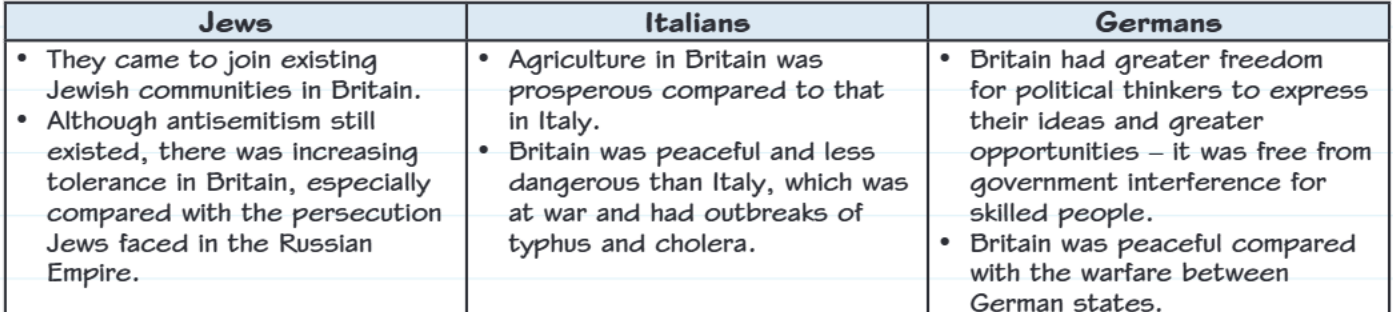
Jewish communities migrated to Britain primarily to join existing Jewish communities that were already established there. Although antisemitism existed in Britain, there was still increasing tolerance compared to other regions. Most importantly, Jews faced severe persecution in the Russian Empire, making Britain a much safer destination for Jewish families seeking security.
Italian migration
Italians were attracted to Britain mainly for economic reasons. Agriculture in Britain was more prosperous compared to conditions in Italy. Additionally, Britain offered a peaceful environment, which contrasted sharply with Italy's problems of warfare and disease outbreaks, particularly typhus and cholera epidemics that made life dangerous and difficult.
German migration
Germans valued Britain's greater political freedom, which allowed political thinkers to express their ideas more freely. Britain also provided better opportunities for skilled workers, as there was less government interference affecting working people. The peaceful conditions in Britain were especially appealing compared to the ongoing conflicts and warfare between various German states.
Important
Common Push and Pull Factors
Across all European migration groups, similar patterns emerge:
- Push factors: Persecution, warfare, economic hardship, political oppression
- Pull factors: Safety, political freedom, economic opportunities, established communities
- Britain's appeal: Relative tolerance, industrial growth, and peaceful conditions
Timeline of key events
- 1600: East India Company formed to trade in Indian Ocean
- 1840s-1850s: Great Irish Famine forces mass migration from Ireland
- 1858: British government takes direct control of India (British Raj established)
Summary
Key Points to Remember:
- Multiple migration sources: Britain received migrants from Ireland, the British Empire (especially India), and various European countries during c1700-c1900
- Push and pull factors: People migrated due to problems at home (famine, persecution, warfare) and opportunities in Britain (work, safety, political freedom)
- Settlement patterns: Many migrants settled in port cities like Liverpool and Glasgow, often forming communities with others from their homeland
- Empire connections: Britain's expanding empire created new migration routes, bringing servants, sailors, students and traders from distant territories
- Economic opportunities: Britain's industrial growth and agricultural prosperity attracted people seeking better working conditions and higher wages