Changes for women and the family (Edexcel GCSE History): Revision Notes
📚Revision Notes
Changes for women and the family, 1924-41
The period between 1924 and 1941 saw dramatic shifts in Soviet policies towards women and families. These changes reflected broader political transformations, from early revolutionary ideals to Stalin's more conservative approach that prioritised state needs over individual freedoms.
Overview of change
The scale of change for women during this period was enormous. In 1928, there were 3 million women working across the Soviet Union. By 1940, this number had increased to 13 million women in employment. However, despite official claims of equality, the reality for women remained complex and often contradictory.
Note
This dramatic increase in female employment occurred during the same period when many women's rights were being restricted, highlighting the complex and often contradictory nature of Soviet policies towards women.
Women and the Bolshevik reforms
Following the revolution, the Bolshevik government introduced several progressive reforms that were designed to liberate women from traditional constraints. These early changes aimed to break down what the Bolsheviks saw as outdated bourgeois traditions.
The key reforms included making divorce much simpler to obtain, ensuring that abortion and contraception became easily accessible, introducing equal pay for equal work, and creating equal educational opportunities for women. These changes were revolutionary for their time and represented a genuine attempt to create equality between men and women in Soviet society.
Important
The reforms were specifically designed to challenge traditional marriage structures and free women to participate as equals alongside men in all areas of life, including work, politics, and society. This represented a radical departure from traditional Russian social structures.
Changes for women under Stalinism
By the 1930s, Stalin had decided that marriage and the traditional family unit needed to be strengthened rather than weakened. This marked a significant reversal of earlier Bolshevik policies and reflected Stalin's broader concerns about social stability and population growth.
Important
Three main factors drove this change in approach:
- Population concerns: Birth rates were falling at a time when Stalin wanted a growing population to support industrialisation
- Social problems: Stalin disliked some of the social consequences that had emerged from easier divorces, including gangs of children living on the streets who were blamed on family breakdown and absent fathers
- Party attitudes: The Communist Party remained dominated by men who maintained traditional beliefs that women were not their equals
Changes in the position of women after 1936
The year 1936 marked a turning point in Soviet family policy, with several significant reversals of earlier reforms.
Restrictions on reproduction rights
Abortions were completely banned in 1936, and sterilisations were also prohibited. The state made it much more difficult for people to obtain contraceptives, effectively limiting women's control over their reproductive choices.
Note
This represented a complete reversal of the 1920 legalisation of abortion, which had been one of the most progressive reproductive rights policies in the world at that time.
Stricter divorce conditions
Divorce became much more expensive and complicated. Higher fees were introduced, with 50 roubles charged for a first divorce and 150 roubles for a second divorce. Additionally, child support payments were established, starting at 25% of wages for one child and increasing with additional children.
Financial incentives for large families
To encourage population growth, mothers who had six children or more received substantial financial rewards of 2,000 roubles per year for five years. This was a considerable sum designed to make large families more attractive.
Closure of Zhenotdel
In 1930, Zhenotdel, which was the women's section of the Communist Party, was permanently closed. Zhenotdel had been instrumental in convincing the Bolshevik Party to legalise abortion in 1920 and had successfully organised groups focused on women's issues throughout the 1920s. However, party leaders became concerned that these groups posed a challenge to mainstream communist ideology, which was still dominated by male perspectives.
Important
When Zhenotdel was shut down in 1930, the official explanation was that all women's issues had been resolved under socialism. In reality, women's rights were increasingly under attack during this period.
Changes in women's employment
Despite restrictions in other areas, women's participation in the workforce continued to expand dramatically during the 1930s.
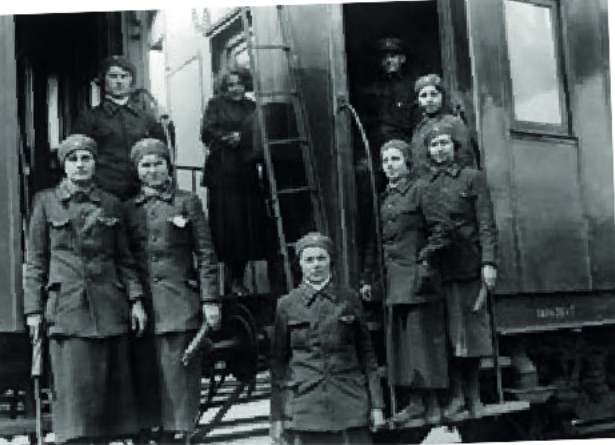
Women made up 40% of all industrial workers by 1937, representing a much larger proportion than in 1928. However, significant inequalities persisted in the workplace. Very few women reached managerial positions, and women consistently received lower pay than men for similar work.
Most employment opportunities for women remained concentrated in industries that had traditionally employed women, such as textiles and other manufacturing sectors. While women did enter some traditionally male-dominated fields, such as railway work, these remained exceptional cases rather than the norm.
Note
This expansion in women's employment was driven primarily by the needs of rapid industrialisation rather than by genuine commitment to gender equality. Women's labour was essential for Stalin's economic plans, even as their other rights were being restricted.
Changes in the political position of women
The closure of Zhenotdel in 1930 had lasting consequences for women's political representation and influence. This organisation had been successful at raising awareness about issues specifically affecting women and had provided a platform for women's voices within the Communist Party structure.
Without this dedicated organisation, women's concerns became increasingly marginalised within the broader political system. The official Soviet position maintained that equality existed between men and women, but the reality was often very different from this ideal.
Timeline of major events
- 1920: Abortion legalised by Bolshevik government (influenced by Zhenotdel)
- 1928: 3 million women working in Soviet Union
- 1930: Zhenotdel (women's section of Communist Party) closed permanently
- 1936: Major policy reversals implemented:
- Abortions banned completely
- Divorce fees increased significantly
- Sterilisations prohibited
- Financial incentives introduced for large families
- 1937: Women comprised 40% of all industrial workers
- 1940: 13 million women working (increase from 3 million in 1928)
Summary
Key Points to Remember:
-
Dramatic reversal: Stalin's policies after 1930 reversed many early Bolshevik reforms that had aimed to liberate women from traditional constraints.
-
Employment growth: Despite social restrictions, women's participation in the workforce increased massively from 3 million workers in 1928 to 13 million by 1940.
-
State priorities: Changes in family policy reflected Stalin's priorities for population growth and social stability rather than genuine concern for women's equality.
-
Political marginalization: The closure of Zhenotdel in 1930 removed women's main voice within the Communist Party and reduced their political influence.
-
Gap between theory and practice: While the Soviet Union officially promoted equality between men and women, the reality remained far from equal in terms of pay, career opportunities, and reproductive rights.