Threats to the tsarist regime (Edexcel GCSE History): Revision Notes
📚Revision Notes
Threats to the tsarist regime
Growing discontent in early 1917
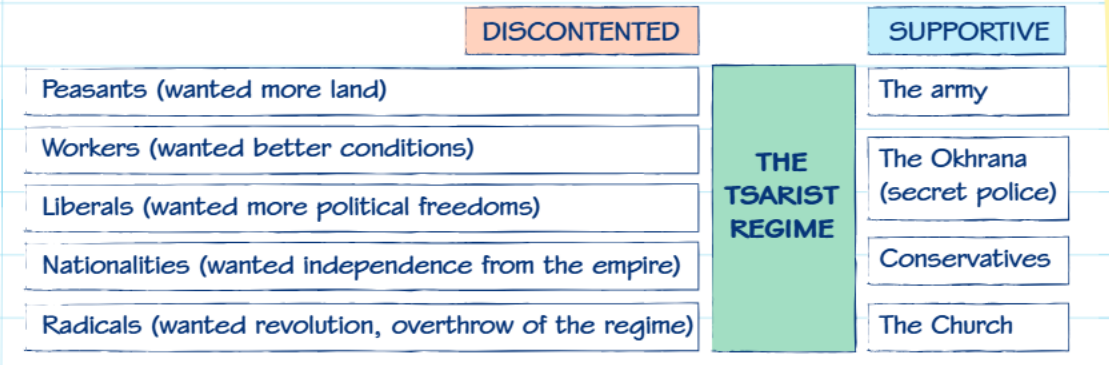
By early 1917, opposition to the tsarist regime was rapidly increasing across Russia. The autocratic system of government that had ruled the country for centuries was facing mounting pressure from multiple groups within society who were becoming increasingly unhappy with their circumstances.
The Romanov family had controlled Russia for 300 years, with Tsar Nicholas II holding power since 1894. However, his position was becoming increasingly unstable as various groups demanded change, while his traditional supporters - the army, secret police (Okhrana), conservatives, and the Orthodox Church - were struggling to maintain control.
Note
The traditional pillars of tsarist support were weakening significantly by 1917. The army was demoralised by military defeats, the secret police were overwhelmed by growing opposition, and even conservative supporters were questioning the regime's ability to govern effectively.
The peasants and their grievances
The vast majority of Russia's population consisted of peasants who lived in extreme poverty. Their main complaints centred around land ownership and basic survival needs.
Peasants desperately wanted more land to farm and feed their families. The existing system of land distribution left many without adequate resources, and rising population numbers made poverty even worse, with famine becoming a regular threat to rural communities.
Important
The 1905 peasant uprising was a powerful warning sign for the tsarist regime. Widespread peasant unrest had erupted across rural Russia, with angry peasants burning down landowner houses and seizing landowner property. The government was forced to use brutal military repression to restore order and end these uprisings.
The First World War created additional hardships for peasant families. Over 15 million people working in agriculture were conscripted to fight, leaving farms without adequate labour. The horses that peasants relied on for farm work were also taken by the army. Furthermore, the military began requisitioning peasant crops, taking away food that families needed to survive.
The town workers and urban discontent
Russia's growing industrialisation had concentrated large numbers of workers in cities, often in massive factories employing thousands of people. These urban workers faced terrible living and working conditions that fuelled their opposition to the regime.
Working conditions in the cities were extremely harsh. Homes were severely overcrowded, and working conditions were unsafe with long hours and strict factory regulations. When workers attempted to organise strikes to improve their situation, factory owners would either dismiss them or call in police or military forces to violently break up their protests.
Important
The industrial workers had demonstrated their power during the 1905 Revolution when they joined with middle-class liberals in a general strike that nearly brought down the tsar's government. This showed the potential threat that organised worker opposition could pose to the regime.
During the First World War, economic problems severely impacted urban areas. Many factories were forced to close, leading to widespread unemployment. Food prices increased dramatically, making life extremely difficult for working families in the cities.
Organised political opposition
Several distinct political groups emerged to challenge tsarist rule, each with different ideas about how Russia should be governed and what changes were needed.
Radicals and revolutionaries
The most extreme opposition came from radical groups who wanted to completely overthrow the tsarist system and replace it with an entirely new form of government.
Example
Political Opposition Groups: Key Ideologies
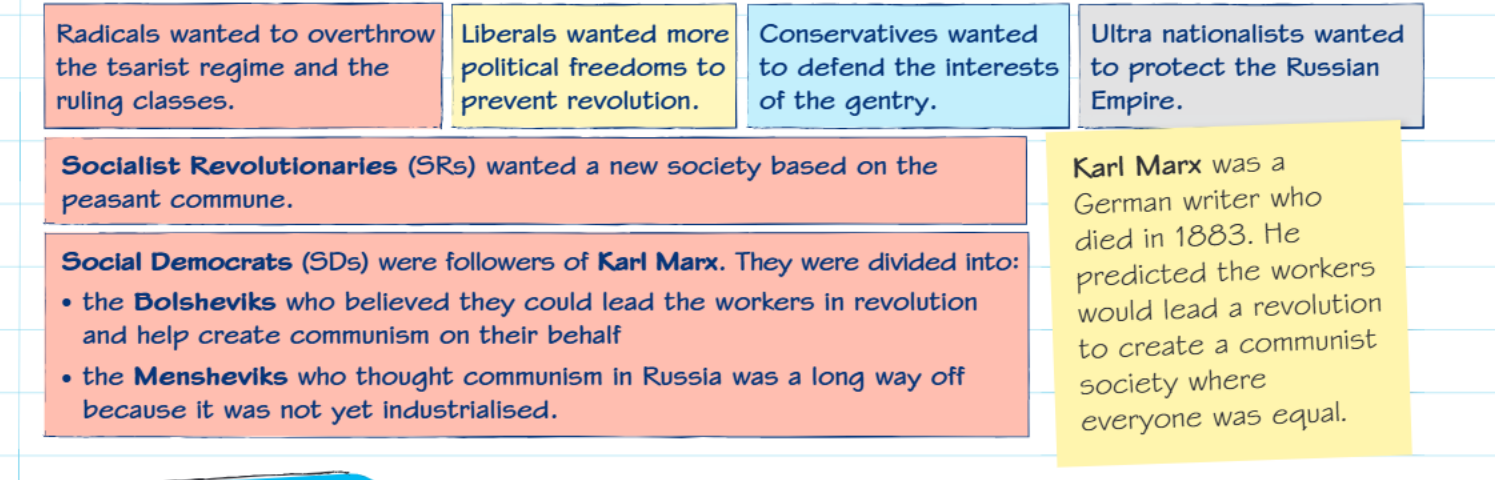
Socialist Revolutionaries (SRs): Envisioned creating a new society built around the traditional peasant commune system. They believed Russia's agricultural heritage could form the foundation for a more equal society.
Social Democrats (SDs): Followed the ideas of Karl Marx, believing that industrial workers would eventually lead a revolution to establish a communist society where everyone would be equal.
Social Democrats (SDs) followed the ideas of Karl Marx, a German writer who had died in 1883. Marx had predicted that industrial workers would eventually lead a revolution to establish a communist society where everyone would be equal. However, the Social Democrats were split into two competing factions:
- Bolsheviks believed they could actively lead the workers in revolution and help create a communist system on behalf of the working class
- Mensheviks thought that communist revolution in Russia was still far in the future because the country had not yet become sufficiently industrialised
Moderate opposition
Liberals wanted significant political reforms but hoped to achieve change through peaceful means rather than revolution. They sought greater political freedoms and constitutional limits on the tsar's power to prevent revolutionary upheaval.
Conservatives primarily defended the interests of the gentry (landowners) and wanted to maintain traditional social structures while making minimal changes to the existing system.
Ultra nationalists focused on protecting and expanding the Russian Empire, emphasising Russian cultural dominance over the empire's many ethnic minorities.
Note
The diversity of opposition groups created both opportunities and challenges for anti-tsarist forces. While it meant broad-based opposition to the regime, the different groups often disagreed on methods and goals, making unified action difficult to achieve.
Timeline of key events
- 1883: Karl Marx dies, leaving behind influential writings on communist theory
- 1894: Nicholas II becomes Tsar of Russia
- 1905: Major peasant uprisings and general strike nearly overthrow the regime
- 1914: Russia enters First World War
- 1917: Growing discontent reaches critical levels as war continues
Summary
Key Points to Remember:
-
Multiple groups opposed the tsar: Peasants wanted land, workers wanted better conditions, and various political groups wanted different types of reform or revolution
-
Economic hardship fuelled opposition: Poverty, poor working conditions, and the impact of World War I made life increasingly difficult for ordinary Russians
-
Political opposition was organised but divided: Revolutionary groups like the SRs and SDs had clear ideologies but disagreed on methods and timing
-
The 1905 Revolution showed the regime's vulnerability: Earlier uprisings demonstrated that coordinated opposition could seriously threaten tsarist rule
-
Traditional supporters were weakening: The army, secret police, conservatives, and Church were struggling to maintain control as opposition grew stronger