Balboa and the conquistadors, 1513–28 (Edexcel GCSE History): Revision Notes
📚Revision Notes
Balboa and the conquistadors, 1513-28
Between 1513 and around 1528, Spanish conquistadors dramatically expanded their control across Central America, taking over Panama, Cuba, Mexico, and Peru. This period marked a crucial phase in Spain's creation of its vast overseas empire, with Vasco Núñez de Balboa playing a particularly important role in these early conquests.
Who were the conquistadors?
The conquistadors were professional soldiers whose name comes from a Spanish and Portuguese word meaning "conqueror." These men participated in military expeditions designed to explore and conquer new lands in Central and South America, driven primarily by the hope of gaining enormous wealth. While officially only Spanish Catholics could serve as conquistadors, many were actually foreign mercenaries who fought on behalf of the Spanish government.
Note
The conquistadors didn't work alone - they were accompanied by Catholic priests whose mission was to convert the Indigenous peoples they encountered to Christianity. This religious element was used to justify the often brutal treatment of local populations, as the Spanish claimed they were bringing salvation to non-Christian peoples.
Balboa's rise to power and early activities
Vasco Núñez de Balboa arrived in Central America as early as 1509, and by 1511 had established himself as governor of Santa María la Antigua del Darién. His early years in the region demonstrated the typical pattern of conquistador behaviour - a combination of exploration, exploitation, and violence.
During his time exploring the area, Balboa and his men were able to acquire pearls and gold by intimidating local Indigenous populations. These valuable resources were then sent back to Spain, demonstrating the wealth that could be extracted from the new territories.
Important
Balboa's approach was characterised by ruthlessness - Indigenous peoples were treated brutally, showing the devastating impact of Spanish colonisation on native populations.
The potential for significant wealth in the region led to dangerous rivalries between Spanish leaders. Balboa found himself in competition with Pedrarias, another ambitious conquistador, and this rivalry would ultimately prove fatal for Balboa.
The "discovery" of the Pacific Ocean, 1513
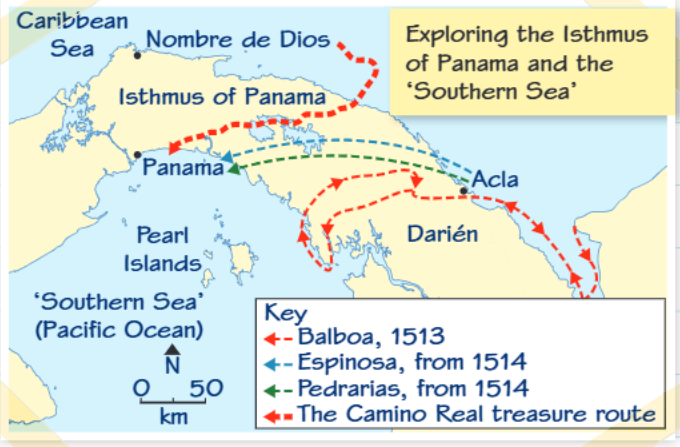
Balboa's most significant achievement came in 1513 when he led an expedition that crossed the Isthmus of Panama. An isthmus is a narrow strip of land with sea on each side, and Panama's unique geography made it a crucial corridor between two major bodies of water.
During this expedition, Balboa and his men became the first Europeans to see what they called the "Southern Sea" - what we now know as the Pacific Ocean. This was a momentous discovery because it revealed that there was another vast ocean on the western side of the Americas, opening up entirely new possibilities for Spanish expansion and trade.
Following European customs of the time, Balboa claimed both the sea and all the lands surrounding it for Spain. This single act of claiming territory would have enormous consequences for the future of Spanish colonisation in the Americas.
Note
The new route across the isthmus gave Spain a strategic advantage, providing them with the opportunity to launch invasions and establish control over lands along the Pacific coast. This discovery was crucial for Spain's later conquests in Peru and other Pacific territories.
The founding and significance of Panama
Following Balboa's initial discoveries, other Spanish leaders including Pedrarias and Espinosa (his second-in-command) explored the area more thoroughly. They eventually agreed to establish a permanent settlement on the Pacific coast, founding the city of Panama.
The location of Panama was strategically chosen for several important reasons. It was positioned as close as possible to Nombre de Dios on the Caribbean side, making it ideal for moving goods, people, and communications between the Pacific Ocean and the Caribbean Sea. This positioning was crucial because it created the shortest possible route for transporting wealth from Pacific conquests back to Spain.
The area around Panama also offered practical advantages for settlement. The land was fertile, making it suitable for agriculture to support the growing Spanish population. Additionally, the nearby seas were rich with fish, providing a reliable food source for the colonists.
Panama quickly developed into an important port facility, perfectly suited for Spanish shipping needs. The settlement became a vital starting point for further Spanish conquests, with later expeditions, including those led by Francisco Pizarro, launching from Panama to conquer territories further south.
However, Balboa's success also sealed his fate. In 1519, the rivalry between Balboa and Pedrarias reached its climax when Pedrarias had Balboa executed for treason in the settlement of Acla. With Balboa eliminated, Pedrarias replaced him as governor, consolidating Spanish control over the region.
Timeline of key events
- 1509: Balboa arrives in Central America
- 1511: Balboa becomes governor of Santa María la Antigua del Darién
- 1513: Balboa crosses the Isthmus of Panama and discovers the Pacific Ocean
- 1514: Espinosa and Pedrarias begin their own explorations of the region
- 1519: Balboa is executed for treason by Pedrarias in Acla
Summary
Key Points to Remember:
-
Balboa's Pacific discovery in 1513 was crucial - it revealed a new ocean and opened up possibilities for Spanish expansion along the Pacific coast
-
The Isthmus of Panama became strategically vital - its narrow geography provided the shortest route between the Atlantic and Pacific, making it perfect for transporting wealth back to Spain
-
Conquistadors combined exploration with exploitation - they sought wealth through intimidating and brutally treating Indigenous peoples while claiming to spread Christianity
-
Rivalry between Spanish leaders could be deadly - Balboa's competition with Pedrarias ultimately led to his execution in 1519, showing how dangerous internal conflicts could be
-
Panama became a launching pad for further conquests - the settlement established the foundation for later Spanish expeditions, including Pizarro's conquest of Peru