Impacts of government policy (Edexcel GCSE History): Revision Notes
📚Revision Notes
Development of the Plains, c1862-c1876: Impacts of government policy
The First Fort Laramie Treaty, 1851
The First Fort Laramie Treaty of 1851 represents a crucial turning point in US government policy towards Indigenous peoples of the Plains. This treaty emerged from growing tensions between migrating settlers and Plains Indian tribes, fundamentally reshaping relationships across the American West.
Note
This treaty marked a watershed moment that would establish patterns of US-Indigenous relations for decades to come, effectively ending the era of Indigenous autonomy on the Great Plains.
Background tensions leading to the treaty
During the late 1840s and early 1850s, several factors created mounting pressure between Indigenous peoples and the expanding United States. The discovery of gold in California in 1849 triggered a massive surge in migration along the Oregon Trail, with thousands of settlers crossing traditional Indigenous lands.
This dramatic increase in westward migration created severe problems for Plains Indian communities. The constant flow of waggon trains disrupted buffalo herds, which formed the foundation of Plains Indian economy and culture. As food supplies became scarcer, conflicts between tribes intensified as they competed for remaining resources.
Note
The buffalo was central to Plains Indian life, providing not only food but also materials for clothing, shelter, and tools. The disruption of buffalo migration patterns by waggon trains had devastating effects that went far beyond simple food scarcity.
Many settlers travelling west feared attacks from Indigenous tribes, though they often misunderstood the nature of intertribal conflicts they witnessed. These settlers demanded protection from the US Army, putting pressure on the government to take action. Meanwhile, Indigenous communities grew increasingly concerned about the impact of migration on their traditional lands and resources.
Key provisions of the 1851 treaty
The US government responded to these mounting tensions by negotiating the First Fort Laramie Treaty. This agreement established several important precedents that would shape future government policy towards Indigenous peoples.
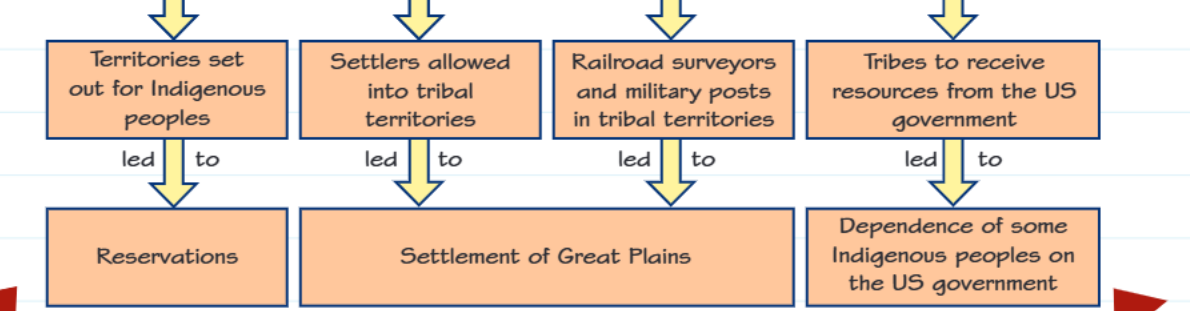
The treaty created specific territorial boundaries for different Indigenous tribes, essentially establishing the first reservation system on the Plains. It also granted settlers the right to travel through and establish communities within these designated tribal territories. Perhaps most significantly, the agreement allowed railroad surveyors and military posts to be built in Indigenous lands, paving the way for future development.
Important
The reservation system established by this treaty fundamentally altered Indigenous ways of life, confining previously nomadic peoples to fixed territories and beginning a process of systematic cultural disruption.
In exchange for these concessions, the US government promised to provide annual payments and resources to the participating tribes. The Indigenous nations involved agreed to accept a yearly payment of $50,000 as compensation for the changes to their lands and way of life.
Long-term significance and consequences
The Fort Laramie Treaty had profound and lasting impacts that extended far beyond its immediate provisions. Most importantly, it marked the beginning of the reservation system that would define US-Indigenous relations for decades to come.
The treaty prioritised the needs of settlers over previous commitments the government had made to Indigenous peoples, particularly those outlined in the Indian Trade and Intercourse Act of 1834. This shift in priorities meant that the concept of a "Permanent Indian Frontier" - a boundary that would separate Indigenous and settler lands - was effectively abandoned.
Important
The abandonment of the "Permanent Indian Frontier" concept represented a fundamental betrayal of previous government promises and marked a decisive shift towards prioritising economic expansion over Indigenous rights.
The agreement opened the Great Plains to systematic settlement and development. By allowing railroads and military posts in Indigenous territories, the treaty created the infrastructure necessary for large-scale migration and economic development of the region.
Perhaps most significantly, the treaty created a system of dependence that would have devastating long-term consequences for Indigenous communities. The annual payments became a tool that the US government could use to control Indigenous peoples, gradually undermining their traditional independence and self-sufficiency.
Timeline of key events
- 1834: Indian Trade and Intercourse Act established concept of Permanent Indian Frontier
- 1849: California Gold Rush begins, massively increasing migration along Oregon Trail
- 1850-1851: Growing tensions and conflicts between settlers and Plains Indians
- 1851: First Fort Laramie Treaty signed, establishing reservation system
- 1851 onwards: Systematic settlement of Great Plains begins, Indigenous dependence on government increases
The broader impact on government policy
The Fort Laramie Treaty established patterns that would characterise US government policy towards Indigenous peoples throughout the period of Plains development. It demonstrated how the government would consistently prioritise economic development and settler interests over Indigenous rights and previous treaty obligations.
The treaty's emphasis on providing government resources to Indigenous communities in exchange for land concessions became a standard approach. This created a cycle where Indigenous peoples were forced to give up more of their traditional lands and autonomy in return for basic survival needs that had previously been met through their traditional economies.
Note
This cycle of dependence was not accidental but represented a deliberate strategy to weaken Indigenous resistance to further territorial expansion and cultural assimilation efforts.
The agreement also showed how the government would use legal frameworks to legitimise the taking of Indigenous lands while appearing to provide fair compensation. The $50,000 annual payment may have seemed generous, but it represented a tiny fraction of the value of the lands and resources being surrendered.
Summary
Key Points to Remember:
- The 1851 Fort Laramie Treaty marked the beginning of the reservation system and the end of the Permanent Indian Frontier concept
- Growing migration due to the California Gold Rush created the tensions that led to the treaty negotiations
- The treaty prioritised settler and economic interests over previous government commitments to Indigenous peoples
- Annual government payments created a system of dependence that undermined Indigenous self-sufficiency
- The agreement established patterns of land cession in exchange for government resources that would continue throughout the Plains development period