Changing government attitudes (Edexcel GCSE History): Revision Notes
📚Revision Notes
Changing government attitudes
The shift in government policy
By the 1880s, the United States government began to change its approach towards Indigenous peoples of the Plains. Originally, the reservation system was created to help Plains Indians maintain their traditional way of life while keeping them separate from white American society. The goal was to prevent conflict as white settlers moved westward. However, as time passed, the government started to view this system differently, believing that Indigenous peoples should become dependent on government support rather than living independently.
Note
The reservation system represented a fundamental shift from viewing Indigenous peoples as sovereign nations to treating them as wards of the state requiring government oversight and control.
This change represented a major shift from protection to what was called "assimilation" - the idea that Indigenous peoples should become part of mainstream American society by abandoning their traditional ways of life.
Competing pressures on government policy
The government faced conflicting demands from different groups when deciding how to handle Indigenous peoples. These competing pressures pulled policy in different directions.
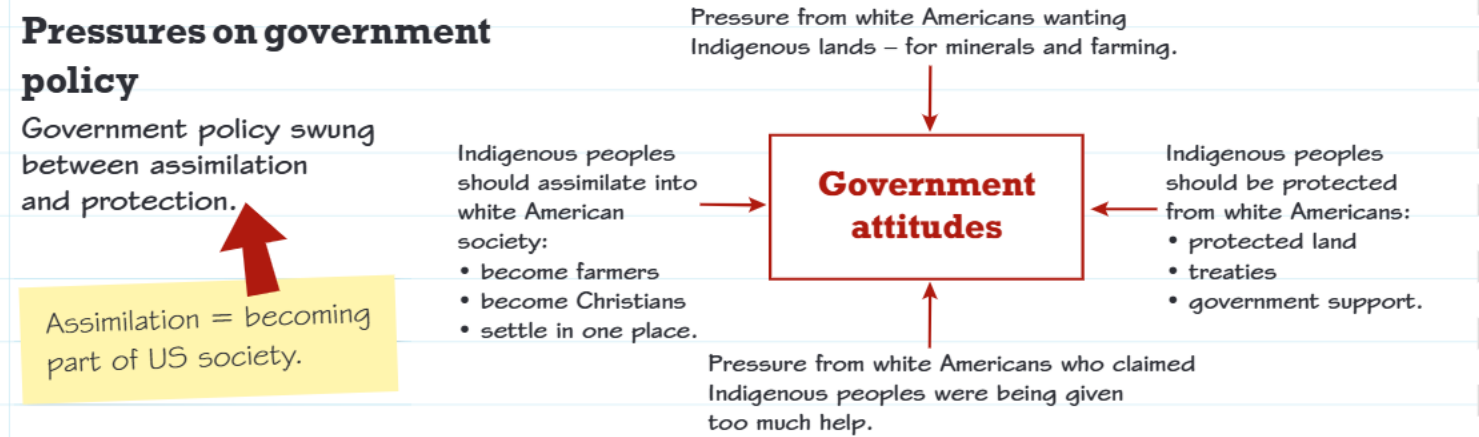
White American settlers created significant pressure by demanding access to Indigenous lands, particularly areas rich in minerals or suitable for farming. At the same time, some white Americans complained that Indigenous peoples were receiving too much help from the government and that this support was costly and unnecessary.
On the other hand, there were calls for Indigenous peoples to be integrated into American society through assimilation. This meant encouraging them to become individual farmers, convert to Christianity, and adopt American customs. Conversely, other voices argued for continued protection of Indigenous peoples through maintaining treaties and providing government support.
Note
Four Main Pressures on Government Policy:
- White settlers demanding Indigenous lands for farming and mining
- Complaints about the cost of supporting Indigenous peoples
- Calls for assimilation and integration into American society
- Advocates for continued protection and treaty obligations
These conflicting pressures meant that government policy constantly shifted between different approaches, creating an inconsistent and often harmful situation for Indigenous communities.
The Dawes Act of 1887
The most significant piece of legislation reflecting changing government attitudes was the Dawes Act, passed in 1887. This law fundamentally changed how the government dealt with Indigenous lands and communities.
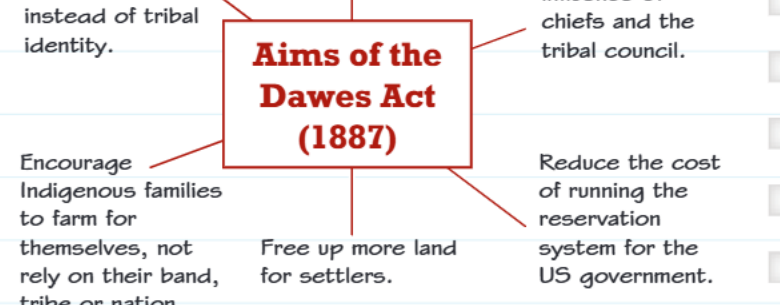
Under the Dawes Act, each Indigenous family received an individual allotment of 160 acres from reservation land - essentially a homestead plot. Single Indigenous Americans received 80 acres, while orphans under 18 years old were allocated 40 acres. This system aimed to encourage individual farming rather than the traditional communal way of life practised by many Indigenous groups.
The act included several important provisions that revealed the government's true intentions. Indigenous Americans who accepted their land allotment and left the reservation could become American citizens. However, they were not allowed to sell their land allotments for 25 years, which was meant to prevent them from quickly losing their land to white settlers.
Important
Critical Provision of the Dawes Act: Any reservation land that remained after all the allotments had been distributed could be sold to white Americans. This provision meant that large amounts of Indigenous land would ultimately transfer to white ownership - this was often the real goal of the legislation.
The devastating impact of the Dawes Act
The consequences of the Dawes Act proved disastrous for Indigenous peoples. The legislation was designed to improve conditions, but it actually made life much worse for most Indigenous communities.
By 1890, just three years after the act was passed, approximately half of all the land that Indigenous peoples had possessed in 1887 had been transferred to white American ownership. This massive loss of land occurred incredibly quickly and left many Indigenous families with much less territory than they had before.
Indigenous Americans who accepted their allotments often discovered that the land was too poor for successful farming. The dry conditions of much of the western territory made agriculture extremely difficult, and many Indigenous peoples lacked the farming experience and resources needed to make their plots productive. As a result, most Indigenous Americans ended up selling their land as quickly as possible, often for very low prices.
Important
The Reality of Land Loss: Many Indigenous Americans were cheated or pressured into selling their land for far less than it was worth. This left numerous Indigenous families completely landless and with no means of supporting themselves, defeating the supposed purpose of making them self-sufficient farmers.
The closure of the frontier
The impact of these policies extended beyond individual Indigenous communities to mark a major turning point in American history. In 1890, the US Census Office, which was part of the federal government, made an important declaration that reflected how completely the situation had changed.
The census office announced that there was no longer a clear "frontier" line separating settled areas from the wilderness. This meant that the so-called "wilderness" areas, many of which had been Indigenous lands, were now considered to be under complete American control. The USA had achieved total dominance over the western territories.
Note
The declaration of the frontier's closure symbolised the end of an era in American expansion and the complete defeat of Indigenous resistance to white settlement. It represented the final stage in the government's changing attitude towards Indigenous peoples - from treating them as separate nations to viewing them as obstacles to be removed or assimilated.
Timeline of key events
- 1880s: Government attitudes begin shifting from protection to assimilation
- 1887: Dawes Act passed, breaking up tribal lands into individual allotments
- 1890: US Census declares the frontier closed; half of Indigenous lands lost since 1887
Summary
Key Points to Remember:
- The government's attitude towards Indigenous peoples shifted dramatically in the 1880s from protection to forced assimilation into American society
- Multiple competing pressures influenced government policy, including demands from white settlers for land and conflicting views on how Indigenous peoples should be treated
- The Dawes Act of 1887 broke up tribal lands into individual plots, aiming to destroy traditional communal ways of life and encourage individual farming
- The Dawes Act was devastating for Indigenous peoples, resulting in the loss of half their remaining lands by 1890 and leaving many families landless and impoverished
- The closure of the frontier in 1890 marked the complete American control over western territories and the end of Indigenous independence