The Johnson County War (Edexcel GCSE History): Revision Notes
📚Revision Notes
The Johnson County War (1892)

Introduction to range wars
Range wars were major conflicts that erupted across the American West as different groups fought for control of land and resources. The Johnson County War of 1892 became the most famous of these conflicts, representing a clash between wealthy cattle barons and homesteaders alongside small ranchers who were trying to establish themselves in Wyoming.
Note
The Johnson County War occurred during a period of rapid Western expansion when competing interests clashed over land use, political control, and economic opportunities in the developing territories.
Background to the Johnson County War
The growth of Wyoming's cattle industry
In the early 1870s, Wyoming territory had a tiny population of only around 9,000 US citizens. Most of the land remained public, creating perfect conditions for large-scale cattle operations. Wealthy investors from the East provided the money needed to establish huge cattle ranches. This meant that just a few very rich people controlled most of Wyoming's cattle industry and held significant political power in the territory.
The devastating winter of 1886-87
A particularly harsh winter brought disaster to the open-range cattle herds throughout Wyoming. The winter of 1886-87 caused massive losses for the big ranchers, and some even faced bankruptcy as a result. Smaller ranchers proved more adaptable during this crisis, as they could better protect their smaller herds. This shift weakened the big ranchers' position while allowing smaller operators to gain strength.
Important
The harsh winter of 1886-87 marked a critical turning point that shifted the balance of power from large cattle operations to smaller, more adaptable ranchers. This change in economic dynamics set the stage for the conflicts that would follow.
Growing tensions between large and small ranchers
As more people moved to Wyoming, the population increased significantly. By 1894, homesteaders had claimed about 10,000 acres of land, using barbed wire fences to mark their boundaries. This created serious problems for the large cattle operations, who had grown used to freely using vast areas of public land for grazing.
These newcomers also challenged the political control that big ranchers had enjoyed for years. In Johnson County specifically, local juries refused to convict people accused of stealing cattle from the large ranches. This showed that ordinary community members sympathised more with small ranchers than with wealthy cattle barons.
Note
The refusal of local juries to convict accused cattle rustlers demonstrated a significant shift in community loyalties. This resistance to the cattle barons' influence would prove crucial during the events of 1892.
The murders of Ella Watson and Jim Averill
The situation became critical with the killings of two homesteaders, Ella Watson and Jim Averill. Both had established a 640-acre claim on public land that rancher Albert Bothwell wanted for his cattle operations. Averill had written angry newspaper letters criticising Bothwell's behaviour.
Watson had managed to build up a small cattle herd, but Bothwell accused her of rustling cattle from larger operations. Both Bothwell and his allies claimed that Watson and Averill were stealing livestock. Shortly after these accusations were made, both homesteaders were lynched, and Bothwell took over their land.
Example
Case Study: The Watson and Averill Murders
The 1889 lynching of Ella Watson and Jim Averill perfectly illustrates the escalating tensions:
The Setup:
- Watson and Averill claimed 640 acres of public land
- Albert Bothwell wanted this land for his cattle operation
- Averill publicly criticised Bothwell in newspaper letters
The Accusations:
- Bothwell accused Watson of cattle rustling
- No legal proceedings or evidence was presented
- Accusations served as justification for violence
The Outcome:
- Both homesteaders were lynched without trial
- Bothwell immediately seized their land
- No legal consequences for the perpetrators
The conflict begins
Following the Watson and Averill murders, smaller ranchers decided to organise their own spring round-up of cattle. They planned to hold this gathering earlier than the official round-up conducted by the WSGA (Wyoming Stock Growers Association), which represented the big cattle barons' interests.
WSGA members became convinced that the small ranchers intended to use this early round-up as cover for stealing more cattle from the large operations. This belief led them to plan extreme action.
The 'invasion'
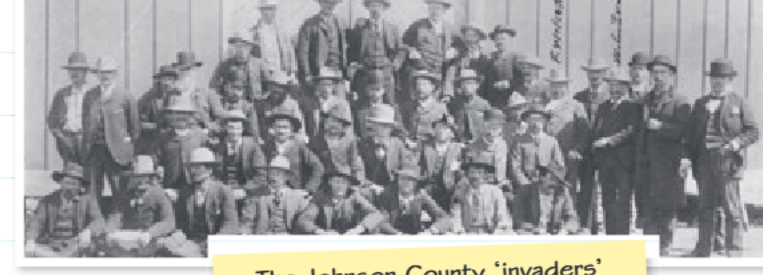
The WSGA made a dramatic decision to hire 22 professional gunfighters from Texas to carry out what they called an 'invasion' of Johnson County. Their plan involved killing 70 people they suspected of cattle rustling. The organisation set aside $100,000 for this operation, expecting to spend most of the money on legal costs after the killings took place.
However, the invasion failed completely. The hired gunfighters became trapped in a prolonged gun battle with Nate Champion, a local rancher. News of the invasion spread quickly to Sheriff Angus of Johnson County and to residents of Buffalo, the county's main town. The local community surrounded the invaders and placed them under arrest.
Important
The WSGA's plan represented an unprecedented escalation of vigilante violence in the American West. The decision to hire professional killers and target 70 individuals shows how far wealthy cattle interests were willing to go to maintain their power.
Consequences of the Johnson County War
The aftermath of the failed invasion revealed just how much political influence the WSGA and their supporters wielded. The organisation used their allocated $100,000 to hire Chicago's best lawyers. These skilled legal representatives successfully moved the trial from Johnson County to Cheyenne, where juries would be more sympathetic to the WSGA's position.
The WSGA lawyers then used delaying tactics to postpone the trial repeatedly. They continued these delays until Johnson County could no longer afford to keep the prisoners in jail. Meanwhile, the state government, which contained many WSGA supporters, refused to help cover the trial costs.
Through these legal manoeuvres, the invaders eventually went free without facing any consequences for their attempted killings.
Note
The manipulation of the legal system demonstrated that economic power could override justice in the late 19th century West. Moving the trial to Cheyenne was particularly strategic, as that city had stronger ties to the cattle industry and was less sympathetic to small ranchers.
Significance of the Johnson County War
Although the hired gunfighters escaped punishment, the Johnson County War revealed something important about changing attitudes towards law and order in the American West. The strong resistance that vigilante justice encountered in Johnson County demonstrated that local communities were becoming unwilling to accept violence as a solution to disputes.
The conflict highlighted the ongoing struggle between wealthy cattle interests and ordinary settlers. It also showed how economic power could manipulate the legal system. Most importantly, the war marked a turning point in Western settlement, proving that homesteaders and small ranchers could successfully stand up to powerful cattle barons.
Important
The Johnson County War marked the beginning of the end for the era of unchecked vigilante justice in the American West. Despite the legal outcome, the community's resistance sent a clear message that organised violence would no longer be tolerated.
Timeline of key events
- Early 1870s: Wyoming territory population only 9,000; large Eastern-funded cattle ranches established
- 1886-87: Harsh winter devastated cattle herds, weakening big ranchers' power
- 1889: Ella Watson and Jim Averill murdered; Albert Bothwell seized their land
- 1892: Johnson County War
- Small ranchers announced early spring round-up
- WSGA hired 22 Texas gunfighters to eliminate 70 suspected rustlers
- Invasion failed when locals surrounded gunfighters in Buffalo
- Legal proceedings moved to Cheyenne through WSGA influence
- Later 1890s: Invaders released without punishment due to legal delays
Summary
Key Points to Remember:
- The Johnson County War of 1892 was the most famous range war, pitting wealthy cattle barons against homesteaders and small ranchers in Wyoming
- The WSGA spent $100,000 to hire 22 Texas gunfighters with orders to kill 70 suspected cattle rustlers
- The invasion failed when Sheriff Angus and Buffalo residents surrounded and arrested the hired gunfighters
- Despite the failed invasion, the powerful WSGA used wealth and political connections to ensure the gunfighters went free
- The conflict showed growing community resistance to vigilante justice and marked an important shift in Western settlement patterns