Lawlessness! (Edexcel GCSE History): Revision Notes
📚Revision Notes
Lawlessness in the American West, c1835-c1862
Understanding lawlessness in the West
Lawlessness in the American West during this period didn't mean there were no laws at all. Rather, it described a situation where law enforcement systems were so overwhelmed and inadequate that they couldn't prevent crime or catch lawbreakers effectively. As western settlements grew rapidly, criminal activity became increasingly common and difficult to control.
Note
Understanding lawlessness is crucial: it wasn't the absence of laws, but rather the complete breakdown of systems meant to enforce those laws in the face of rapid expansion and population growth.
Multiple causes of widespread lawlessness
The breakdown of law and order in the West resulted from several interconnected factors that created a perfect storm for criminal activity.
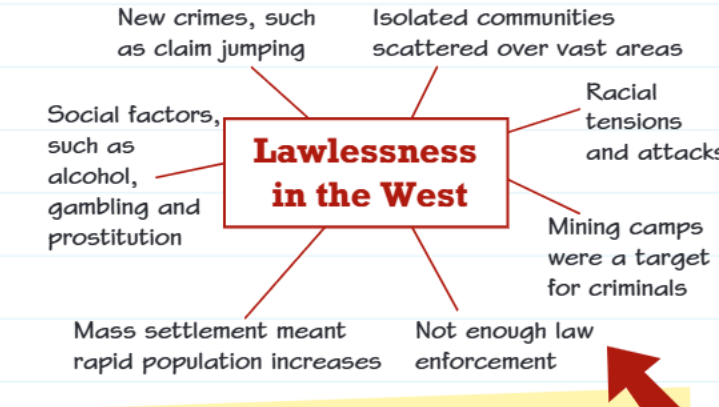
The fundamental problem was that mass settlement led to rapid population increases that existing law enforcement simply couldn't handle. Towns could grow from hundreds to thousands of residents almost overnight, but the number of lawmen remained tiny. These isolated communities were scattered across vast areas, making it nearly impossible for limited law enforcement to patrol effectively or respond quickly to crimes.
Social factors created volatile environments where conflicts easily escalated. The predominantly male populations in many settlements, combined with widespread alcohol consumption, gambling, and prostitution, led to frequent violence and disorder. Racial tensions and attacks, particularly targeting Chinese migrants and other minority groups, added another dangerous element to already unstable communities.
The discovery of gold and other valuable resources brought entirely new types of crimes like claim jumping, where individuals would illegally seize someone else's mining claim. Mining camps became prime targets for criminals who knew miners often carried significant amounts of gold and had limited protection.
Most critically, there was simply insufficient law enforcement to cope with the scale and spread of criminal activity across the western territories.
Common problems in mining camps
Mining camps faced particularly severe challenges with maintaining order and safety. These settlements were typically isolated in remote mountain locations, far from established towns and regular law enforcement. The population was overwhelmingly male, and the dangerous, physically demanding work combined with easy access to alcohol frequently resulted in violence.
Violence was often fuelled by alcohol, gambling, and fights over women in these male-dominated environments. The camps attracted not only legitimate miners seeking their fortune, but also outlaws and con artists who specifically targeted successful miners. These criminals would swindle miners who had struck it rich, sometimes selling them worthless land with false promises of gold deposits.
Important
Discrimination and Violence Against Chinese Migrants
Prejudice against Chinese migrants created additional violence and instability in mining camps. Chinese miners faced systematic discrimination and were often victims of racially motivated attacks, making these communities even more dangerous and unstable.
The situation worsened with the emergence of claim jumping, where people would use force to take over promising mining claims that rightfully belonged to others. Miners' courts were sometimes established to help settle these disputes, with camps typically selecting a respected older miner to serve as judge.
Case study: San Francisco gangs and the Gold Rush
Example
Case Study: San Francisco's Transformation and Gang Control
San Francisco provides a dramatic example of how rapid population growth could lead to complete breakdown of law and order. The California Gold Rush transformed this small town of approximately 1,000 people into a booming city of 25,000 residents by 1849. This explosive growth created serious social and criminal problems.
The Problem: Many prospectors who had travelled to California hoping to strike it rich found no gold and became unemployed and desperate. With few legitimate opportunities available, some turned to crime for survival. Very few prospectors actually found gold, leaving San Francisco filled with disappointed and often desperate migrants.
Criminal Control: By 1851, gangs had gained significant control over parts of San Francisco. The few local law enforcement officers were completely overwhelmed and unable to cope with the scale of criminal activity. Many officers were even corrupted through bribes from criminal organisations, making the official justice system essentially useless. Murder, violence, and theft became commonplace throughout the city.
Additional Challenges: The situation was further complicated by massive Chinese migration. A famine in China led to approximately 20,000 Chinese people arriving in San Francisco in 1852. Chinese people were legally banned from working new mining claims, forcing them to search only in areas that had already been worked by white Americans. When Chinese miners did find overlooked gold, white Americans would often steal it from them. Courts actively discriminated against Chinese people, making it nearly impossible for them to seek justice through official legal channels.
Community responses: Taking law into their own hands
Faced with completely inadequate official law enforcement, western communities developed their own methods to combat crime and maintain some semblance of order.
Vigilance committees emerged as citizen groups that decided to punish suspected lawbreakers themselves rather than relying on the failed official justice system. Citizens of San Francisco established a vigilance committee to control gang violence in 1851, and this idea quickly spread to mining camps throughout the West.
Note
While vigilance committees sometimes succeeded in restoring order, they also carried the risk of becoming lawless themselves, as they operated outside official legal frameworks and could potentially become corrupt or biassed in their judgments.
Miners' courts represented another community-based solution to the breakdown of official justice. Miners would establish their own informal legal systems to settle disputes, particularly over mining claims and other conflicts. These courts typically selected a respected older miner to serve as judge and would hear cases according to rules that the mining community had collectively agreed upon.
Key terms
Vigilance committee (vigilantes): A group of citizens that decides to punish suspected lawbreakers itself, instead of relying on the official justice system, usually because that system is inadequate or has failed completely.
Miners' courts: Informal legal systems established by miners to settle disputes over claims and other conflicts. The mining camp would usually select a respected older miner to serve as judge.
Claim jumping: A new type of crime that emerged during the Gold Rush, where a person would illegally take over a promising mining claim that belonged to someone else.
Timeline of key events
- c1835-1840s: Early western migration begins, isolated settlements established across western territories
- 1849: California Gold Rush begins, San Francisco population explodes from approximately 1,000 to 25,000 people
- 1851: Criminal gangs gain control over parts of San Francisco; citizens form vigilance committee to combat gang violence
- 1852: Approximately 20,000 Chinese migrants arrive in San Francisco following famine in China
- c1850s-1860s: Miners' courts and vigilance committees spread throughout western mining camps and settlements
Summary
Key Points to Remember:
-
Lawlessness meant breakdown of law enforcement, not absence of laws - rapid western expansion overwhelmed existing systems of justice and created opportunities for widespread criminal activity.
-
Multiple interconnected causes created the perfect conditions for lawlessness - isolation, mass migration, social problems, racial tensions, new types of crimes, and completely insufficient law enforcement all contributed.
-
San Francisco's dramatic transformation from 1,000 to 25,000 people by 1849 shows how quickly the Gold Rush could destabilise communities and create opportunities for criminal gangs to gain control.
-
Communities developed their own justice systems when official ones failed - vigilance committees and miners' courts emerged as responses to inadequate law enforcement, though these carried their own risks and problems.
-
Racial discrimination against Chinese migrants was both a cause and consequence of lawlessness - legal systems actively worked against minority groups, while racial tensions contributed to violence and instability in western communities.