Problems of settling the Plains (Edexcel GCSE History): Revision Notes
📚Revision Notes
Problems of settling the Plains
Introduction
During the period of westward expansion in the American West (c1835-c1895), settlers discovered that life on the Great Plains presented enormous challenges. While the Plains offered vast amounts of land for farming and settlement, the environment was harsh and unforgiving, creating obstacles that were very different from those faced in the eastern United States.
Note
The Great Plains stretch across much of the central United States, from Texas to Canada, and from the Rocky Mountains to approximately the 100th meridian. This vast grassland region covers parts of ten U.S. states and represents one of the world's largest prairie ecosystems.
Environmental challenges
Extreme climate conditions
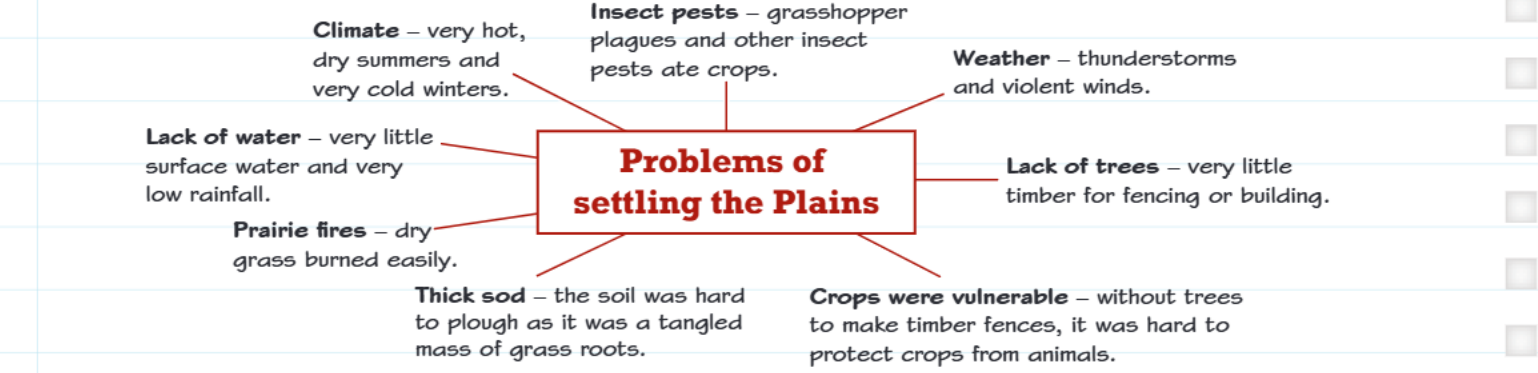
The Plains experienced severe weather patterns that made daily life extremely difficult for settlers. Summers were intensely hot and dry, creating challenging conditions for both people and crops. Winters brought bitter cold temperatures that could be life-threatening. This dramatic seasonal variation required settlers to prepare for both extremes, often with limited resources.
Note
Temperature variations on the Plains could be extreme, with summer temperatures often exceeding 100°F (38°C) and winter temperatures dropping well below 0°F (-18°C). These dramatic swings made it nearly impossible to maintain consistent living conditions without proper shelter and heating.
Lack of water resources
Important
One of the most serious problems facing Plains settlers was the scarcity of water. The region received very little rainfall throughout the year, and surface water sources were extremely rare. This created major difficulties for drinking water, cooking, cleaning, and most importantly, irrigating crops. Without reliable water sources, successful farming became nearly impossible.
Severe weather events
The Plains were regularly struck by violent thunderstorms and powerful winds that could destroy crops, damage buildings, and endanger lives. These unpredictable weather patterns made it difficult for settlers to plan their agricultural activities and maintain their homes and property.
Note
Plains weather was notoriously unpredictable, with settlers having little warning of approaching storms. The flat landscape provided no natural barriers to slow down severe weather systems, allowing storms to build tremendous power as they moved across the region.
Natural obstacles to settlement
Thick sod and difficult soil
Important
The Plains soil presented a unique challenge that eastern farmers had never encountered. The ground was covered with thick sod - a dense mat of tangled grass roots that had been growing for centuries. This made ploughing extremely difficult, as the farming equipment that worked well in the East would often break when used on Plains soil.
Initially, settlers had to dig up this tough sod by hand using spades, which was exhausting and time-consuming work.
Example
Manual Sod Breaking Process:
Step 1: Cut the sod into manageable blocks using spades or special sod-cutting tools Step 2: Lift and turn each block by hand - each block could weigh 50+ pounds Step 3: Break up the turned sod and prepare it for planting Step 4: Repeat this process for entire fields, often taking weeks for small plots
A typical family might spend months preparing just a few acres for their first crop.
Scarcity of trees and timber
Unlike the eastern United States, the Plains had very few trees. This created serious problems for construction and farming. Without adequate timber, settlers could not build traditional wooden houses or create fences to protect their crops and livestock from wild animals.
Important
The lack of fencing material made it nearly impossible to establish proper boundaries or safeguard agricultural investments. This fundamental problem would persist until technological innovations provided alternative solutions.
Prairie fires
Important
The dry grassland of the Plains was highly susceptible to prairie fires, which could spread rapidly across vast areas. These fires posed a constant threat to settlements, crops, and livestock. The fires occurred naturally due to lightning strikes or could be accidentally started by human activities.
Agricultural difficulties
Insect pest infestations
Example
The Grasshopper Plague Crisis:
The Rocky Mountain grasshopper was especially notorious for the devastation it caused:
- Swarms could cover hundreds of square miles
- A single swarm might contain billions of insects
- They would eat not just crops, but also clothing, tool handles, and even house shutters
- Some plagues lasted for several consecutive years, destroying entire communities' livelihoods
Settlers faced devastating attacks from insect pests, particularly grasshopper plagues. These insects would arrive in massive swarms and completely destroy crops, leaving farmers with nothing to harvest.
Crop vulnerability
Without proper fencing to protect their fields, settlers found their crops were extremely vulnerable to damage from wild animals and livestock. Traditional farming methods from the East were often ineffective on the Plains, leading to repeated crop failures and economic hardship.
Note
Eastern farming techniques were designed for different soil types, climate conditions, and pest environments. Settlers had to learn entirely new approaches to agriculture, often through costly trial and error.
Solutions and adaptations
Alternative building methods
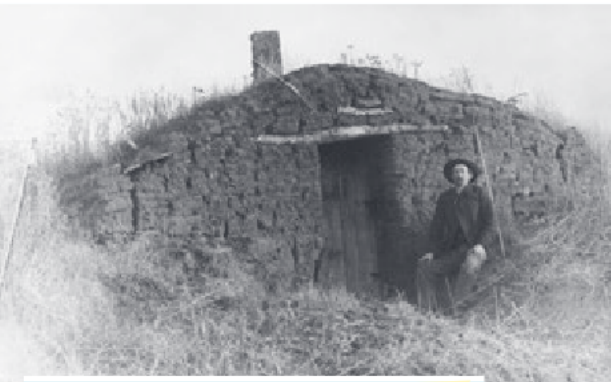
Due to the lack of timber, settlers developed creative solutions for housing. Many lived in caves dug into hillsides or built sod houses constructed from blocks of earth and grass.
Note
Sod House Advantages and Disadvantages:
Advantages:
- Thick earth walls provided excellent insulation during harsh winters
- Earth construction was fireproof, offering protection from prairie fires
- Building materials were readily available on-site
- Cost-effective compared to importing timber
Disadvantages:
- Difficult to keep clean due to dirt walls and roof
- Often infested with insects and small animals
- Could become muddy during heavy rains
- Dark interior with limited natural light
Innovations in fencing
The shortage of wood for fencing remained a major problem until 1874, when barbed wire was introduced as a cheaper alternative to wooden fences. Before this innovation, settlers had to pay enormous amounts of money to import timber for fencing their claims, making homesteading very expensive.
Important
The introduction of barbed wire was a revolutionary solution that finally made large-scale farming economically viable on the Plains. This single innovation transformed the economics of Plains settlement.
Comparison with other regions
The farming conditions on the Plains were dramatically different from those in other parts of America. Crops that thrived in eastern states would shrivel up and die from lack of water on the Plains, or be destroyed by insect infestations like grasshopper swarms.
In contrast, regions like California and Oregon on the west coast had much better farming conditions. By the 1850s, Californian farmers were so successful that they began exporting their produce worldwide.
Note
The contrast between Plains farming and West Coast agriculture was stark. While Plains settlers struggled with basic survival, California's Mediterranean climate and fertile soil allowed for diverse, profitable agriculture from the early days of settlement.
Timeline of key developments
- c1835-1850s: Early settlers encounter major challenges with Plains environment
- 1850s: California farmers begin large-scale successful agriculture and export
- 1874: Barbed wire introduced, providing affordable fencing solution for Plains settlers
Key takeaways
Summary
Essential Points to Remember:
- The Plains environment was extremely harsh, with hot dry summers, cold winters, and little rainfall
- Lack of trees created major problems for building houses and fencing crops
- Thick sod made farming much more difficult than in eastern states
- Insect plagues, especially grasshoppers, could destroy entire crops
- Settlers adapted by building sod houses and living in caves until better solutions became available
- The introduction of barbed wire in 1874 finally provided an affordable fencing solution
- Success on the Plains required completely different approaches compared to eastern farming methods