Inequalities (Edexcel GCSE Maths): Revision Notes
📚Revision Notes
Inequalities
What are inequalities?
Inequalities are mathematical statements that compare two values, showing whether one is greater than, less than, or equal to another. Don't worry - once you understand the basic principles, solving inequalities is very similar to solving regular equations!
Note
The beauty of inequalities is that they use almost identical solving techniques to regular equations. If you're comfortable with solving equations, you're already most of the way there!
Understanding inequality symbols
Learning the inequality symbols is your first step to mastering this topic. Each symbol has a specific meaning that tells you how two values relate to each other.
The four main inequality symbols are:
- means "greater than"
- means "less than"
- means "greater than or equal to"
- means "less than or equal to"
Note
Memory Trick: "The one at the BIG end is BIGGEST"
This means the wide part of the symbol always points towards the larger value. For example, both and mean exactly the same thing - that is greater than 4.
Solving inequalities algebraically
The wonderful news about inequalities is that you can solve them using almost exactly the same methods as regular equations. You can add, subtract, multiply, and divide both sides to isolate your variable.
When solving inequalities, follow these familiar steps:
- Simplify both sides if needed
- Add or subtract terms to get variables on one side
- Add or subtract constants to isolate the variable term
- Multiply or divide to get the variable by itself
Example
Worked Example: Solving a Linear Inequality
Let's solve:
Step 1: Subtract from both sides
Step 2: Subtract 7 from both sides
Step 3: Check your answer by substituting and Since , our answer is correct!
The process feels natural because it mirrors equation solving techniques you already know.
The crucial rule about negative numbers
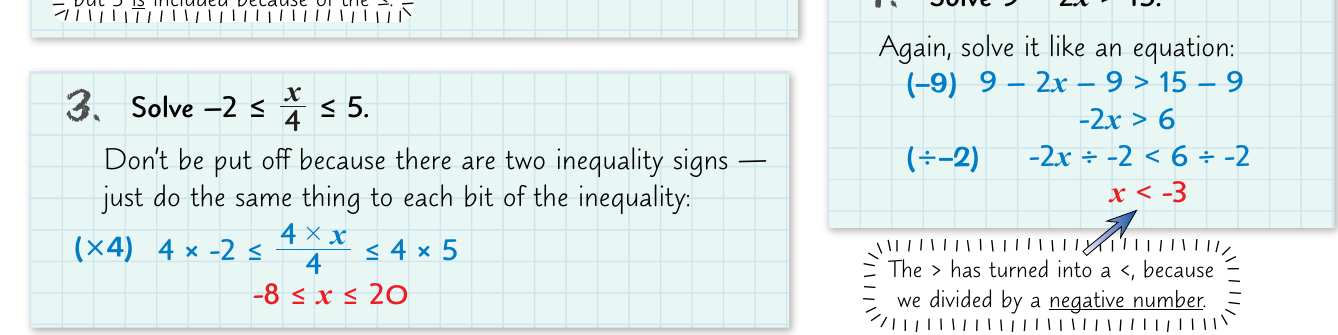
Here's the one critical difference between solving equations and inequalities: when you multiply or divide both sides by a negative number, you must flip the inequality sign.
Important
The Golden Rule of Inequalities
Whenever you MULTIPLY OR DIVIDE by a NEGATIVE NUMBER, you must FLIP THE INEQUALITY SIGN.
This rule exists because multiplying by a negative number reverses the order of values on the number line.
Example
Worked Example: Inequality with Negative Coefficient
Let's solve:
Step 1: Divide both sides by (remember to flip the sign!)
Notice how the became when we divided by the negative number.
This might seem tricky at first, but with practice, you'll remember to check whether you're dividing or multiplying by a negative number and flip the sign accordingly.
Representing inequalities on number lines
Visual representation helps you understand inequality solutions better. Number lines show the range of values that satisfy your inequality using specific symbols.

When drawing inequalities on number lines:
- Use an open circle (○) for or symbols (the value is not included)
- Use a closed circle (●) for or symbols (the value is included)
- Draw a line or arrow showing all values that satisfy the inequality
Note
Circle Types Made Simple
- Open circle: Think "not equal to" - use for strict inequalities ( or )
- Closed circle: Think "can equal" - use for inclusive inequalities ( or )
For compound inequalities like , you're showing all values between -4 and 3, where -4 is not included but 3 is included.
Working with different types of problems
Inequalities appear in various forms, from simple one-step problems to compound inequalities involving multiple conditions.
When dealing with integer solutions, remember that you're looking for whole number values (positive, negative, or zero) that satisfy your inequality. Always check your work by substituting a value back into the original inequality.
For compound inequalities, treat each part of the inequality separately while maintaining the relationship between all parts. This means performing the same operation to all sections of the compound inequality.
Note
Pro Tip: Always Check Your Work
After solving any inequality, pick a value from your solution range and substitute it back into the original inequality. If it makes the inequality true, you're on the right track!
Summary
Key Points to Remember:
- The inequality symbols point towards the smaller value: means greater than, means less than
- Solve inequalities just like equations, but flip the sign when multiplying or dividing by negative numbers
- Use open circles for strict inequalities ( or ) and closed circles for inclusive inequalities ( or )
- Always check your answer by substituting a value back into the original inequality
- The memory aid "the one at the BIG end is BIGGEST" helps you remember which way the symbols point