Sequences (Edexcel GCSE Maths): Revision Notes
📚Revision Notes
Sequences
What is the nth term?
When working with sequences, you'll often need to find a formula called the "nth term" or "general term". This is essentially an expression that allows you to calculate any term in the sequence by substituting different values of n (the position number). Think of it as a mathematical recipe that works for every term in the sequence.
The nth term is particularly useful because it gives you a direct way to find any term without having to list out all the previous terms.
Note
For example, if you want the 100th term, you can just substitute n = 100 into your formula instead of writing out all 99 previous terms!
Finding the nth term of an arithmetic sequence
Arithmetic sequences are sequences where you add (or subtract) the same number each time to get from one term to the next. This constant value is called the common difference. There are two main approaches you can use to find the nth term formula for these sequences.
Note
What makes a sequence arithmetic?
The key feature is that the difference between consecutive terms is always the same. For example: 3, 7, 11, 15, 19... has a common difference of +4.
Method 1: Work it out step by step
This method involves systematically working through the pattern to build up your formula. Here's how it works:
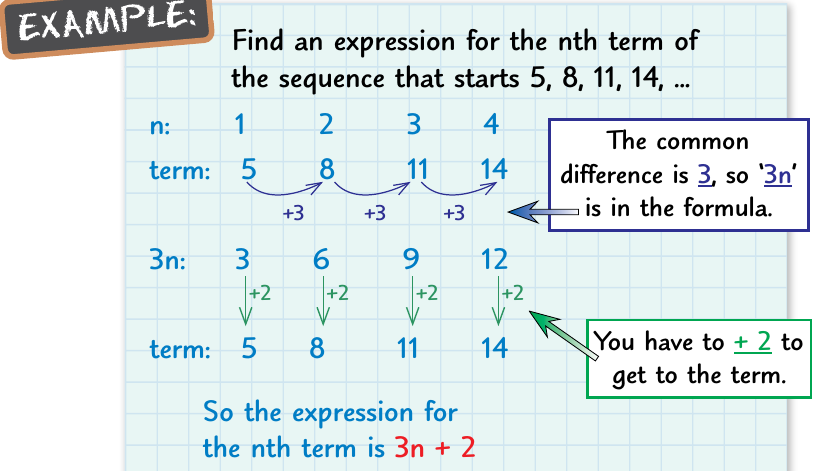
The process involves three key steps:
-
Find the common difference - Look at how much the sequence increases (or decreases) each time. This tells you what to multiply n by in your formula.
-
Work out the adjustment needed - Once you know what to multiply n by, you need to figure out what to add or subtract to get the correct terms.
-
Combine everything together - Put both parts together to create your complete nth term formula.
Important
It's crucial to always check your formula by substituting the first few values of n back into it. If you get the original sequence terms, you know your formula is correct.
Method 2: Learn the standard formula
For arithmetic sequences, there's a standard formula you can memorise and apply directly:
Where:
-
is the common difference
-
is the first term
Note
Why this formula works:
The common difference () tells you how much the sequence increases per position, and the adjustment ensures you get the correct starting value.
Working with quadratic sequences
Not all sequences are arithmetic. Some follow quadratic patterns, where the nth term involves . These require a different approach but the same checking principle applies.
Example
The nth term of a sequence is given by .
a) Find the 6th term in the sequence.
This is dead easy — just put into the expression:
So, the 6th term is 34.
b) Is 45 a term in this sequence?
Set it equal to 45:
Since is not a whole number, 45 is not in the sequence .
With quadratic sequences, you're given the formula and asked to find specific terms or determine whether certain values appear in the sequence.
Note
Quadratic vs Arithmetic Sequences:
While arithmetic sequences have a constant difference between terms, quadratic sequences have a constant second difference - the difference between the differences changes in a regular pattern.
Deciding if a term is in a sequence
Sometimes you'll be given a formula and asked whether a specific number appears in the sequence. Here's the strategy:
-
Set up an equation - Make the nth term formula equal to the value you're testing
-
Solve for n - Work out what value of n would give you that term
-
Check if n is a whole number - If n is a positive whole number, the value is in the sequence. If not, it isn't.
Important
Critical Rule: Sequence positions must be positive whole numbers (1st term, 2nd term, 3rd term, etc.). If solving the equation gives you a decimal or negative number, that position doesn't exist in the sequence.
Checking your work
Always verify your answers by substituting values back into your formula. This is one of the most important habits you can develop when working with sequences. If your formula gives you the correct terms when you substitute , , etc., you can be confident it's right.
For checking whether a term is in a sequence, make sure your arithmetic is correct when solving the equation. Double-check your calculations, especially when dealing with square roots or fractions.
Important
Common Checking Mistakes:
-
Not verifying the formula with the first few terms
-
Making arithmetic errors when solving for n
-
Forgetting that n must be a positive whole number
Summary
Key Points to Remember:
-
The nth term is a formula that lets you find any term in a sequence by substituting the position number
-
For arithmetic sequences, always identify the common difference first
-
You can use either the step-by-step method or the standard formula
-
To check if a value is in a sequence, set the formula equal to that value and solve for n
-
Always verify your formulas by substituting the first few values of n back into them