Trial and Improvement (Edexcel GCSE Maths): Revision Notes
📚Revision Notes
Trial and improvement
What is trial and improvement?
Trial and improvement is a mathematical technique used to find approximate solutions to equations that cannot be solved easily using standard algebraic methods. This method involves systematically testing different values until you narrow down to the correct answer within a specified degree of accuracy.
Important
You should only use this method when you're specifically told to do so in an exam question - don't choose it randomly when other algebraic methods would work better.
The step-by-step method
The trial and improvement process follows a systematic four-step approach that helps you gradually get closer to the correct answer:
Step 1: Start with two initial values Begin by substituting two different values into your equation. These should give you results that are on opposite sides of your target - one too big and one too small. The question will usually suggest which values to try first.
Step 2: Choose your next value Pick a value that lies between your previous two attempts. Focus on choosing something closer to whichever previous attempt gave you a result nearer to your target.
Step 3: Continue the process Keep repeating this process, always selecting new values between your closest opposite cases. You'll gradually narrow down the range until you have two values that differ by only 1 in the final digit.
Step 4: Take the exact middle value Once you have two values that bracket your answer (one slightly too big, one slightly too small), take the value exactly halfway between them. This gives you the most accurate answer possible to the required degree of accuracy.
Note
The key to success with this method is patience and systematic thinking. Each step should logically follow from your previous results, gradually closing in on the target value.
Worked example
Let's see how this works in practice with a complete step-by-step solution:
Example
Worked Example: Solving
We need to find the solution to 1 decimal place using trial and improvement.
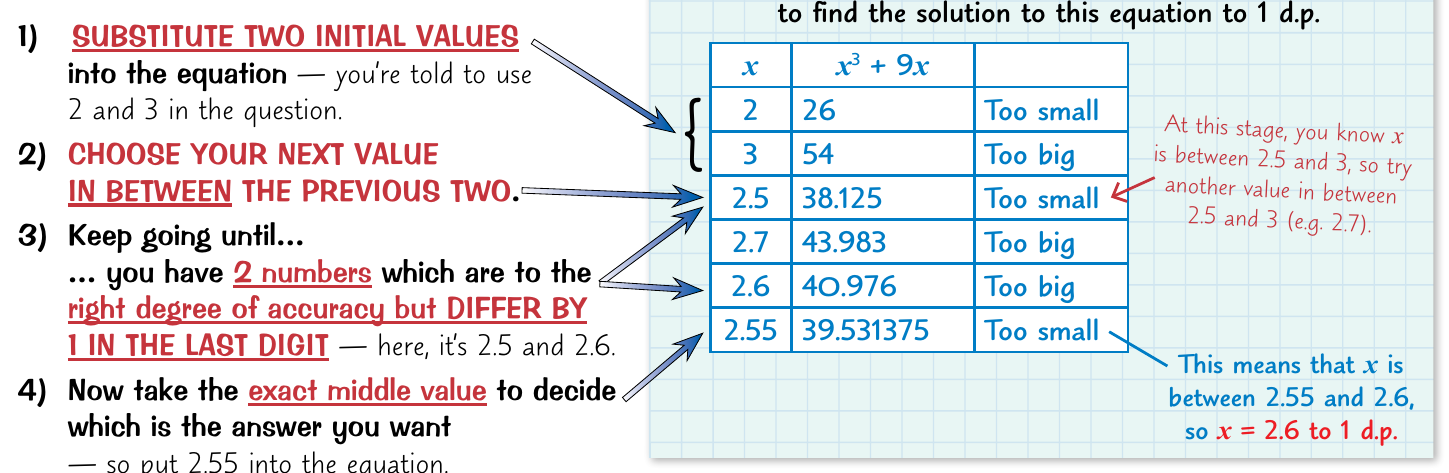
Step 1: Initial trials
- Try : (too small)
- Try : (too big)
Step 2: Narrow down Since we know the answer lies between 2 and 3, we try : (too small)
Step 3: Continue narrowing The answer is between 2.5 and 3, so we try : (too big)
Now we know it's between 2.5 and 2.7, so we try : (too big)
The answer is between 2.5 and 2.6, so we try : (too small)
Step 4: Final answer Since we have 2.55 (too small) and 2.6 (too big), and these differ by 1 in the last digit, we take the exact middle value: 2.575.
To 1 decimal place, this rounds to 2.6.
Important exam tips
Understanding the method is only half the battle - knowing how to apply it effectively in exams is equally important.
Important
Always show your working - this is crucial for gaining marks in exams. Create a clear table showing your values, the calculated results, and whether each result is too big or too small.
Note
Use a systematic approach - don't guess randomly. Always choose your next value logically based on your previous results. This demonstrates mathematical thinking and helps you avoid costly mistakes.
Important
Check your accuracy - make sure you're working to the correct number of decimal places as specified in the question. A common mistake is giving your final answer to the wrong degree of accuracy.
Note
Keep track of your progress - maintaining an organised table helps you see the pattern and avoid making mistakes. It also makes it easier for examiners to follow your working and award marks.
Remember!
Summary
Key Points to Remember:
- Trial and improvement finds approximate solutions to equations that are difficult to solve algebraically
- Always use this method only when specifically instructed to do so in exam questions
- Follow the systematic four-step process: start with opposites, choose between them, continue narrowing down, then take the middle value
- Show all your working clearly in a table format to gain maximum marks
- The method works by gradually narrowing down the range until you reach the required degree of accuracy