Areas (Edexcel GCSE Maths): Revision Notes
📚Revision Notes
Areas
Understanding how to calculate areas is essential for GCSE mathematics. This topic covers everything from basic triangles to complex composite shapes and circles. Let's work through the key concepts and formulas you need to master.
Areas of triangles and quadrilaterals
When calculating areas of triangles and quadrilaterals, there's one fundamental principle that applies to all shapes in this category.
Important
The most important thing to remember is that you must always use the vertical height - this is the perpendicular distance, not the sloping height. This is a common source of errors in exam questions.
Triangle area
The area of any triangle can be found using the base and the perpendicular height drawn to that base.
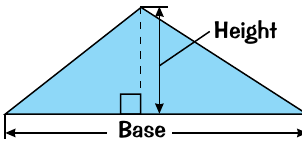
The formula for triangle area is:
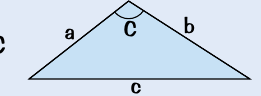
Note
There's also an alternative formula that uses trigonometry, which you might encounter later: , where and are two sides and is the angle between them.
Parallelogram area
A parallelogram's area is calculated by multiplying the base by the vertical height. Notice this is similar to a rectangle, but we must use the perpendicular height, not the slanted side.
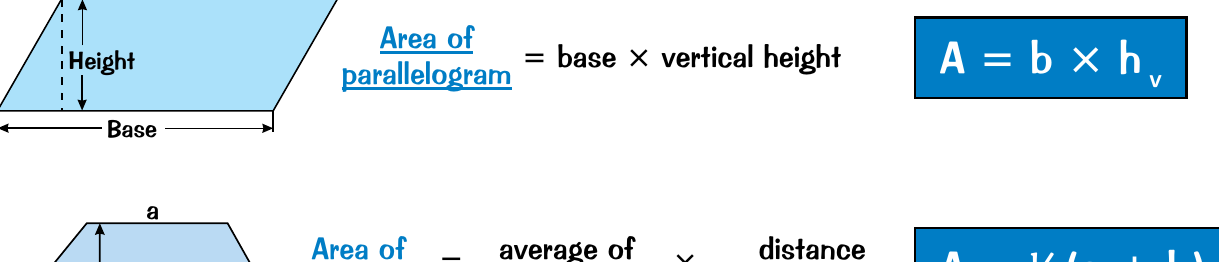
Note
Think of this as "pushing" a parallelogram into a rectangle - the area remains the same, but we need the perpendicular height to calculate it correctly.
Trapezium area
A trapezium (or trapezoid) has two parallel sides. To find its area, we use the average of the parallel sides multiplied by the distance between them.
Here, '' and '' are the lengths of the parallel sides, and the vertical height is the perpendicular distance between them.
Working with composite shapes
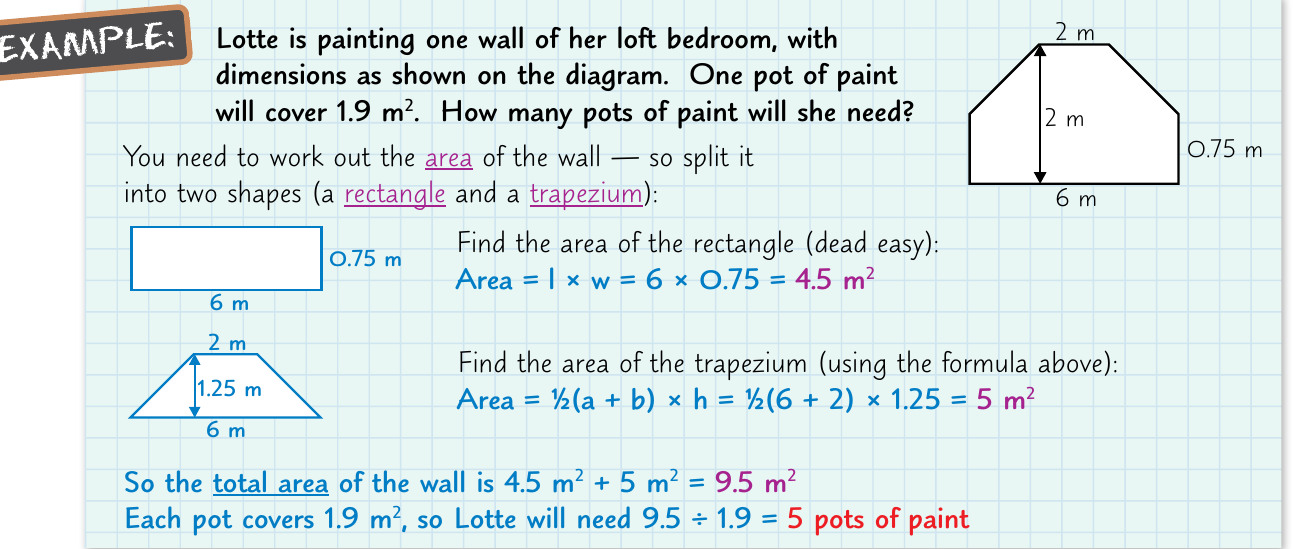
Many real-world problems involve composite shapes - these are made up of different basic shapes joined together. The key strategy is to break them down into simpler shapes that you can calculate separately.
Note
Strategy for Composite Shapes:
When tackling composite shapes, follow these systematic steps:
- Identify the basic shapes within the composite shape
- Work out the area of each basic shape separately
- Add up all the individual areas to get the total area
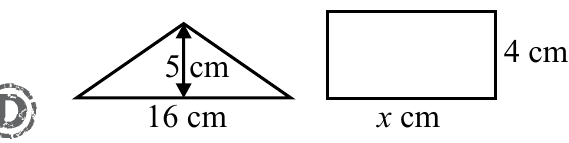
For example, if you have a house-shaped wall, you might split it into a rectangle for the main wall and a triangle for the roof section. Calculate each area using the appropriate formula, then add them together.
Areas and circumference of circles
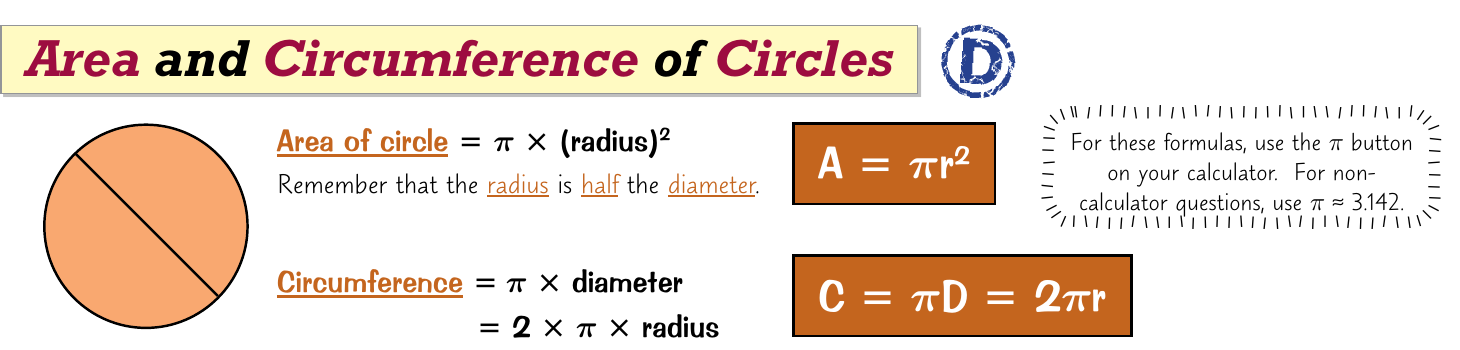
Circle calculations involve the mathematical constant π (pi). Understanding when and how to use π is crucial for both calculator and non-calculator questions.
Note
Working with π:
- For calculator problems, use the π button on your calculator
- For non-calculator questions, you can use π ≈ 3.142
Circle area
The area of a circle depends on its radius (remember that radius is half the diameter):
Circumference
The circumference is the distance around the outside of the circle:
where is the diameter and is the radius.
Areas of sectors and segments
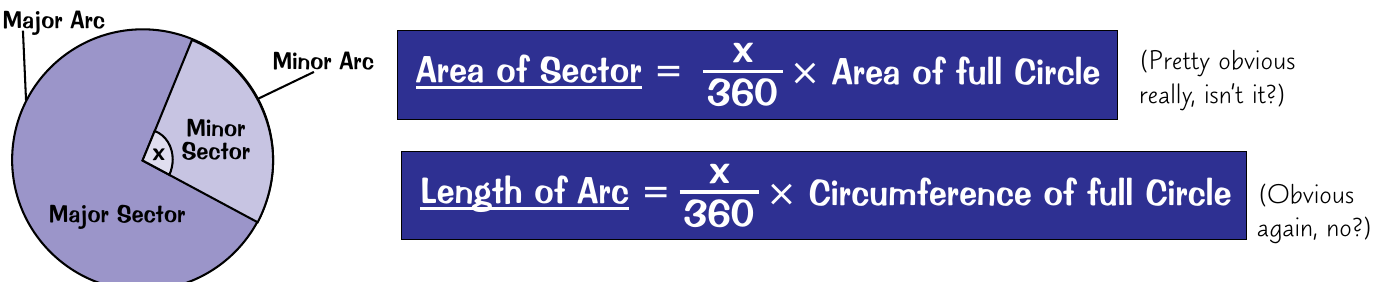
Working with parts of circles requires understanding sectors, arcs, and segments. These calculations are based on the proportion of the full circle.
Sectors and arcs
A sector is like a slice of pie - it's a portion of the circle bounded by two radii and an arc. The formulas for sectors are based on the fraction of the full circle:
where is the angle at the centre in degrees.
Segments
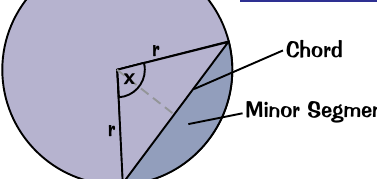
A segment is the area between a chord and the arc it cuts off.
Example
Worked Example: Finding the Area of a Segment
To find the area of a segment, follow these steps:
Step 1: Calculate the area of the sector using the formula above
Step 2: Calculate the area of the triangle formed by the two radii and the chord
Step 3: Subtract the triangle area from the sector area
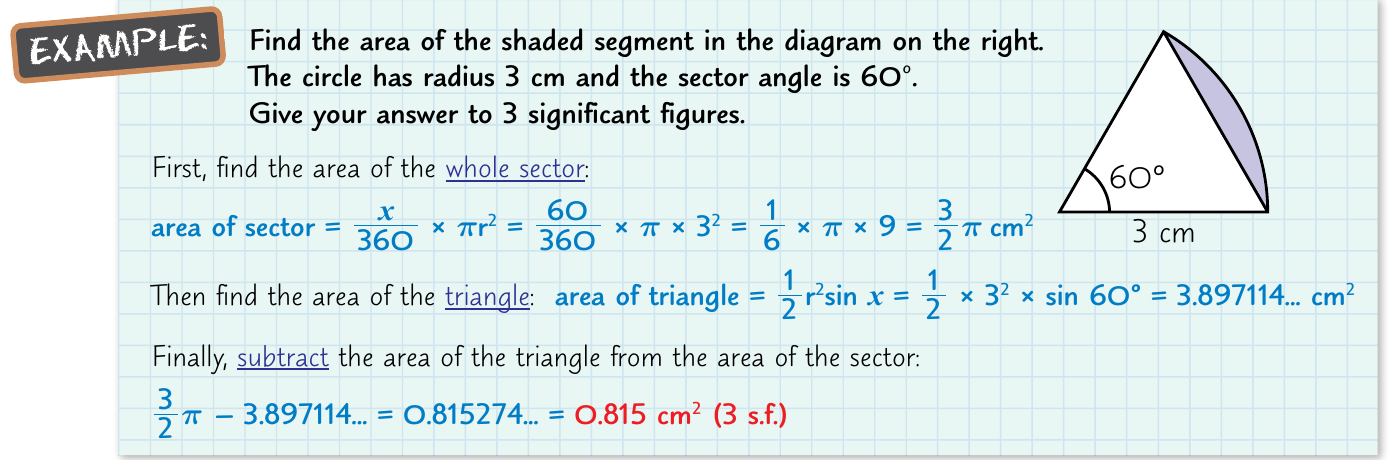
This process involves using trigonometry for the triangle area, typically using the formula: , where is the radius and is the angle.
Important reminders about perimeters
Important
Common Mistake Alert:
When calculating perimeters of semicircles or quarter circles, don't forget to include the straight edges as well as the curved parts. This is a common mistake that can cost you marks.

For a semicircle, the perimeter includes the curved part () plus the diameter.
Summary
Key Points to Remember:
- Always use vertical height for area calculations, not sloping measurements
- Break down composite shapes into simpler triangles, rectangles, and other basic shapes
- For circles, Area = πr² and Circumference = 2πr or πD
- Sector areas and arc lengths are proportional to the angle: multiply by (x/360)
- Segment area = Sector area - Triangle area
- Don't forget to include straight edges when calculating perimeters of semicircles and quarter circles