Geometry (Edexcel GCSE Maths): Revision Notes
📚Revision Notes
Fundamental angle properties in geometry
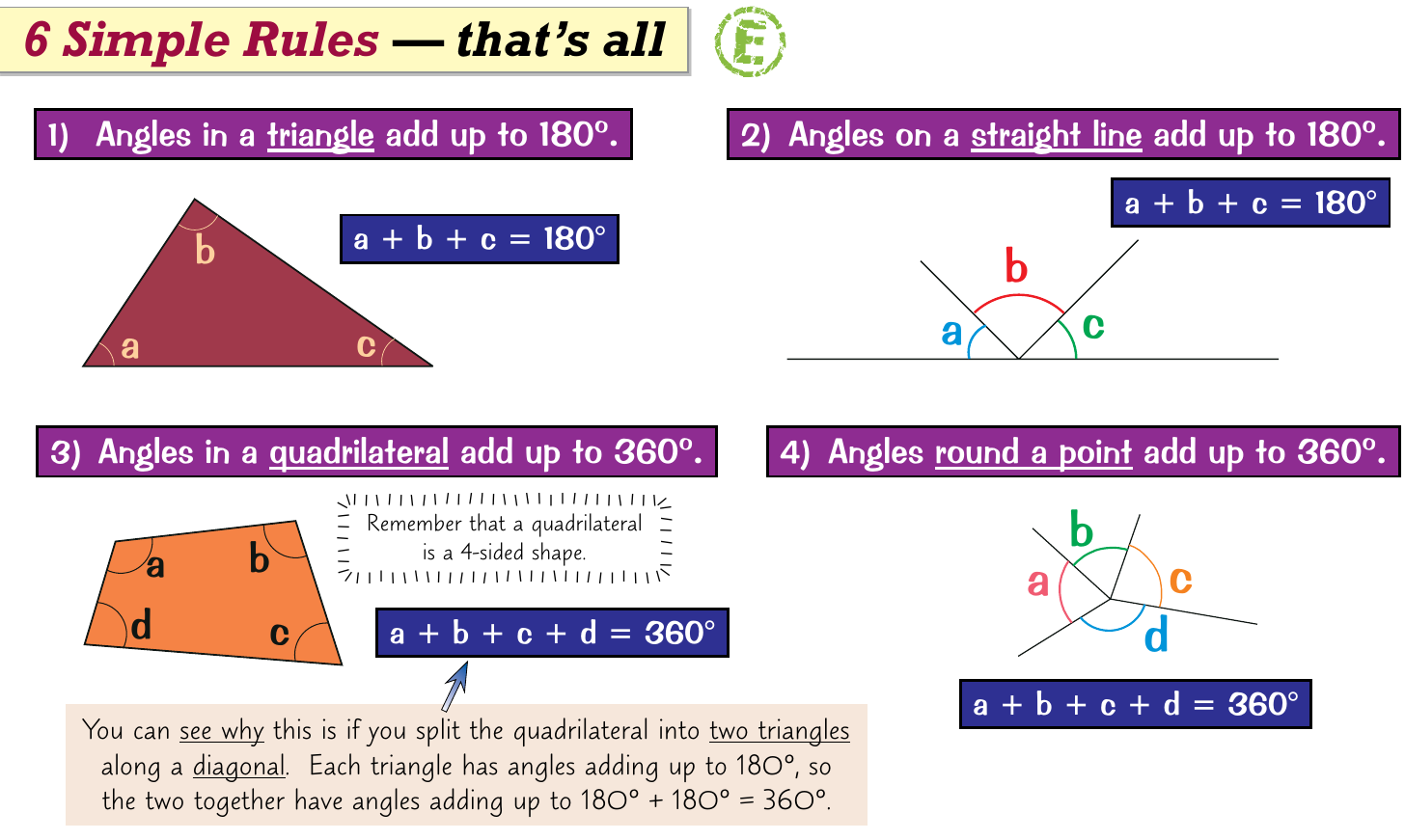
Understanding angle relationships is crucial for solving geometric problems. These six essential rules form the foundation of angle calculations in GCSE geometry. Master these thoroughly and you'll be well-equipped to tackle any angle-related question.
Note
These fundamental angle properties are the building blocks of geometry. Every complex geometric problem can be broken down using these six rules, so understanding them thoroughly is essential for success.
Triangle angle sum
Every triangle, regardless of its shape or size, has interior angles that total exactly 180°. This fundamental property applies to all triangles - whether they're equilateral, isosceles, or scalene.
Important
The triangle angle sum property is one of the most fundamental rules in geometry. Remember: for ANY triangle. This rule has no exceptions and forms the basis for many other geometric proofs.
When working with triangles, if you know two angles, you can always find the third by subtracting the sum of the known angles from 180°.
Angles on a straight line
When two or more angles sit adjacent to each other on a straight line, they will always sum to 180°. This makes sense because a straight line represents half of a full rotation around a point.
Note
Think of a straight line as half a circle - since a full circle is 360°, a straight line (half a circle) must be 180°. This mental image helps remember why angles on a straight line sum to 180°.
This rule is particularly useful when dealing with angles formed by intersecting lines or when working with supplementary angles.
Quadrilateral angle sum
The interior angles of any four-sided shape (quadrilateral) always total 360°. This includes squares, rectangles, parallelograms, trapeziums, and irregular quadrilaterals.
Example
Understanding Why Quadrilaterals Sum to 360°
Step 1: Take any quadrilateral and draw a diagonal Step 2: Notice this creates two triangles Step 3: Each triangle has angles totalling 180° Step 4: Therefore:
This explains why for any quadrilateral.
You can understand why this works by splitting any quadrilateral into two triangles using a diagonal. Since each triangle has angles totalling 180°, the quadrilateral must have angles totalling .
Angles around a point
When several angles meet at a single point, they create a complete rotation, which measures 360°. This is equivalent to a full circle around that point.
Note
Imagine standing at the point and rotating through all the angles - you complete exactly one full turn, which is 360°. This is the same as the degrees in a complete circle.
This rule is essential when dealing with angles formed by multiple lines intersecting at a common point.
Exterior angle theorem
When you extend one side of a triangle, you create an exterior angle. This exterior angle has a special relationship with the interior angles of the triangle.

Important
Exterior Angle Theorem: The exterior angle equals the sum of the two opposite interior angles (the two angles that don't share a vertex with the exterior angle).
In mathematical terms: where is the exterior angle and , are the opposite interior angles.
This relationship can be proven using the fact that angles in a triangle sum to 180° and angles on a straight line also sum to 180°.
Isosceles triangles
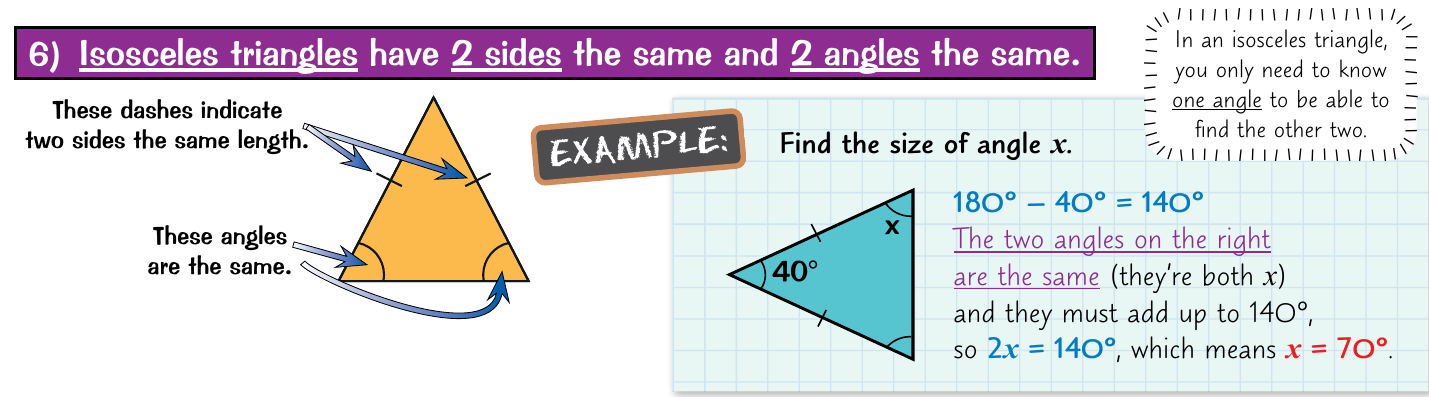
Isosceles triangles have two sides of equal length, which creates two equal angles opposite these equal sides. This property makes calculating unknown angles in isosceles triangles much simpler.
Example
Finding Angles in an Isosceles Triangle
Given: An isosceles triangle with one angle of 140°
Step 1: Identify which angle is given (the different one or one of the equal ones) Step 2: Since the triangle is isosceles, two angles are equal Step 3: If 140° is one of the equal angles, then: , so Step 4: The remaining angle = (This is impossible!) Step 5: Therefore, 140° must be the different angle Step 6: The two equal angles = each
When you know just one angle in an isosceles triangle, you can determine the other two. If you know one of the equal angles, the other equal angle is the same value. If you know the different angle, you can find each of the equal angles by subtracting the known angle from 180° and dividing by 2.
Summary
Key Points to Remember:
- Triangle angles always sum to 180° - no exceptions
- Straight line angles total 180° - think of it as half a circle
- Quadrilateral angles sum to 360° - double that of a triangle
- Angles around a point complete a full 360° rotation
- An exterior angle of a triangle equals the sum of the two opposite interior angles
- Isosceles triangles have two equal sides and two equal angles - knowing one angle lets you find the others