Loci and Constructions — Worked Examples (Edexcel GCSE Maths): Revision Notes
📚Revision Notes
Loci and constructions — worked examples
When you understand what loci are and how to perform individual constructions, the next step is combining them to solve more complex problems. In examinations, you'll often encounter questions that require you to find regions satisfying multiple conditions simultaneously.
Note
The term "loci" is the plural of "locus" - a set of points that satisfy a particular condition. Understanding this concept is fundamental to solving complex geometric problems.
Finding regions that satisfy multiple conditions
The key strategy for tackling these problems is straightforward: draw each individual locus first, then identify the area where all conditions overlap. This systematic approach ensures you don't miss any requirements and helps you visualise the solution clearly.
When faced with multiple conditions, it's essential to work methodically rather than trying to solve everything at once. This prevents errors and makes the problem much more manageable.
Example
Method for Combining Multiple Loci:
Step 1: Read through all the conditions carefully Step 2: Draw each locus separately using the appropriate construction techniques Step 3: Identify the region where all loci intersect or overlap Step 4: Shade or mark this region as your final answer
Example 1: Square with distance and proximity conditions
Consider a square where you need to find points that are within 3 cm of one vertex and closer to another vertex than to a third vertex.
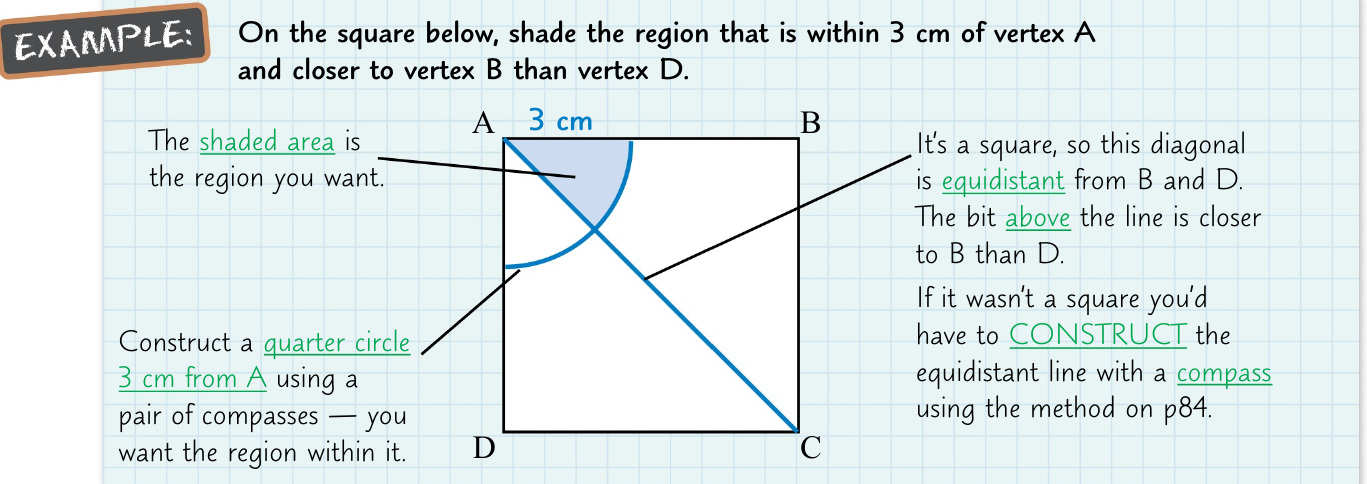
For this type of problem, you need to combine two different loci: a quarter circle representing all points within 3 cm of vertex A, and a perpendicular bisector line showing points equidistant from vertices B and D.
Example
Worked Example: Square with Multiple Conditions
Given: Square ABCD with two conditions to satisfy simultaneously
Condition 1: Points within 3 cm of vertex A
- Use compasses set to 3 cm radius from point A
- Draw a quarter circle (only the part inside the square is relevant)
Condition 2: Points closer to vertex B than to vertex D
- Draw the perpendicular bisector of line segment BD
- The diagonal of the square conveniently serves as this perpendicular bisector
- Points closer to B are on one side, points closer to D are on the other
Solution: The shaded region shows where both conditions are satisfied - points that are both within 3 cm of A AND closer to B than to D.
Example 2: Ice cream van positioning problem
This example demonstrates a practical application where an ice cream van must satisfy multiple location constraints.
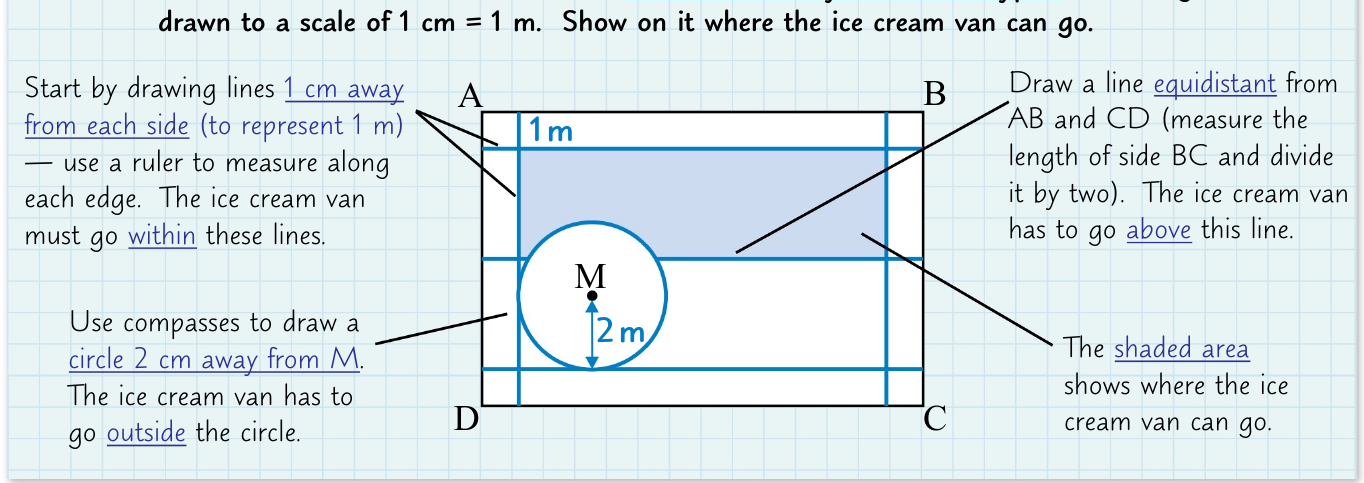
The van must be positioned so that it meets several requirements simultaneously. This type of real-world application shows how loci concepts apply beyond pure mathematics.
Example
Worked Example: Ice cream van location
The van must be positioned so that it is:
- At least 1 metre away from each edge of the rectangular field
- Closer to side AB than to side CD
- At least 2 metres away from a maypole at point M
Step-by-step solution:
Step 1: Draw lines 1 metre inside each edge of the rectangle (minimum distance requirement) Step 2: Draw the perpendicular bisector of the rectangle to show points equidistant from AB and CD Step 3: Draw a circle with radius 2 metres centred at M (the van must be outside this circle)
Result: The shaded region shows where all three conditions are satisfied simultaneously.
Example 3: Garden visiting problem
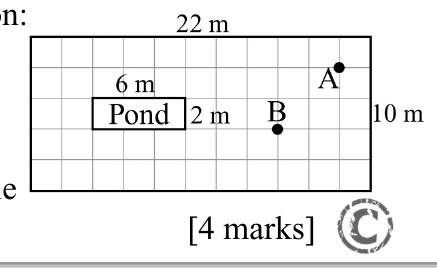
This examination-style question involves a rectangular area with a pond and specific visiting constraints.
Example
Worked Example: Garden visiting constraints
Problem type: Rectangular area with pond and distance constraints
Key skill: Applying loci concepts to real-world scenarios with multiple geometric constraints
Method: Follow the standard approach - identify each condition, draw the corresponding locus, then find the intersection region where all conditions are met.
Important construction tips
Understanding the theory is only half the battle - accurate construction technique is equally important for success in examinations.
Accuracy is essential
Important
Always use proper geometric tools - a ruler and pair of compasses - for all constructions. Freehand drawing or estimation will not earn full marks in examinations. The precision of your construction directly affects the accuracy of your final answer.
Leave construction lines visible
When questions ask you to "leave your construction lines clearly visible", ensure you don't erase the arcs and lines used in your construction process. These show the examiner your method and can earn you marks even if your final answer has minor errors.
Note
Construction lines are like showing your working in algebra - they demonstrate your understanding of the process and can earn partial credit even when the final answer isn't perfect.
Right angles and measurement
In many examples, lines meet at right angles, which allows you to use a ruler for measuring rather than compasses for construction. However, always read the question carefully - if it specifically asks for constructions to be shown, you must use the appropriate geometric methods.
Word problems require interpretation
Some questions present the mathematical requirements within a story or practical context. Take time to identify what geometric conditions are actually being described, then proceed with the standard loci construction methods.
Important
Common mistake to avoid: Don't get distracted by the story context in word problems. Focus on identifying the geometric conditions, then apply the same construction techniques you would use for any loci problem.
Summary
Key Points to Remember:
- Always draw each locus separately before finding their intersection
- Use ruler and compasses for accurate constructions, not freehand sketching
- Leave construction lines visible when specifically requested
- The shaded region represents where ALL conditions are satisfied simultaneously
- Word problems still require the same geometric construction techniques - just identify the conditions first