More Transformation Stuff (Edexcel GCSE Maths): Revision Notes
📚Revision Notes
More transformation stuff
This section covers advanced transformation concepts that build on basic transformations. You'll learn how to work with multiple transformations and understand how enlargements affect different measurements.
Combinations of transformations
Sometimes you might need to apply several transformations one after another to the same shape. The good news is that these multiple transformations can often be replaced by a single, equivalent transformation.
When examiners ask you to perform two transformations on the same shape, they usually want you to find the single transformation that would produce the same final result. This approach is much more efficient than working through each step separately.
Note
The key insight is that you can ignore the intermediate shape and focus on comparing the original and final positions when finding the equivalent single transformation.
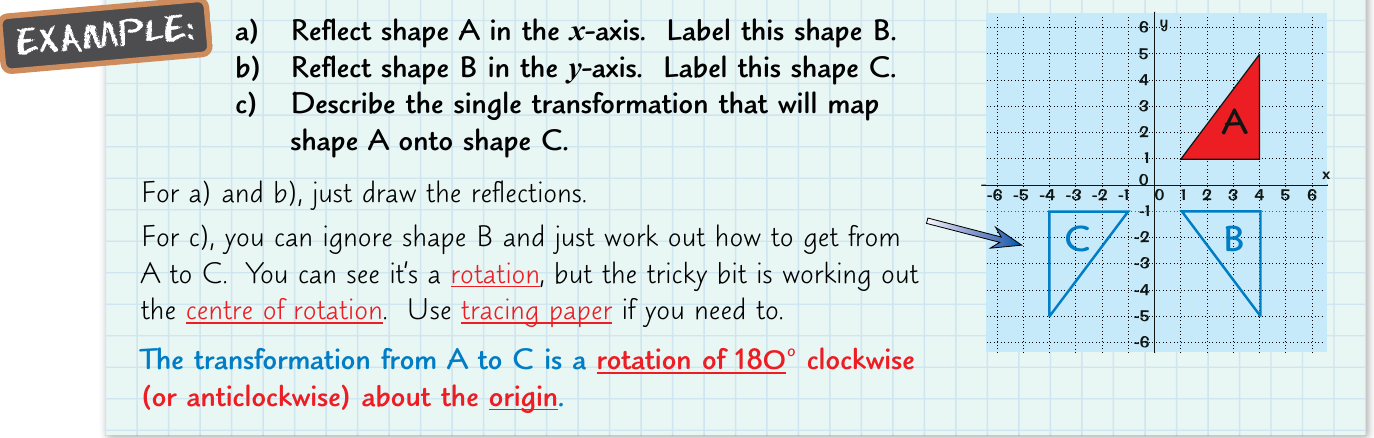
Let's look at how this works with a practical example. If you reflect shape A across the x-axis to create shape B, then reflect shape B across the y-axis to create shape C, you can find one transformation that takes you directly from A to C.
For the first two parts of such problems, you simply draw the reflections as requested. However, for finding the single transformation, you can ignore the intermediate shape and focus on comparing the original and final positions.
Example
Worked Example: Finding the Single Transformation
When you perform two reflections in sequence (first across the x-axis, then across the y-axis), the result is actually a rotation of 180° about the origin.
You can verify this by using tracing paper to check how the original shape needs to move to reach its final position.
Important
Common Mistake to Avoid: Don't try to work through each transformation step by step when finding the equivalent single transformation. Instead, compare the original and final positions directly.
How enlargement affects area and volume
When you enlarge a shape using a scale factor, different measurements change in different ways. This is crucial to understand for solving problems involving similar shapes.
The fundamental rule is that for a scale factor of :
- All lengths become times bigger
- All areas become times bigger
- All volumes become times bigger
This happens because area involves two dimensions (length × width), while volume involves three dimensions (length × width × height). Each dimension gets multiplied by the scale factor, so the overall effect is multiplied accordingly.
Note
Remember: the powers increase with dimensions - length (), area (), volume (). This pattern helps you remember which formula to use.
You can use these relationships to solve problems involving similar shapes. For example, if you know the surface areas of two similar cylinders, you can find the scale factor by taking the square root of the area ratio. Once you have the scale factor, you can find unknown volumes by cubing it.
Example
Worked Example: Cylinder Scale Factor Problem
If cylinder A has surface area cm² and cylinder B has surface area cm², the scale factor is:
This means cylinder B's volume will be times larger than cylinder A's volume.
If cylinder A has volume cm³, then cylinder B has volume:
Working with scale factors
To find the scale factor between two similar shapes, you can use any corresponding measurements:
- Scale factor =
- Scale factor =
- Scale factor =
Remember that the scale factor tells you how much bigger the new shape is compared to the original. Once you know the scale factor, you can find any missing measurement by applying the appropriate relationship.
Important
Essential Formula Relationships:
Summary
Key Points to Remember:
- Multiple transformations can often be replaced by a single equivalent transformation
- For scale factor : lengths scale by , areas by , and volumes by
- To find a scale factor, divide corresponding measurements or use square/cube roots for areas/volumes
- When working with combinations of transformations, focus on comparing the original and final positions
- Always check your scale factor calculations by verifying that the relationships make sense