Polygons (Edexcel GCSE Maths): Revision Notes
📚Revision Notes
Polygons
What is a polygon?
A polygon is a shape with multiple straight sides that are connected to form a closed figure. These shapes can be classified into two main types: regular and irregular polygons.
A regular polygon has all sides of equal length and all angles of equal measure. Think of it as a perfectly symmetrical shape where every side and angle is identical.
An irregular polygon has sides of different lengths and angles of different measures. These shapes don't have the same symmetry as regular polygons.
Note
The key difference between regular and irregular polygons is uniformity. Regular polygons have perfect symmetry, while irregular polygons can have sides and angles of varying sizes. This distinction is crucial when applying angle formulas later.
Common polygon names
You need to be familiar with the names of polygons based on their number of sides, particularly those with 3 to 10 sides. Here's what you need to know:
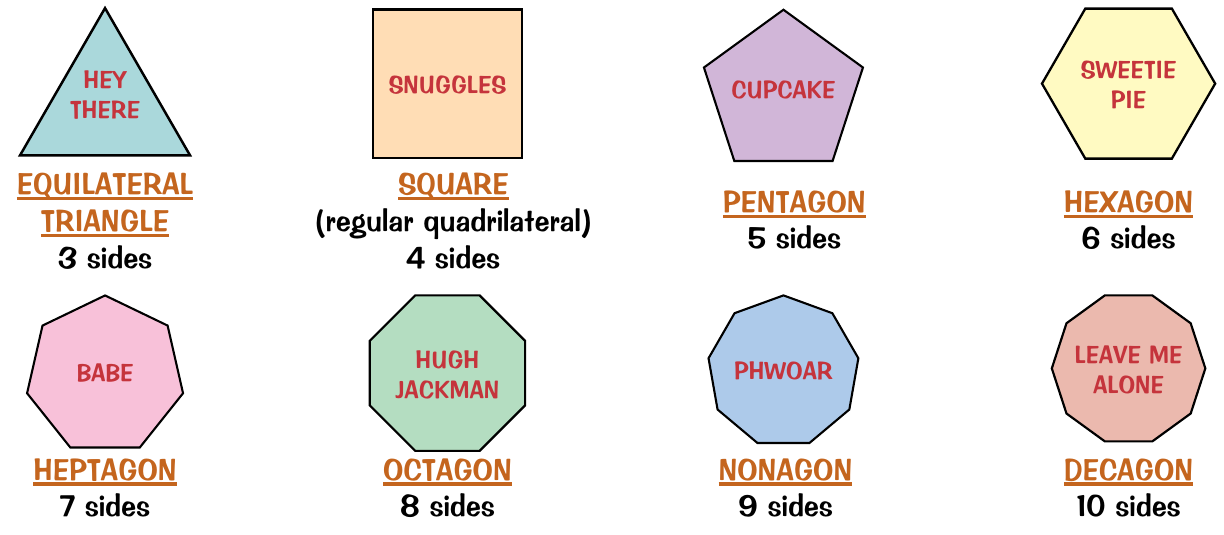
- Triangle (3 sides) - The simplest polygon
- Square (4 sides) - Also called a regular quadrilateral
- Pentagon (5 sides) - Think of the Pentagon building in America
- Hexagon (6 sides) - Like the shape of a honeycomb cell
- Heptagon (7 sides) - Less common but still important
- Octagon (8 sides) - Like a stop sign
- Nonagon (9 sides) - Sometimes called enneagon
- Decagon (10 sides) - The largest you typically need to know
Remember that in a regular polygon, all sides and angles are equal, whilst in an irregular polygon, the sides and angles can be different.
Note
Memory tip: Many of these names have roots in Greek or Latin numbers. For example, "pentagon" comes from "penta" (five) and "gon" (angle). Understanding these roots can help you remember the names more easily.
Interior and exterior angles
Understanding polygon angles is crucial for solving geometry problems. There are important formulas you need to learn that apply to different types of polygons.
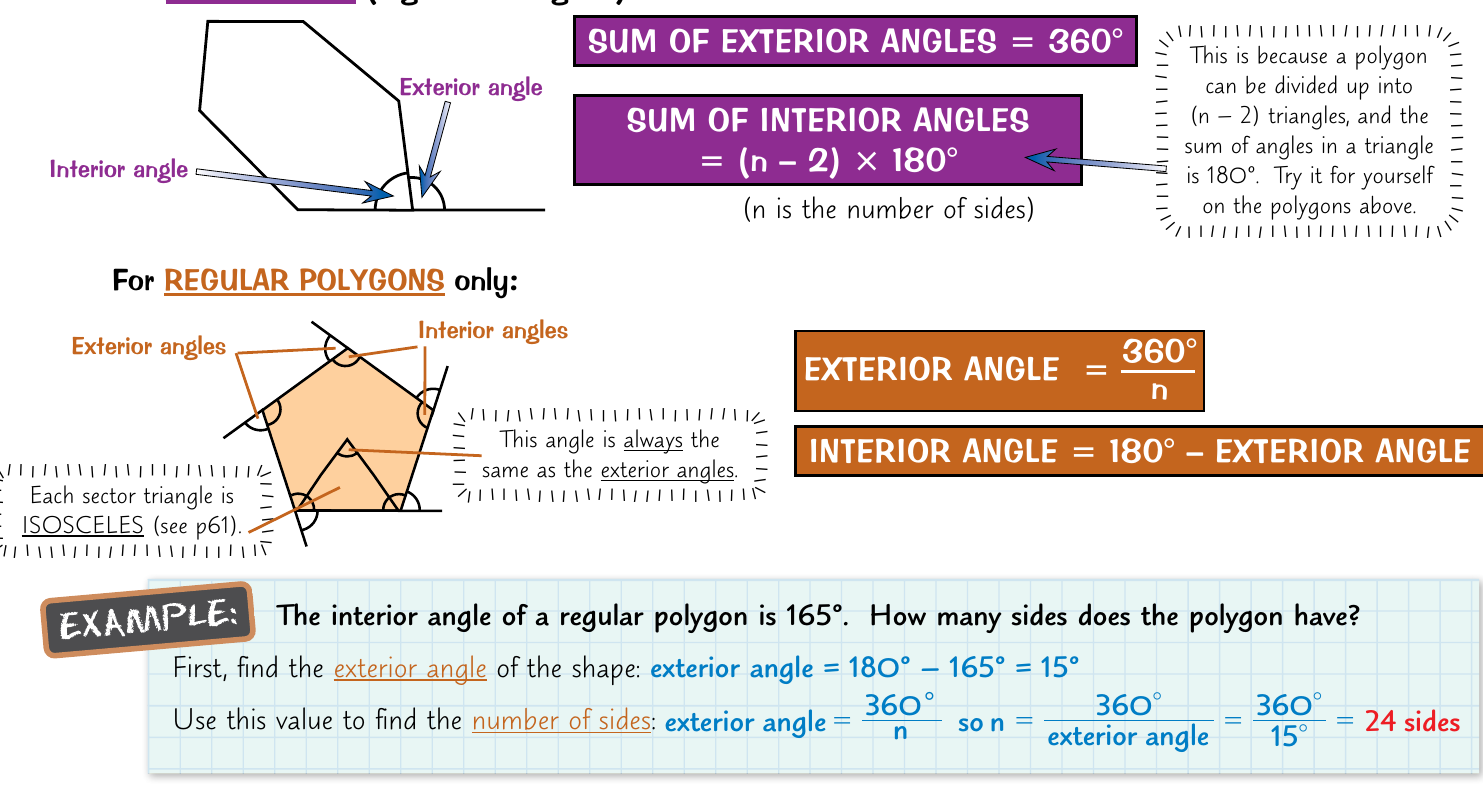
For any polygon (regular or irregular)
The sum of exterior angles in any polygon is always the same, regardless of the number of sides:
The sum of interior angles depends on the number of sides:
Where represents the number of sides in the polygon.
Important
Critical concept: The exterior angle sum is ALWAYS 360° for any polygon, no matter how many sides it has. This is a fundamental property that never changes.
For regular polygons only
Since all angles are equal in regular polygons, we can find individual angles:
These formulas work because the interior and exterior angles at each vertex are supplementary (they add up to 180°).
Working with angle problems
Let's look at how to use these formulas in practice. If you're given the interior angle of a regular polygon and need to find the number of sides, follow these steps:
Example
Worked Example: Finding the Number of Sides
Problem: A regular polygon has an interior angle of 165°. How many sides does it have?
Solution: Step 1: Find the exterior angle using: exterior angle = 180° - interior angle
Step 2: Find the number of sides using:
Answer: The polygon has 24 sides.
This method works because exterior angles must divide evenly into 360° for a regular polygon to exist.
Key concepts to remember
The reason these formulas work is based on fundamental geometric principles. Any polygon can be divided into triangles by drawing lines from one vertex to all non-adjacent vertices. Since each triangle has angles that sum to 180°, and you can make triangles from an -sided polygon, the total interior angle sum becomes .
For exterior angles, imagine walking around the perimeter of any polygon and measuring how much you turn at each corner. By the time you return to your starting point, you will have turned through a complete circle, which is 360°.
Note
Understanding the geometry: The in the interior angle formula represents the number of triangles you can form inside a polygon. A triangle (3 sides) forms 1 triangle, a square (4 sides) forms 2 triangles, and so on. This visual approach helps explain why the formula works.
Summary
Key Points to Remember:
- A polygon is a many-sided shape that can be regular (equal sides and angles) or irregular (unequal sides and angles)
- Learn the names of polygons from triangle (3 sides) to decagon (10 sides)
- The sum of exterior angles in any polygon is always 360°
- The sum of interior angles follows the formula
- For regular polygons, divide the totals by the number of sides to find individual angles
- Interior and exterior angles at each vertex are supplementary (add up to 180°)