Similar Shapes (Edexcel GCSE Maths): Revision Notes
📚Revision Notes
Similar shapes
What are similar shapes?
Similar shapes are figures that have exactly the same shape but can be different sizes. Think of them as shapes from the same family - they look alike but one might be bigger or smaller than the other. Similar shapes can also be rotated or reflected versions of each other.
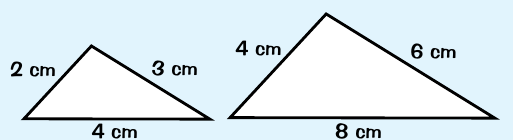
The key thing to remember is that similar shapes maintain their proportions. If you imagine enlarging or shrinking a shape uniformly, you get a similar shape.
Note
When working with similar shapes, remember that they can appear in different orientations. A shape might be rotated, flipped, or turned upside down and still be similar to the original!
Properties of similar shapes
The most important property of similar shapes is that they have identical angles. Every angle in one shape matches perfectly with the corresponding angle in the similar shape.
Important
Essential conditions for similar shapes:
For shapes to be similar, two conditions must be met:
- All corresponding angles must be equal
- All corresponding sides must be proportional (in the same ratio)
Both conditions must be satisfied - having just one is not enough!
Special conditions for similar triangles
Triangles have three special conditions that can prove they're similar. If any one of these conditions is true, you can be certain the triangles are similar:
Condition 1: All angles match
When all three angles in one triangle are the same as the three angles in another triangle, the triangles are similar. You only need to check that the angles correspond correctly.
Condition 2: All three sides are proportional
If you can show that all three sides of one triangle are in the same ratio to the corresponding sides of another triangle, then the triangles are similar.
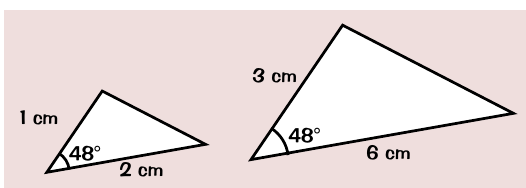
Condition 3: Two sides are proportional with the same included angle
When two sides of one triangle are proportional to two sides of another triangle, and the angle between these sides is the same in both triangles, the triangles are similar.
Important
Warning about orientations: Be careful if one triangle appears to be rotated or flipped - they might still be similar, but don't be fooled by their different orientations! Always check the conditions systematically.
Working with scale factors
The scale factor is a crucial concept when dealing with similar shapes. It tells you how much bigger or smaller one shape is compared to another.
Finding the scale factor
To find the scale factor, you need to compare corresponding sides between the two similar shapes:
Note
The scale factor is always calculated using corresponding sides. Make sure you're comparing the right sides between the two shapes!
Using scale factors to find missing sides
Once you know the scale factor, you can find any missing side length by multiplying the corresponding known side by the scale factor.
Worked examples
Example
Worked Example 1: Triangle similarity
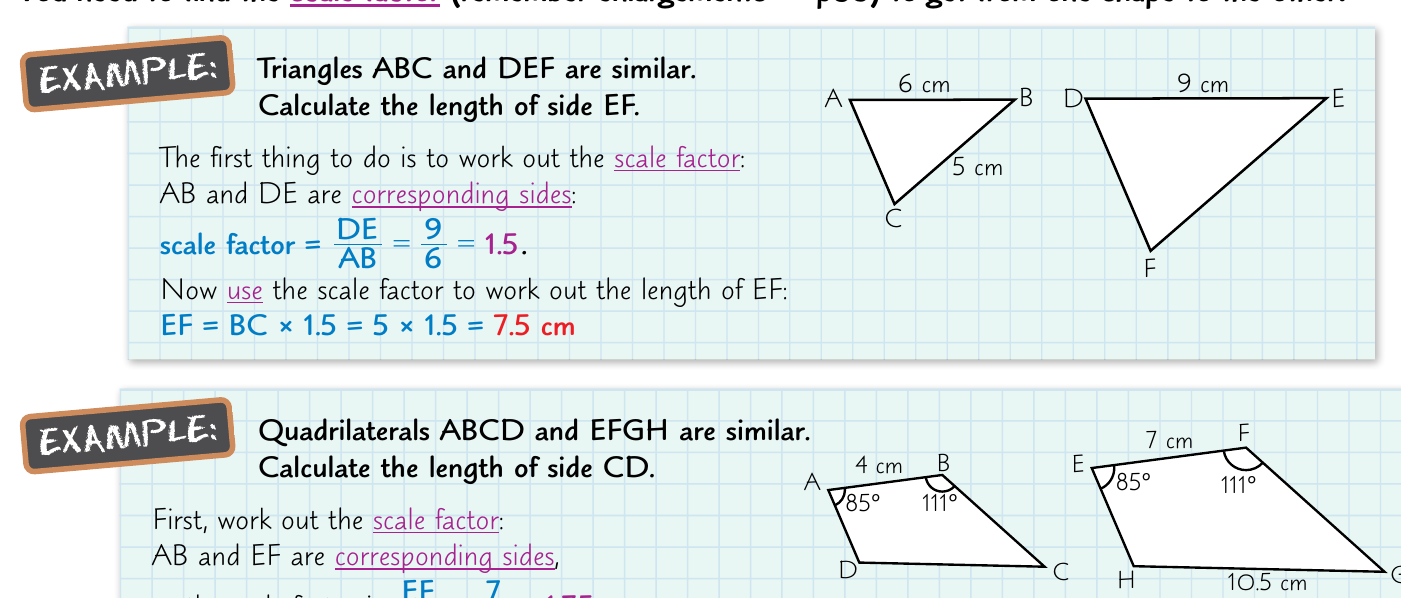
When triangles ABC and DEF are similar, and you know that AB = 6 cm, BC = 5 cm, and DE = 9 cm, you can find the missing side EF.
Step 1: Calculate the scale factor using corresponding sides
Step 2: Use this scale factor to find the missing side
Example
Worked Example 2: Quadrilateral similarity
For similar quadrilaterals ABCD and EFGH, when you know AB = 4 cm, EF = 7 cm, and GH = 10.5 cm, you can find CD.
Step 1: Calculate the scale factor
Step 2: Find CD by working backwards Since you're going from the larger shape to the smaller one, you divide:
Summary
Key Points to Remember:
- Similar shapes have the same shape but different sizes - they're like family members who look alike
- Similar shapes always have identical corresponding angles
- All corresponding sides in similar shapes are proportional
- For triangles, you only need to prove one of three conditions: all angles match, all sides are proportional, or two sides are proportional with the same included angle
- Scale factor = , and you can use it to find missing sides by multiplication or division