Surface Area (Edexcel GCSE Maths): Revision Notes
📚Revision Notes
Surface area
What is surface area?
Surface area is a fundamental concept in geometry that measures the total area of all the outer surfaces of a three-dimensional object. Think of it as the amount of material you would need to completely cover the outside of a 3D shape. For solid objects, surface area represents the sum of all the individual face areas added together.
Note
Imagine wrapping a present - the surface area would be the total amount of wrapping paper needed to cover the entire object completely.
Understanding surface area becomes much easier when you first grasp the concept of nets, which provide a visual foundation for these calculations.
Understanding nets
A net is simply a hollow 3D shape that has been unfolded and laid out flat on a two-dimensional surface. When you imagine cutting along the edges of a 3D shape and flattening it out, you create its net. This flattened pattern shows all the faces of the original shape in a way that makes it easy to calculate the total surface area.
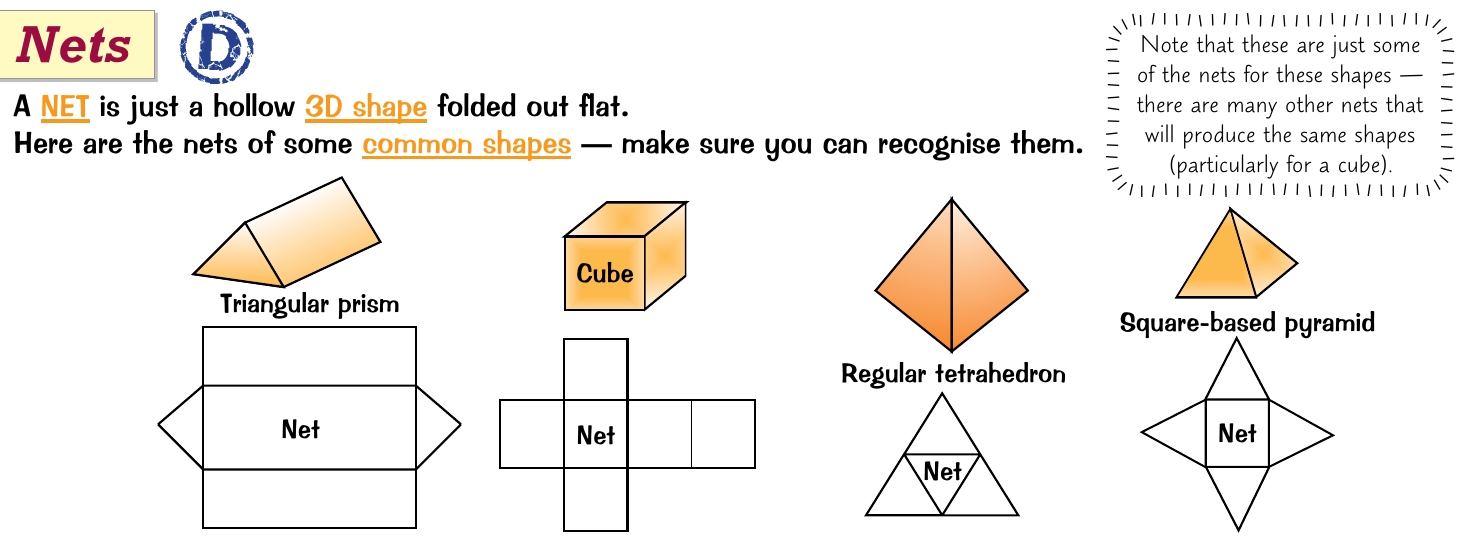
Different 3D shapes have characteristic net patterns. For example, a cube unfolds into a cross-shaped pattern, while a triangular prism creates a net with rectangular and triangular sections. It's important to remember that many 3D shapes can be unfolded in multiple ways, so you might see different net arrangements for the same shape.
Important
Key Insight: The surface area of any 3D shape equals the total area of its net when laid flat. This connection makes surface area calculations much more intuitive and manageable.
Surface area formulas for common shapes
Learning the surface area formulas for standard 3D shapes is essential for GCSE success. Each formula accounts for the specific geometry of the shape, including both curved surfaces and flat faces where applicable.
Sphere surface area
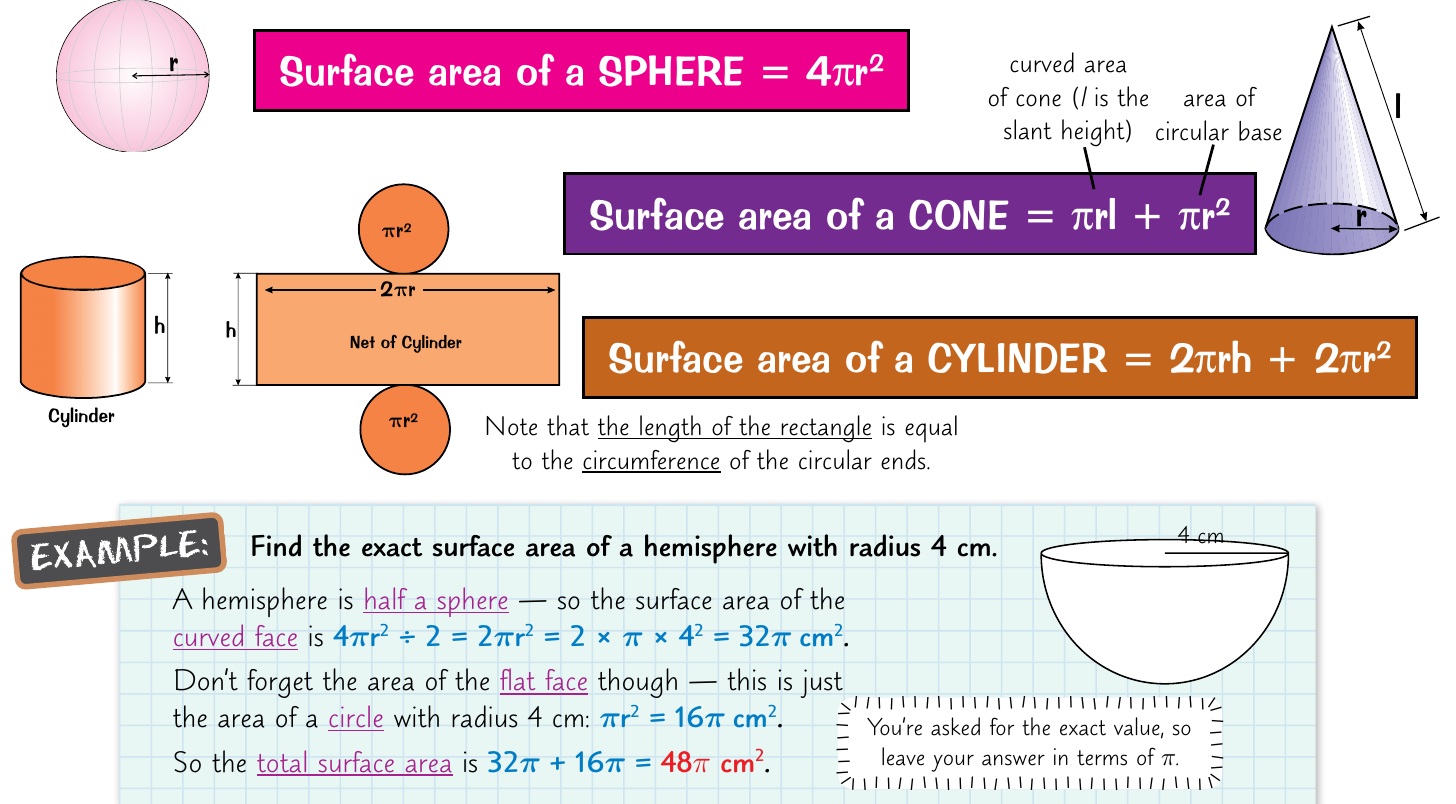
The surface area of a sphere is calculated using the formula , where represents the radius. This formula might seem mysterious at first, but it's actually four times the area of the sphere's great circle (the largest circle that can be drawn on the sphere's surface). The curved surface of a sphere is uniform throughout, making this formula remarkably elegant.
Important
Sphere Surface Area Formula: where is the radius of the sphere.
Cone surface area
A cone's surface area consists of two distinct parts: the curved surface area and the circular base area. The complete formula is , where is the radius of the base and is the slant height of the cone. The first term () represents the curved surface area, while the second term () gives the area of the circular base.
Important
Cone Surface Area Formula: where is the base radius and is the slant height.
Cylinder surface area
Cylinders have both curved surfaces and flat circular ends, which the formula accounts for perfectly. Here, is the radius of the circular ends and is the height of the cylinder. The first term () calculates the curved surface area, while the second term () gives the combined area of both circular ends.
Important
Cylinder Surface Area Formula: where is the radius and is the height.
Note
The cylinder formula becomes clearer when you visualise the net: it consists of a rectangle (the curved surface unfolded) plus two circles (the top and bottom faces).
Worked example: hemisphere surface area
Let's work through a practical example to see how these concepts apply in real calculations.
Example
Worked Example: Finding the Surface Area of a Hemisphere
Problem: Find the exact surface area of a hemisphere with radius 4 cm.
Solution:
A hemisphere is exactly half of a sphere, so we need to account for both the curved surface area and the flat circular base that's created when the sphere is cut in half.
Step 1: Calculate the curved surface area
- Half of sphere's surface area:
- With cm: cm²
Step 2: Calculate the flat circular base area
- Area of circle: cm²
Step 3: Add both areas together
- Total surface area = cm²
Answer: The surface area is cm² (exact form).
This example demonstrates the importance of carefully considering all surfaces when calculating surface area, including any flat faces that might be created when shapes are modified or combined.
Summary
Key Points to Remember:
- Surface area equals the total area of all outer surfaces of a 3D shape
- Nets help visualise surface area by showing all faces laid flat
- Sphere formula: (four times the area of its great circle)
- Cone formula: (curved surface plus circular base)
- Cylinder formula: (curved surface plus two circular ends)
- Always consider both curved surfaces and flat faces in your calculations