The Four Transformations (Edexcel GCSE Maths): Revision Notes
📚Revision Notes
The four transformations
There are four main transformations you need to master in geometry: translation, rotation, reflexion, and enlargement. Each transformation changes the position or size of a shape in a specific way, and understanding how to describe and perform these transformations is essential for success in GCSE mathematics.
1. Translations
A translation moves a shape from one position to another without changing its size, shape, or orientation. Think of it as sliding a shape across the coordinate plane. The movement is described using a vector, which tells you exactly how far and in which direction to move each point of the shape.
When describing a translation, you write the movement as a vector in the form , where represents the horizontal movement and represents the vertical movement. If the shape moves to the right, is positive; if it moves left, is negative. Similarly, if the shape moves up, is positive; if it moves down, is negative.
Example
Worked Example: Translation Vector
If you need to move a triangle 8 units left and 6 units up, you would write this as the vector . The negative sign for the x-value indicates leftward movement, while the positive y-value indicates upward movement.
Note
Direction Signs in Vectors:
- Positive x-value = rightward movement
- Negative x-value = leftward movement
- Positive y-value = upward movement
- Negative y-value = downward movement
2. Rotations
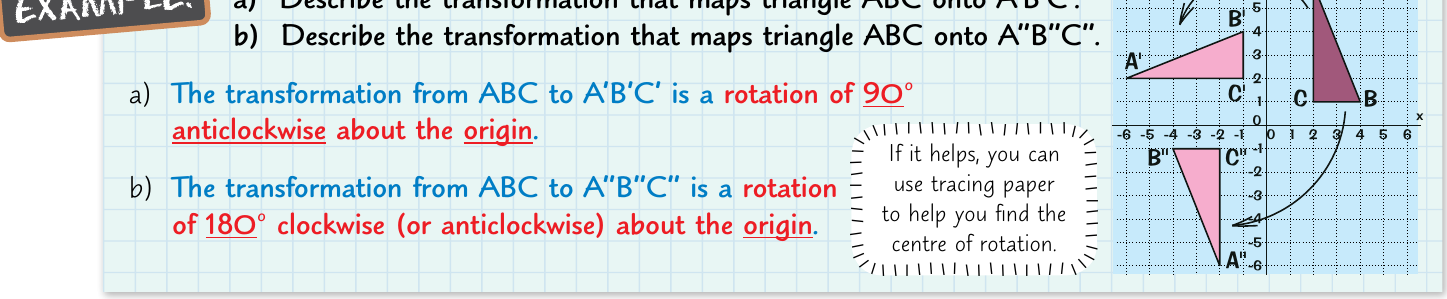
Rotations involve turning a shape around a fixed point called the centre of rotation. When describing a rotation, you must provide three essential pieces of information: the angle of rotation, the direction of rotation, and the centre of rotation.
Important
Three Essential Elements for Describing Rotations:
- Angle of rotation (usually 90°, 180°, or 270°)
- Direction (clockwise or anticlockwise)
- Centre of rotation (the fixed point around which the shape turns)
The angle of rotation is usually given in degrees, with common angles being 90°, 180°, or 270°. The direction can be either clockwise or anticlockwise. Interestingly, for a 180° rotation, the direction doesn't matter because the result is the same whether you turn clockwise or anticlockwise.
The centre of rotation is the fixed point around which the shape turns. This is often the origin (0,0), but it can be any point on the coordinate plane.
Note
Helpful Tip: Use tracing paper to help you visualise the transformation and locate the centre of rotation. This makes it much easier to see where the shape will end up after rotation.
3. Reflections
A reflexion creates a mirror image of a shape across a line called the mirror line or line of reflexion. To fully describe a reflexion, you need to give the equation of the mirror line. This line acts like a mirror, and every point on the original shape has a corresponding point on the reflected shape that is the same distance from the mirror line but on the opposite side.
Note
Common Mirror Lines:
- x-axis:
- y-axis:
- Diagonal lines: or
When reflecting a shape, each point maintains the same distance from the mirror line, but appears on the opposite side, creating a flipped version of the original shape.
4. Enlargements
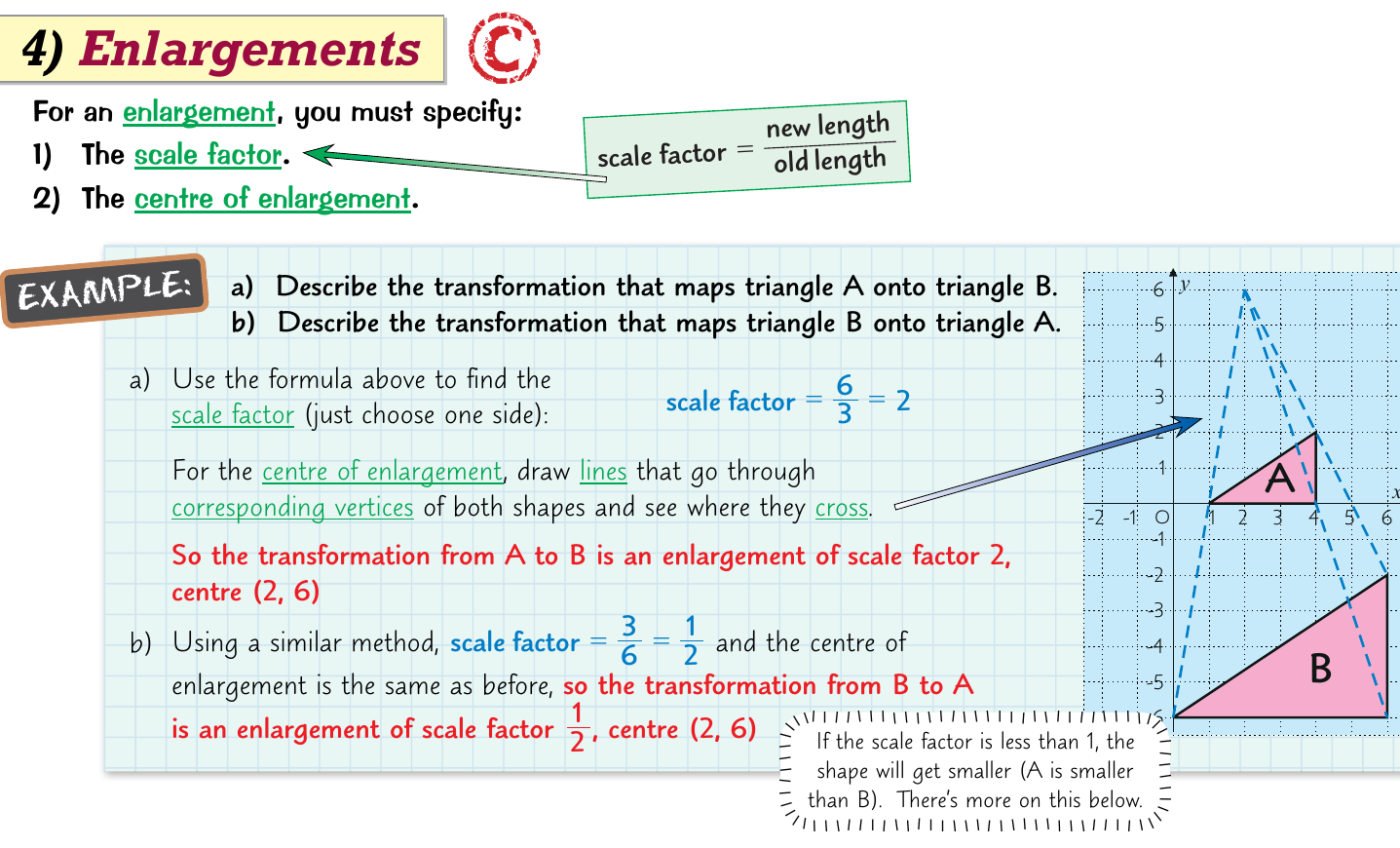
Enlargements change the size of a shape while keeping its angles and proportions the same. To describe an enlargement, you need two pieces of information: the scale factor and the centre of enlargement.
The scale factor determines how much bigger or smaller the new shape will be compared to the original. It's calculated using the formula:
If the scale factor is greater than 1, the shape gets bigger; if it's less than 1, the shape gets smaller.
The centre of enlargement is the fixed point from which the enlargement takes place. To perform an enlargement, you draw lines from the centre of enlargement through each vertex of the original shape, then measure along these lines to find the new positions.
Understanding scale factors
Scale factors follow several important rules that you should memorise:
Important
Scale Factor Rules:
- When the scale factor is greater than 1, the shape becomes larger
- When the scale factor is smaller than 1 (such as ), the shape becomes smaller
- Negative scale factors create the shape on the opposite side of the centre of enlargement
- A scale factor of -1 creates exactly the same effect as a 180° rotation about the centre of enlargement
The scale factor also tells you about the relative distances between points. It shows you how far old points and new points are from the centre of enlargement, which is very useful when drawing enlargements because you can use this information to trace out the positions of the new points.
Working with negative scale factors
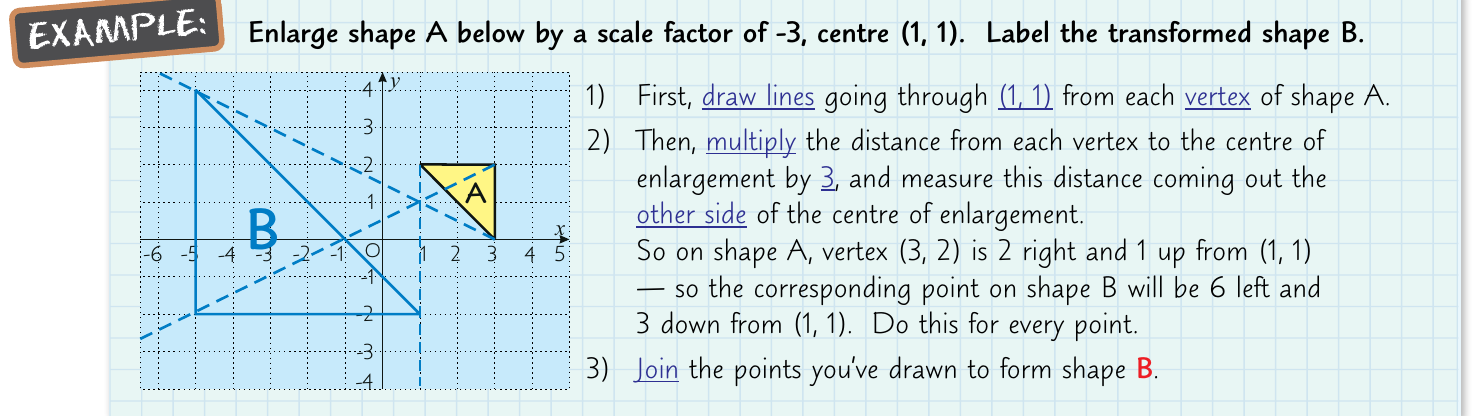
When you encounter a negative scale factor, such as -3, the process involves several steps. First, you draw lines from the centre of enlargement through each vertex of the original shape. Then, you multiply the distance from each vertex to the centre of enlargement by 3 (the numerical value of the scale factor). However, because the scale factor is negative, you measure this distance in the opposite direction from the centre of enlargement.
Example
Worked Example: Negative Scale Factor
For a scale factor of -3:
- Draw lines from the centre of enlargement through each vertex
- Measure the distance from each vertex to the centre
- Multiply this distance by 3 (the numerical value)
- Mark the new point this distance away, but in the opposite direction from the centre
Properties of transformations
Understanding how transformations affect shapes is crucial for solving problems effectively. Under translation, rotation, and reflexion, shapes remain congruent - meaning they keep exactly the same size and shape, with only their position and orientation changing.
However, enlargements work differently. Under enlargement, shapes become similar rather than congruent. This means the position and size change, but the angles and the ratios of the sides remain the same. The shape looks exactly the same but is either bigger or smaller than the original.
Note
Congruent vs Similar Shapes:
- Congruent shapes: Same size AND same shape (result from translation, rotation, reflexion)
- Similar shapes: Same shape but different size (result from enlargement)
Summary
Key Points to Remember:
- Translation: Described by a vector showing horizontal and vertical movement
- Rotation: Requires three details - angle, direction, and centre of rotation
- Reflection: Needs the equation of the mirror line
- Enlargement: Requires scale factor and centre of enlargement
- Congruent shapes: Result from translation, rotation, and reflexion (same size and shape)
- Similar shapes: Result from enlargement (same shape, different size)