Triangle Construction (Edexcel GCSE Maths): Revision Notes
📚Revision Notes
Triangle construction
Triangle construction is a fundamental skill in geometry that involves creating accurate triangles using specific measurements and geometric tools. The method you choose depends on what information you have about the triangle you need to draw.
Note
The key to successful triangle construction is choosing the right method based on the information you have. Each construction method requires different tools and follows a specific sequence of steps.
Constructing triangles with three sides (SSS method)
When you know all three side lengths of a triangle, you can construct it using a ruler and compasses. This method is reliable because there is only one possible triangle that can be formed with three given side lengths.
Step-by-step process for SSS construction
To construct a triangle when you know all three sides, follow these steps:
- Start with a rough sketch - Draw and label a triangle showing the approximate shape you're aiming for. This helps you visualise what you're trying to create.
- Draw the base line - Choose one of the three sides to be your base line and draw it accurately using a ruler. Label the endpoints clearly.
- Set your compasses - For the remaining two sides, set your compasses to the length of each side in turn.
- Create intersecting arcs - Place the compass point at one end of the base line and draw an arc. Then place the compass point at the other end and draw another arc. Where these arcs intersect is your third vertex.
- Complete the triangle - Join the intersection point to both ends of the base line to complete your triangle.
Example
Worked Example: SSS Construction
Construct a triangle with sides 5 cm, 7 cm, and 8 cm.
Step 1: Draw a rough sketch showing the triangle shape Step 2: Draw the base line (8 cm) using a ruler Step 3: Set compasses to 5 cm and draw an arc from one end of the base Step 4: Set compasses to 7 cm and draw an arc from the other end Step 5: Mark where the arcs intersect and join to complete the triangle
Important
This method works because the compasses ensure that each side is exactly the right length, and there's only one point where the two arcs can meet.
Constructing triangles with sides and angles (SAS method)
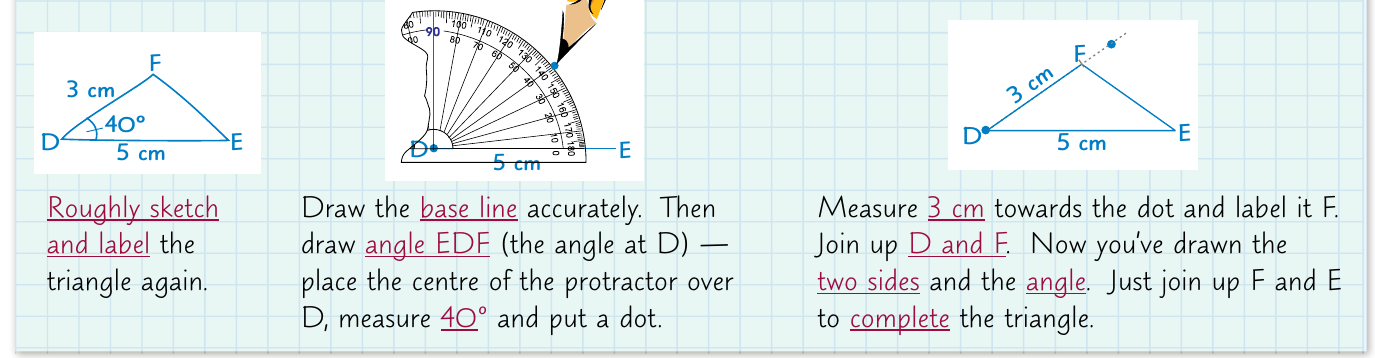
When you have two sides and the angle between them, you can construct the triangle using a ruler and protractor. This is called the SAS (Side-Angle-Side) method.
Step-by-step process for SAS construction
Here's how to construct a triangle when you know two sides and the included angle:
- Create a rough sketch - Draw a rough triangle showing the angle and the two sides you know. This gives you a clear target for your construction.
- Draw the base line accurately - Use your ruler to draw one of the known sides as your base line. Make sure it's exactly the right length.
- Measure the angle - Place your protractor at one end of the base line, with the centre point exactly on the vertex. Mark the required angle and draw a line from the vertex through this mark.
- Measure the second side - Along the angled line you just drew, measure the length of the second known side and mark this point.
- Complete the triangle - Join this point back to the other end of your base line to complete the triangle.
Example
Worked Example: SAS Construction
Construct a triangle with sides 6 cm and 4 cm, with a 60° angle between them.
Step 1: Draw a rough sketch showing the two sides and 60° angle Step 2: Draw the base line (6 cm) accurately with a ruler Step 3: Use a protractor to measure 60° from one end of the base line Step 4: Measure 4 cm along the angled line and mark the point Step 5: Join this point to the other end of the base line
Important
The key to this method is ensuring your angle measurement is precise and your side measurements are accurate.
Understanding triangle congruence conditions
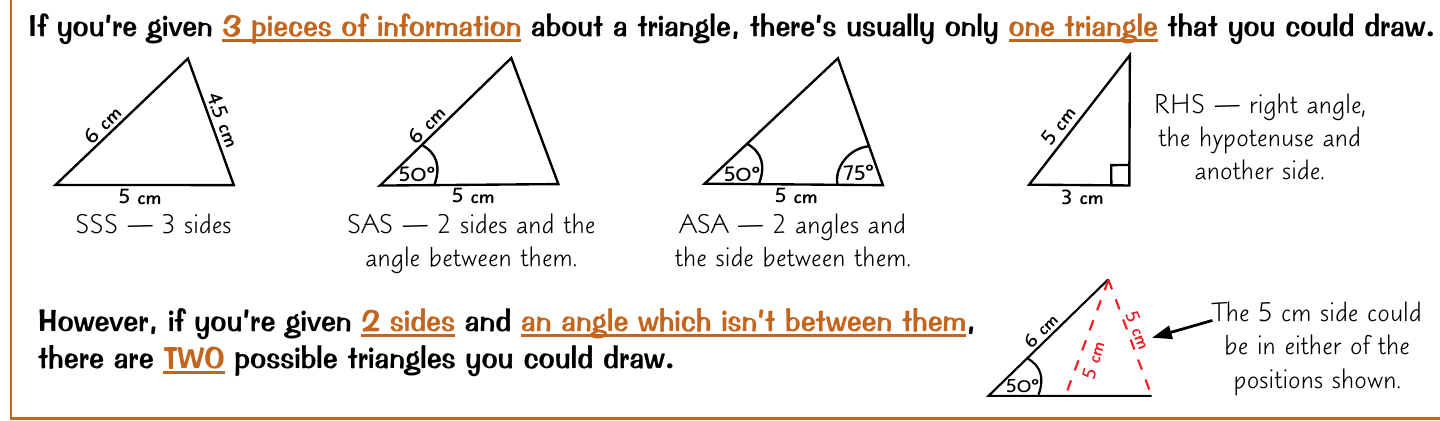
There are four main conditions that guarantee you can construct a unique triangle. Understanding these helps you know when triangle construction is possible and when it results in a unique solution.
The four congruence conditions
- SSS (Side-Side-Side) - When you know all three sides, only one triangle is possible.
- SAS (Side-Angle-Side) - When you know two sides and the angle between them, only one triangle is possible.
- ASA (Angle-Side-Angle) - When you know two angles and the side between them, only one triangle is possible.
- RHS (Right angle-Hypotenuse-Side) - For right-angled triangles, when you know the hypotenuse and one other side, only one triangle is possible.
Note
With three pieces of information that fit one of these patterns, you can typically construct exactly one triangle. These conditions are fundamental to understanding when triangle construction will work.
The ambiguous case
There's one important exception to the "one triangle" rule. When you're given two sides and an angle that isn't between them, you might be able to construct two different triangles that both satisfy the given conditions.
Important
This happens because when you have two sides and a non-included angle, the third vertex can sometimes be positioned in two different places, both creating valid triangles with the same measurements. This is why this situation is called the "ambiguous case".
When working with two sides and a non-included angle, always check whether a second triangle is possible by seeing if your compass arcs intersect the opposite side in two places.
Practical exam tips
Triangle construction questions often appear in GCSE examinations, so being prepared with the right tools and techniques is essential.
Essential equipment
Note
Always bring these tools to your exam:
- Pencil (for construction marks)
- Ruler (for measuring lengths)
- Compasses (for drawing arcs)
- Protractor (for measuring angles)
Construction best practices
Note
Follow these best practices for exam success:
- Leave your construction marks visible - examiners want to see how you built the triangle
- Work accurately but don't spend too long on perfect precision
- Check your final triangle against the given measurements
- Label your vertices clearly
- If asked for an equilateral triangle, remember all sides are equal and all angles are 60°
Summary
Key Points to Remember:
- With three pieces of information about a triangle, you can usually construct exactly one unique triangle
- Use compasses and ruler for SSS construction (three sides known)
- Use protractor and ruler for SAS construction (two sides and included angle known)
- The ambiguous case occurs when you have two sides and a non-included angle - this might give you two possible triangles
- Always bring pencil, ruler, compasses, and protractor to geometry exams
- Leave construction marks visible to show your working