Volume (Edexcel GCSE Maths): Revision Notes
📚Revision Notes
Volume
Volume is a fundamental concept in geometry that measures the amount of space a three-dimensional object occupies. You might also hear it called capacity in some contexts. Understanding how to calculate volume is essential for solving real-world problems involving containers, construction materials, and many other practical applications.
Volumes of cuboids

A cuboid is essentially a rectangular block - a 3D shape with six rectangular faces. Calculating its volume is straightforward and forms the foundation for understanding more complex volume calculations.
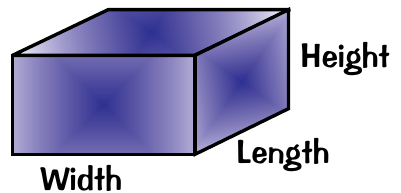
The volume of a cuboid equals the product of its three dimensions. When you multiply length, width, and height together, you get the total space inside the shape.
Formula:
Note
This formula works because you're essentially stacking flat rectangular areas (length × width) to the height of the cuboid. Each layer has the same area, and you're adding up all these layers.
Volumes of prisms

A prism is a special type of 3D shape that maintains the same cross-sectional area throughout its entire length. Think of it like a loaf of bread - every slice would have exactly the same shape and size.
The key principle for all prisms is that volume equals the cross-sectional area multiplied by the length of the prism.
Formula:
Where is the area of the cross-section and is the length.
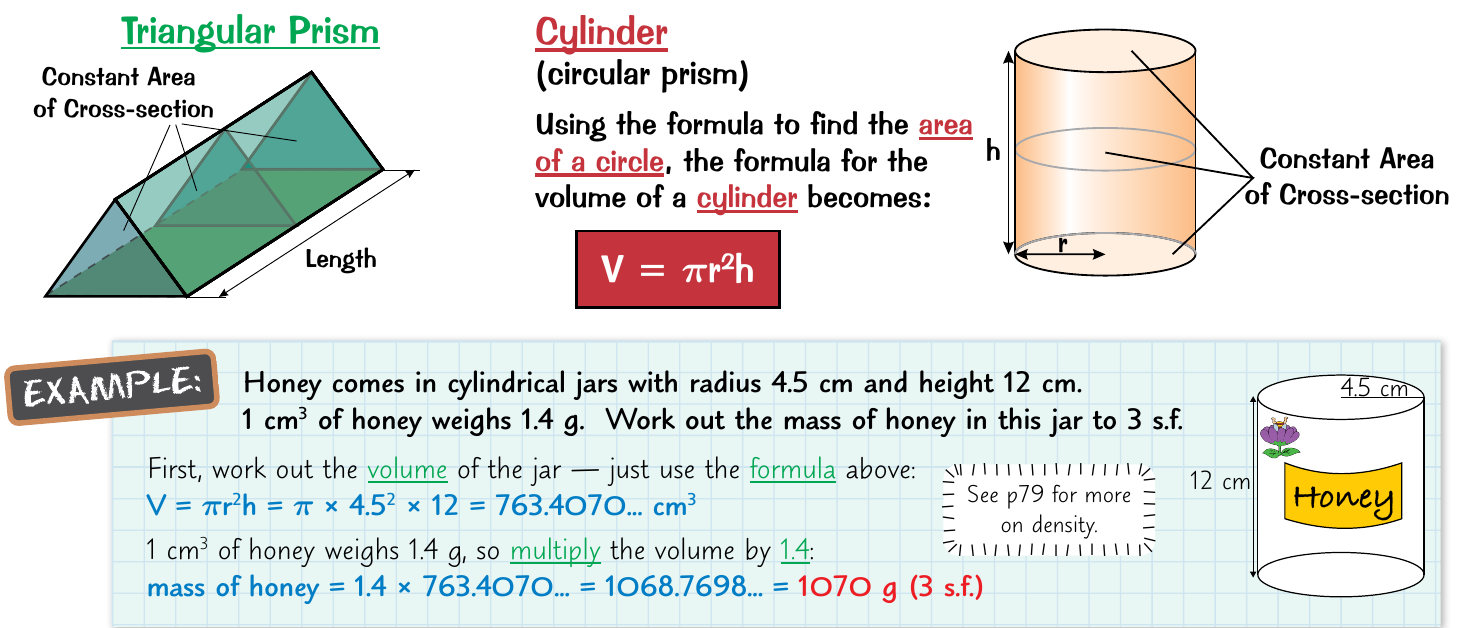
Triangular prisms
For triangular prisms, you first need to calculate the area of the triangular cross-section using the standard triangle area formula (), then multiply by the length of the prism.
Cylinders
A cylinder is actually a special type of prism with a circular cross-section. Since the cross-sectional area of a circle is , the volume formula becomes:
Formula:
Where is the radius of the circular base and is the height of the cylinder.
Example
Worked Example: Calculating Cylinder Volume
If you have a cylindrical honey jar with radius 4.5 cm and height 12 cm:
Step 1: Apply the formula
Step 2: Substitute the values
Step 3: Calculate
If you know that 1 cm³ of honey weighs 1.4 g, you can calculate the total mass by multiplying the volume by the density.
Volumes of spheres
A sphere is a perfectly round 3D shape where every point on the surface is equidistant from the centre. The volume formula for a sphere is more complex than other shapes:
Formula:
Note
This formula might seem complicated, but it's derived from advanced calculus. For practical purposes, you just need to remember to cube the radius, multiply by π, then multiply by 4/3.
A hemisphere is exactly half a sphere, so its volume is simply half the sphere formula:
Formula for hemisphere:
Volumes of pyramids and cones
Pyramids and cones are shapes that taper from a flat base to a single point at the top. The base can be any shape - if it's circular, we call it a cone; if it's any other shape, we call it a pyramid.
Formula for pyramid:
Formula for cone:
The key factor here is the "one-third" multiplier. This means that a pyramid or cone has exactly one-third the volume of a prism or cylinder with the same base area and height.
Important
Always use the vertical (perpendicular) height, not the slant height. The slant height is the distance measured along the sloping side, which is used for surface area calculations, not volume.
Volumes of frustums
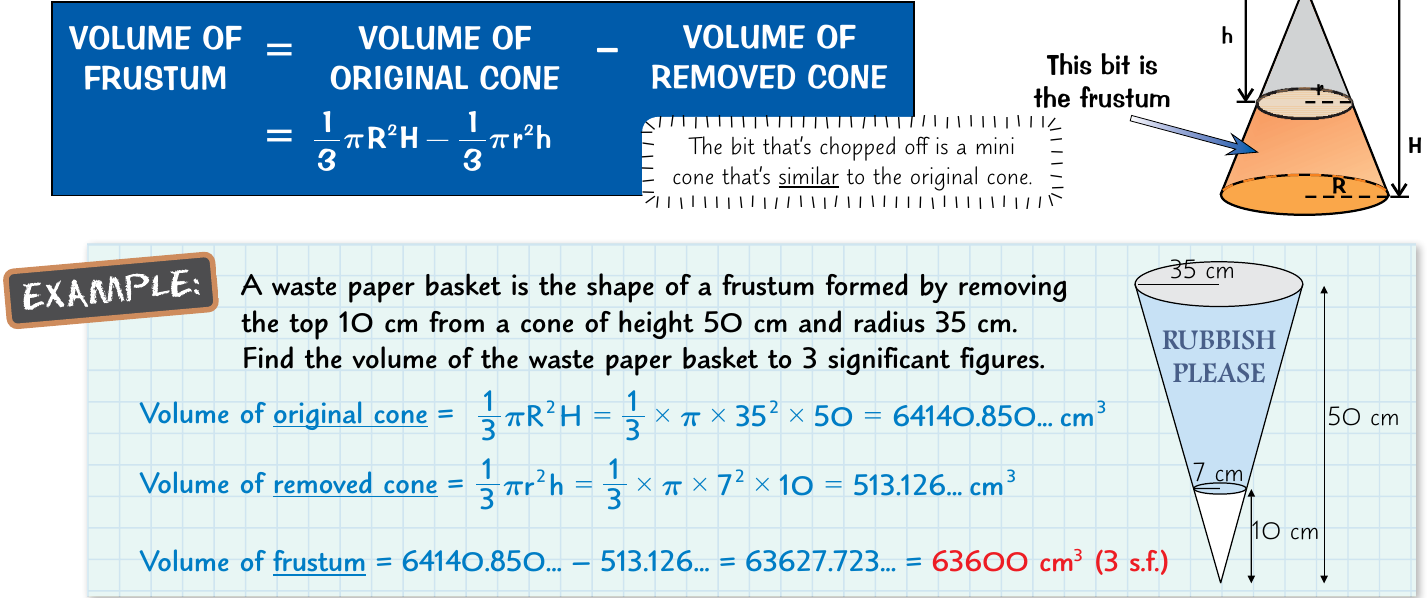
A frustum is what remains when you cut off the top part of a cone parallel to its base. Think of a waste paper basket or a lampshade - these are common examples of frustums.
To find the volume of a frustum, you calculate it as the difference between two cones:
Formula: Volume of frustum = Volume of original cone - Volume of removed cone
This involves:
- Finding the volume of the complete original cone
- Finding the volume of the small cone that was removed from the top
- Subtracting the second volume from the first
Example
Worked Example: Calculating Frustum Volume
If you have a waste paper basket shaped like a frustum where the original cone had height 50 cm and radius 35 cm, and the removed top portion had height 10 cm and radius 7 cm:
Step 1: Calculate original cone volume
Step 2: Calculate removed cone volume
Step 3: Find frustum volume
Summary
Key Points to Remember:
- Cuboid volume: Simply multiply length × width × height
- Prism volume: Cross-sectional area × length - this works for all prisms including cylinders
- Sphere volume: - don't forget to cube the radius
- Pyramid and cone volumes: Always one-third of the equivalent prism/cylinder volume
- Frustum volume: Subtract the small removed cone from the original complete cone
- Use vertical height for pyramids and cones, not slant height
- Volume can also be called capacity - they mean the same thing