3D Pythagoras (Edexcel GCSE Maths): Revision Notes
📚Revision Notes
3D Pythagoras
Understanding the 3D Pythagoras theorem
The 3D Pythagoras theorem is simply an extension of the familiar 2D Pythagoras theorem that you already know. Instead of working with just two dimensions, we now work with three dimensions to find the longest diagonal (called the space diagonal) that runs through the interior of a 3D shape.
Note
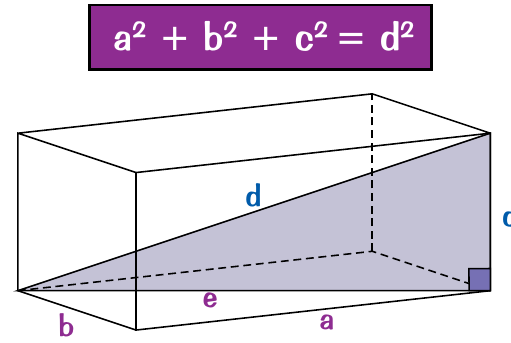
The space diagonal is the longest possible straight line that can be drawn inside a 3D shape, connecting two opposite corners through the interior of the shape.
The fundamental formula for 3D Pythagoras is:
Where , , and are the three perpendicular edges of a rectangular prism (cuboid), and is the space diagonal running from one corner to the opposite corner.
How is 3D Pythagoras derived?
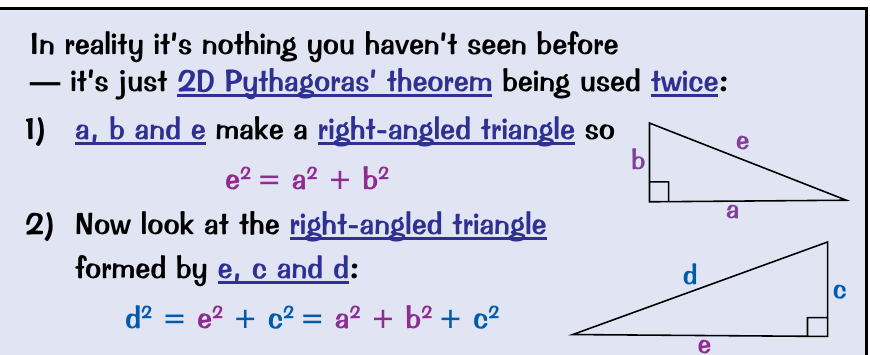
The beauty of 3D Pythagoras lies in its simplicity - it's actually just the 2D Pythagoras theorem applied twice in succession. Here's how it works:
Step 1: First, we use the 2D Pythagoras theorem to find the diagonal of the base rectangle. If the base has sides and , then the diagonal can be found using:
Step 2: Next, we create a new right-angled triangle using the diagonal we just found and the height of the shape. The hypotenuse of this new triangle is our space diagonal :
Step 3: Substituting our expression for into this equation:
Important
Key Insight: The 3D formula is really just a natural extension of what we already know about right-angled triangles. We're not learning anything completely new - we're just applying familiar concepts in a systematic way.
Working with cubes
When dealing with cubes, all three dimensions are equal, which makes the calculation slightly simpler. The key advantage is that we only need to know one measurement to find the space diagonal.
Example
Worked Example: Finding the Space Diagonal of a Cube
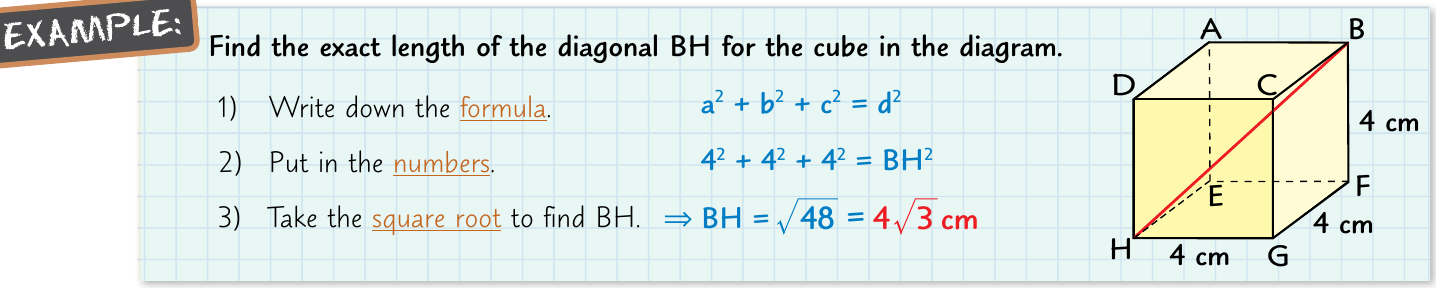
Find the space diagonal BH of a cube with sides of 4 cm.
Step 1: Write down the formula
Step 2: Substitute the values (all sides are 4 cm)
Step 3: Take the square root
Applying 3D Pythagoras to other shapes
The 3D Pythagoras formula isn't limited to just finding diagonals in cuboids. It can be adapted to solve problems involving other 3D shapes, such as pyramids.
Example
Worked Example: Finding the Vertical Height of a Square-Based Pyramid
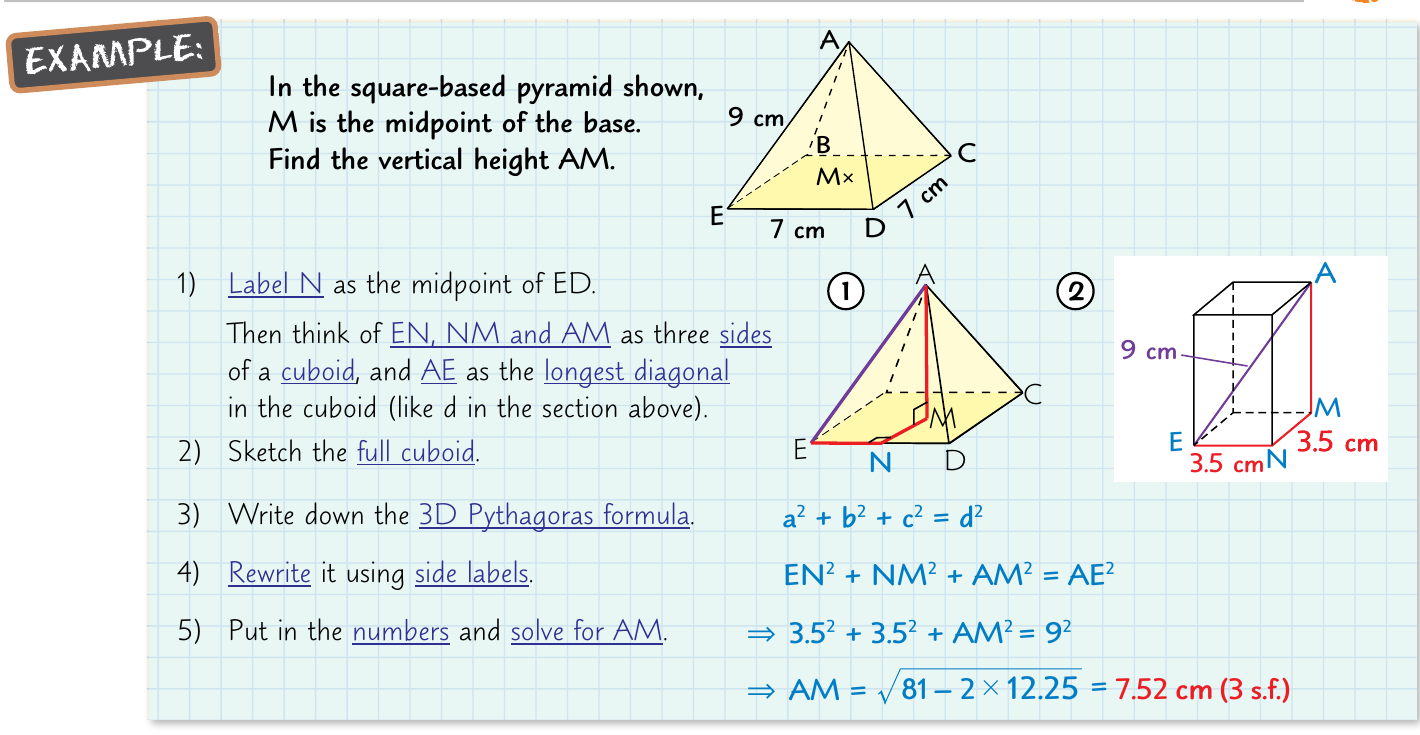
Consider a square-based pyramid where the base has sides of 7 cm and the slant edges are 9 cm long. To find the vertical height:
Step 1: Identify that the midpoint of the base, the apex, and a corner of the base form a right-angled triangle.
Step 2: The three perpendicular dimensions are:
- Half the base diagonal: 3.5 cm
- Half the base diagonal: 3.5 cm
- The vertical height: AM (unknown)
Step 3: Apply the 3D Pythagoras formula:
Key problem-solving steps
When tackling any 3D Pythagoras problem, it's essential to work systematically. Here's a reliable approach that will help you solve any 3D Pythagoras problem:
Summary
Problem-Solving Strategy:
-
Identify the shape - Is it a cuboid, cube, or more complex 3D shape?
-
Find the three perpendicular dimensions - These might be the length, width, and height of a cuboid, or you might need to construct them as in the pyramid example.
-
Apply the formula - Substitute your values into
-
Solve for the unknown - This usually involves taking a square root at the end.
-
Check your answer - Does it make sense given the dimensions of the shape?
Remember!
Summary
Key Points to Remember:
- The 3D Pythagoras formula is where , , are perpendicular edges and is the space diagonal
- It's simply the 2D Pythagoras theorem applied twice - nothing more complicated than what you already know
- For cubes, all three dimensions are the same, making calculations more straightforward
- The formula can be adapted to solve problems involving other 3D shapes like pyramids
- Always work systematically: identify the shape, find the three perpendicular dimensions, apply the formula, and solve