Pythagoras’ Theorem (Edexcel GCSE Maths): Revision Notes
📚Revision Notes
Pythagoras' theorem
Pythagoras' theorem might sound complicated, but it's actually quite straightforward once you understand the basics. This powerful mathematical tool helps us find missing sides in right-angled triangles and calculate distances between points.
What is Pythagoras' theorem?
Pythagoras' theorem describes the relationship between the three sides of a right-angled triangle. It states that in any right-angled triangle, the square of the hypotenuse (the longest side) equals the sum of the squares of the other two sides.
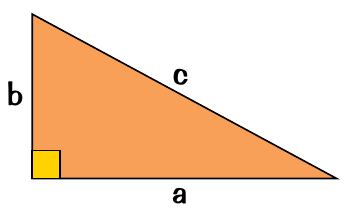
The theorem can be expressed using the formula:
Where:
- and are the two shorter sides (called legs)
- is the hypotenuse (the longest side, opposite the right angle)
Key rules to remember
Important
Critical Rules for Using Pythagoras' Theorem:
-
Right-angled triangles only: The theorem only works for triangles that have a right angle (90°). If there's no right angle, you can't use this method.
-
Finding any side: You can use the theorem to find any of the three sides, not just the hypotenuse. The key is to rearrange the formula correctly.
-
Identifying the hypotenuse: The hypotenuse is always the longest side and sits opposite the right angle. Make sure you identify it correctly before starting your calculations.
-
Check your answer: Always verify that your answer makes sense. The hypotenuse should be longer than either of the other two sides.
Step-by-step method for finding unknown sides
When solving problems using Pythagoras' theorem, it's essential to follow a systematic approach to ensure accuracy and avoid common mistakes.
Note
Systematic Problem-Solving Steps:
- Write down the formula: Start with
- Substitute the numbers: Put the known values into the formula
- Rearrange if necessary: Move terms around to isolate the unknown side
- Take the square root: Find the square root to get your final answer
- Check your answer: Ensure the result is reasonable and gives exact length if required
Example
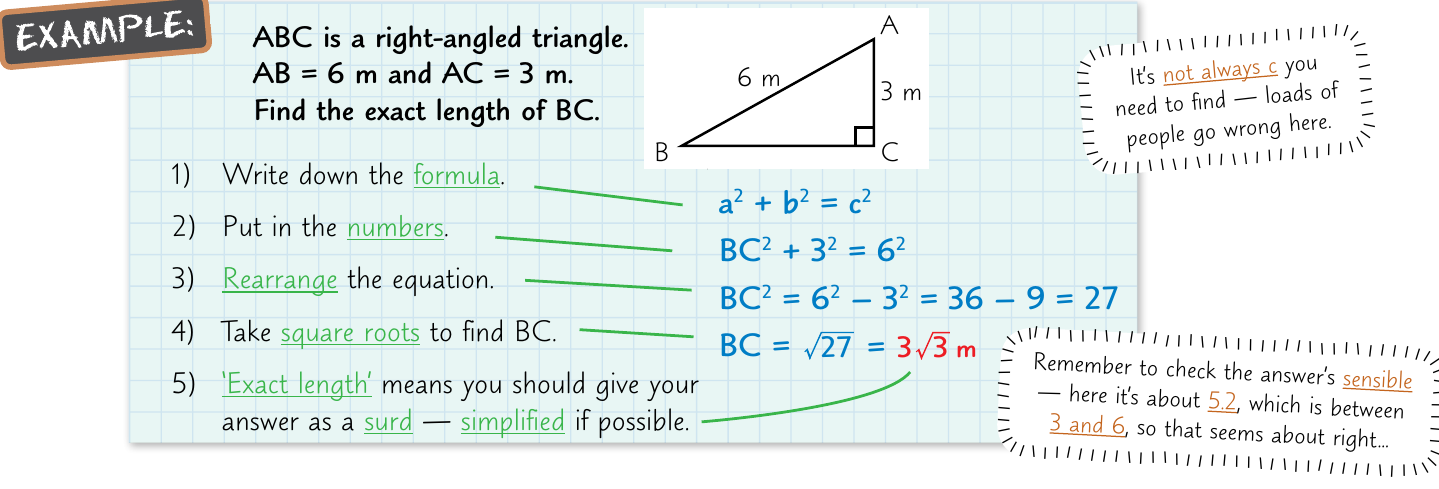
Worked Example: Finding the Exact Length
In this example, we can see how to find the exact length of side BC when we know the hypotenuse and one other side. The solution shows BC = metres, which is left as a surd for the exact answer.
Using Pythagoras to find distance between points
One of the most practical applications of Pythagoras' theorem is finding the straight-line distance between two points on a coordinate plane. This method involves creating a right-angled triangle where the unknown distance becomes the hypotenuse.
Here's how to approach these problems:
Note
Distance Between Points Method:
- Draw a sketch: Plot the points and visualise the right-angled triangle
- Find the horizontal and vertical distances: Calculate the differences in x and y coordinates
- Apply Pythagoras: Use these distances as the two shorter sides to find the hypotenuse
Example
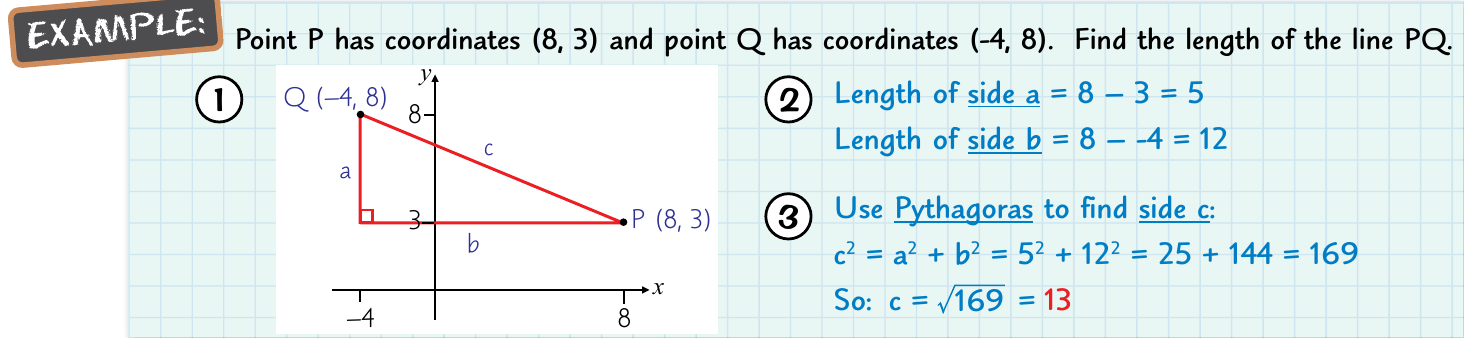
Worked Example: Distance Between Coordinates
This example demonstrates finding the distance between points P(8, 3) and Q(-4, 8). The horizontal distance is 12 units, the vertical distance is 5 units, and using Pythagoras' theorem, the straight-line distance is 13 units.
Using the formula: units
Practice makes perfect
Working through various problems helps reinforce your understanding of the theorem. Whether you're finding missing sides in triangles or calculating distances between coordinates, the same principles apply.

Note
Practice Strategy:
These practice questions cover different aspects of Pythagoras' theorem, from basic triangle problems to coordinate geometry applications. Regular practice with varied problem types will build your confidence and speed.
Remember!
Summary
Key Points to Remember:
- Pythagoras' theorem only works for right-angled triangles - if there's no right angle, you can't use this method
- The formula is where is always the hypotenuse (longest side)
- You can find any unknown side by rearranging the formula appropriately
- Always check your answer makes sense - the hypotenuse should be the longest side
- For coordinate problems, create a right triangle and use the horizontal and vertical distances as your two shorter sides