Trigonometry — Sin, Cos, Tan (Edexcel GCSE Maths): Revision Notes
📚Revision Notes
Trigonometry — Sin, Cos, Tan
Introduction to trigonometry
Trigonometry might seem like a big, intimidating word, but it's actually a powerful and useful mathematical tool. At its core, trigonometry helps us understand the relationships between the angles and sides of triangles, particularly right-angled triangles. Once you master the basics, you'll find trigonometry appearing everywhere from architecture to navigation.
Note
Understanding trigonometry is essential for many fields including engineering, physics, computer graphics, and even music production. The concepts you learn here will form the foundation for more advanced mathematical topics.
The three fundamental trigonometric ratios
There are three essential trigonometric functions that form the foundation of all trigonometry work. Each one creates a specific relationship between an angle in a right-angled triangle and two of its sides.
The three basic formulas are:
- Sine (Sin): Links the opposite side to the hypotenuse
- Cosine (Cos): Links the adjacent side to the hypotenuse
- Tangent (Tan): Links the opposite side to the adjacent side
These can be expressed mathematically as:
Understanding triangle sides
Before you can use trigonometric ratios effectively, you need to understand how to identify the different sides of a right-angled triangle in relation to a specific angle.
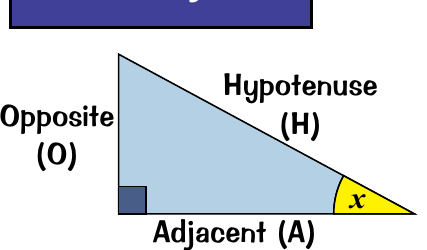
In any right-angled triangle, there are three sides with specific names:
- Hypotenuse: This is always the longest side of the triangle, positioned opposite the right angle
- Opposite: This is the side that sits directly across from the angle you're working with
- Adjacent: This is the side that's next to the angle you're working with (but not the hypotenuse)
Important
Remember that the opposite and adjacent sides change depending on which angle you're considering, but the hypotenuse always stays the same. This is a common source of confusion for students, so always double-check your triangle labelling before proceeding with calculations.
The SOH CAH TOA mnemonic
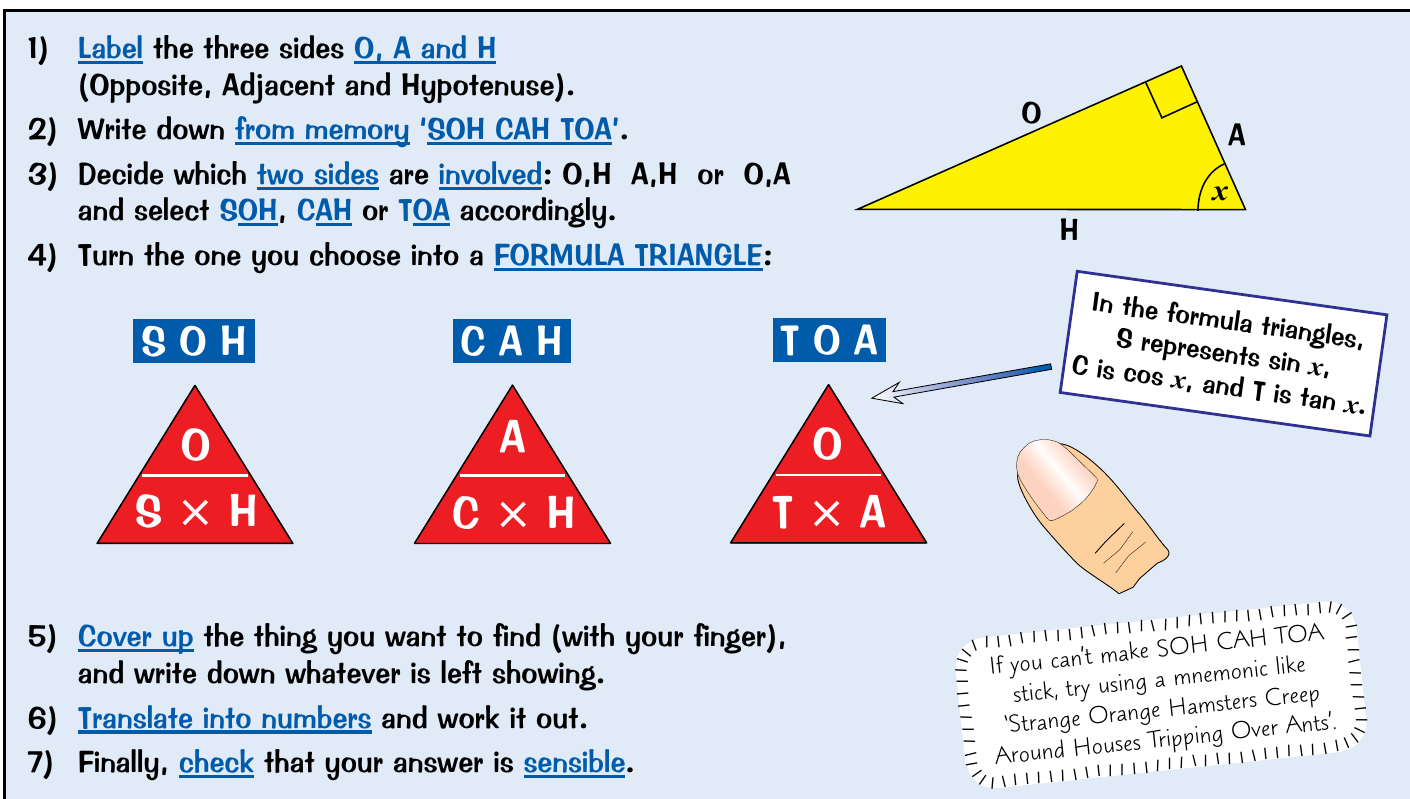
The most popular way to remember the trigonometric ratios is through the mnemonic SOH CAH TOA. This breaks down as:
- SOH: Sine = Opposite ÷ Hypotenuse
- CAH: Cosine = Adjacent ÷ Hypotenuse
- TOA: Tangent = Opposite ÷ Adjacent
Note
Some students prefer alternative mnemonics like "Strange Orange Hamsters Creep Around Houses Tripping Over Ants" to help them remember this sequence. Find the version that works best for you and practice it until it becomes automatic.
Formula triangles method
Formula triangles provide a visual way to rearrange trigonometric equations, making it easier to solve for different variables. This method works particularly well for visual learners.
For each trigonometric ratio, you can create a triangle where:
- The numerator goes on top
- The denominator goes on the bottom
- You cover up what you want to find
Example
Step-by-Step Approach Using Formula Triangles:
- Label the triangle sides as O (Opposite), A (Adjacent), and H (Hypotenuse)
- Write down SOH CAH TOA from memory
- Decide which sides are involved in your problem
- Choose the appropriate formula (SOH, CAH, or TOA)
- Create the formula triangle for your chosen ratio
- Cover up what you want to find with your finger
- Work out the calculation using the remaining visible parts
This systematic approach ensures you don't miss any steps and helps build confidence in your problem-solving abilities.
Solving trigonometry problems
When approaching trigonometry questions, follow these systematic steps to ensure accurate results:
- Identify the triangle type: Ensure you're working with a right-angled triangle
- Label the sides relative to your angle of interest
- Determine which ratio to use based on the sides involved
- Set up your equation using the appropriate formula
- Solve for the unknown using your calculator in DEG mode
- Check your answer to ensure it makes sense
Important
For finding angles, you'll need to use the inverse functions (, , or ) on your calculator. Make sure your calculator is set to degrees (DEG) mode, not radians, when working with angle measurements in degrees.
Worked examples
Let's work through some typical problems to see how these principles apply in practice.
Example
Worked Example 1: Finding a Missing Side
Given: A right-angled triangle with an angle of 30° and hypotenuse of 10 cm Find: The length of the opposite side
Step 1: Identify the known values
- Angle = 30°
- Hypotenuse = 10 cm
- Need to find: Opposite side
Step 2: Choose the appropriate ratio Since we have the hypotenuse and need the opposite, we use SOH (Sine)
Step 3: Solve for the opposite side
Example
Worked Example 2: Finding a Missing Angle
Given: A right-angled triangle with opposite side = 6 cm and adjacent side = 8 cm Find: The angle
Step 1: Identify the known values
- Opposite = 6 cm
- Adjacent = 8 cm
- Need to find: Angle
Step 2: Choose the appropriate ratio Since we have opposite and adjacent, we use TOA (Tangent)
Step 3: Use inverse tangent to find the angle
Angles of elevation and depression
These concepts apply trigonometry to real-world scenarios, particularly useful in surveying, navigation, and construction.
Angle of elevation: This is the angle measured upwards from the horizontal to your line of sight. For example, when you look up at the top of a building, the angle your line of sight makes with the horizontal ground is the angle of elevation.
Angle of depression: This is the angle measured downwards from the horizontal to your line of sight. For instance, when looking down from a cliff to a boat below, the angle your line of sight makes with the horizontal is the angle of depression.
Important
An important relationship to remember is that the angle of elevation from point A to point B equals the angle of depression from point B to point A. This symmetry is extremely useful when solving real-world problems involving heights and distances.
Summary
Key Points to Remember:
- SOH CAH TOA is your best friend - memorise it completely as it's the key to success in trigonometry
- Always identify your triangle sides relative to the angle you're working with before choosing a formula
- The hypotenuse is always the longest side and sits opposite the right angle
- Check your calculator is in DEG mode when working with degrees
- Your answers should make sense - if a side length is negative or an angle is greater than 90°, double-check your work
- Angles of elevation and depression are equal when measured between the same two points
- Practice regularly - trigonometry becomes much easier with repetition and familiarity