Vectors (Edexcel GCSE Maths): Revision Notes
📚Revision Notes
Vectors
What are vectors?
Vectors represent movement with both a specific size and direction. Think of them as instructions that tell you how far to go and which way to travel. While they might seem a bit unusual at first, understanding a few key concepts will help you master vector problems.
Note
Unlike ordinary numbers, vectors carry information about both magnitude (size) and direction. This dual nature makes them perfect for describing movements, forces, and displacements in mathematics and physics.
Vector notation and representation
There are several different ways to write and represent vectors, and it's important to recognise all of them:
Column vectors
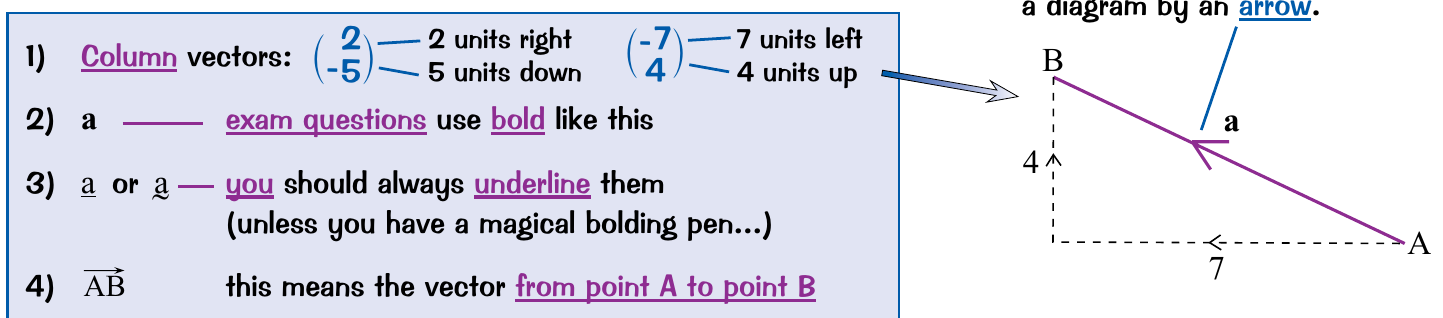
These show movement using coordinates in brackets. For example, the column vector means move 2 units to the right and 5 units down. The top number shows horizontal movement (positive = right, negative = left) and the bottom number shows vertical movement (positive = up, negative = down).
Example
Worked Example: Reading Column Vectors
The column vector means:
- Move 3 units to the left (negative horizontal)
- Move 4 units up (positive vertical)
This represents a movement from any starting point to a position 3 units left and 4 units up.
Bold and underlined notation
In exam questions, vectors are often written in bold text like a or b. When you're writing by hand, you should underline vector letters like or use arrows above them like . This helps distinguish vectors from ordinary numbers or measurements.
Vector from point to point
The notation means "the vector from point A to point B". This shows both the direction (A to B) and represents the movement needed to get from the first point to the second.
Multiplying vectors by scalars
When you multiply a vector by a positive number, you change the vector's size but keep its direction the same. This process is called scalar multiplication, and it literally scales the vector up or down.
Important
If you multiply by a negative number, the vector's direction gets reversed (switched to point the opposite way). This is a crucial concept that many students overlook.
Vectors that are scalar multiples of each other are always parallel to each other.
Adding and subtracting vectors
Vector addition and subtraction allow you to describe movements between points using vectors you already know. This is the foundation of most vector exam questions.
Vector addition
When you see "", this means "go along vector a, then go along vector b". You can think of this as following a route - first follow one vector, then follow the next.
Vector subtraction
The expression "" means "go along vector a, then go backwards along vector d". The minus sign tells you to travel in the opposite direction to vector d.
The route method
To find an unknown vector, you can "get there" by following any route made up of known vectors. This is incredibly useful for solving complex problems.
Note
The route method is like giving directions: "To get from A to C, you can go from A to B, then from B to C." In vector notation, this becomes .
Vectors along a straight line
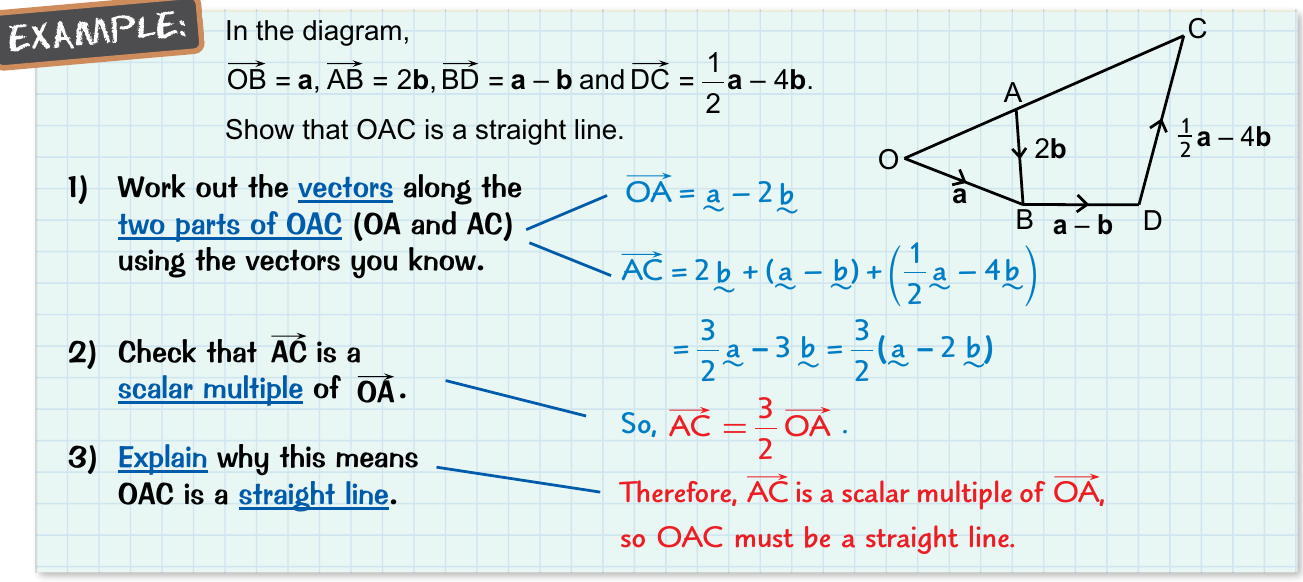
One of the most important applications of vectors is proving that points lie on a straight line. This connects vector algebra with geometric proof.

Important
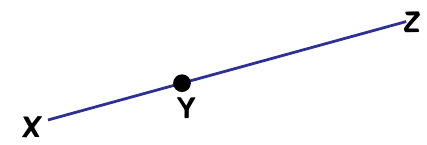
Key Principle for Collinear Points: If points X, Y, and Z form a straight line, then vector must be a scalar multiple of vector . This means the vectors point in the same direction (or opposite directions) and one is simply a scaled version of the other.
To prove three points are collinear (lie on the same straight line):
Example
Worked Example: Proving Collinearity
To prove points A, B, and C are collinear:
Step 1: Calculate the vectors along each part of the line
- Find and
Step 2: Show that one vector is a scalar multiple of the other
- Prove that for some scalar
Step 3: State the conclusion
- Since one vector is a scalar multiple of the other, the points form a straight line
Vector ratios and proportions
Ratios become very useful in vector problems when you need to find vectors to points that divide lines in specific proportions.

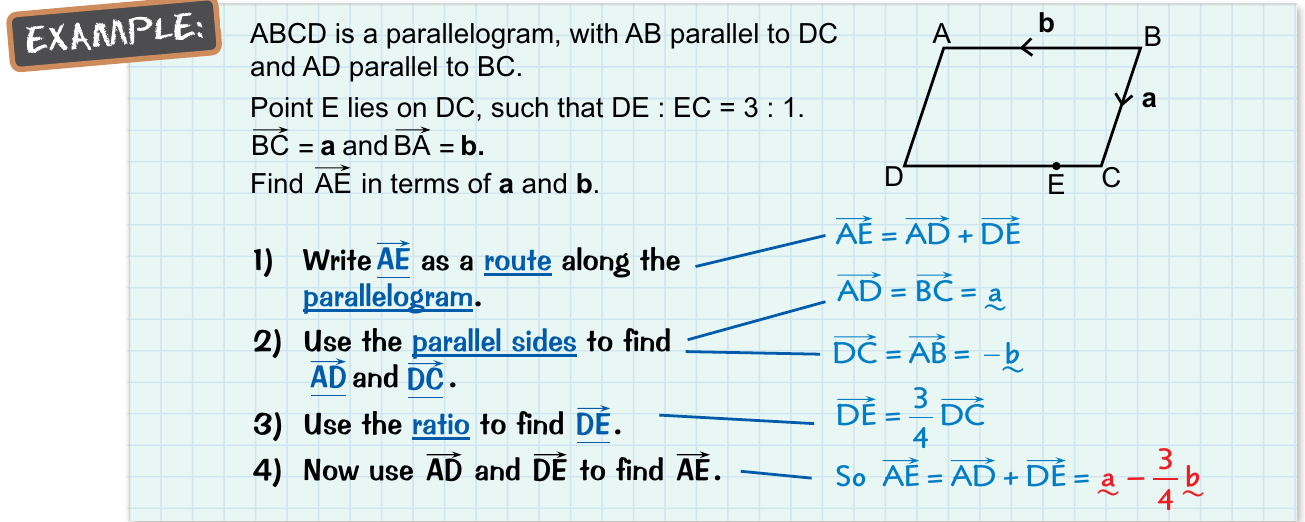
When a point divides a line segment in a given ratio, you can use this information to find vector expressions. For example, if point E divides line DC in the ratio 3:1, then vector DE equals 3/4 of vector DC.
This technique is particularly powerful when working with parallelograms and other geometric shapes, where you can use the properties of parallel sides alongside ratio information.
Example
Worked Example: Using Ratios
If point P divides line segment AB in the ratio 2:3, then:
This is because P divides the line into 2 + 3 = 5 equal parts, with AP taking 2 parts and PB taking 3 parts.
Using vectors in geometric proofs
Vectors provide a powerful method for proving geometric properties. You can use vector methods to prove that shapes are parallelograms, that lines are parallel, or that points are collinear.
The general approach involves expressing unknown vectors in terms of known vectors, using properties like parallel sides or midpoints, applying vector operations to reach your conclusion, and interpreting the mathematical result geometrically.
Summary
Key Steps for Vector Proofs:
- Express unknown vectors in terms of known vectors
- Use properties like parallel sides or midpoints
- Apply vector operations to reach your conclusion
- Interpret the mathematical result geometrically
Remember!
Summary
Essential Vector Concepts:
- Vectors have both size and direction - they represent movement, not just position
- Scalar multiples of vectors are always parallel to each other
- Use the "route method" to find unknown vectors by following paths of known vectors
- Points lie on a straight line if and only if the vectors between them are scalar multiples
- Vector addition means "go along the first vector, then the second" while subtraction means "go backwards along the second vector"