Forces & vector diagrams (Edexcel GCSE Physics Combined Science): Revision Notes
📚Revision Notes
Forces & vector diagrams
Note
A force is a push or pull acting upon an object as a result of its interaction with another object. Forces are represented as vectors because they have both magnitude (size) and direction.
Note
Types of Forces:
- Gravitational force: The force of attraction between two masses.
- Normal force: The support force exerted by a surface.
- Frictional force: The force resisting the motion of two surfaces sliding past each other.
- Tension force: The force transmitted through a string, rope, or wire when it is pulled tight.
Vector Diagrams and Resultant Force
Note
Vector diagrams show the forces acting on an object using arrows. The length of each arrow shows how strong the force is, and the direction of the arrow shows which way the force is pushing or pulling.
Using Scale Drawings to Find a Resultant Force
Step by step:
- Draw all forces acting on the object:
- Ensure the forces are drawn to scale and connected tip-to-tail.
- Determine the resultant force:
- Draw a straight line from the start of the first force to the end of the last force. This line represents the net force acting on the object.
- Measure the magnitude and direction:
- Measure the length of the resultant force line on the diagram to find the magnitude.
- Use a protractor to measure the angle for the direction of the resultant force.
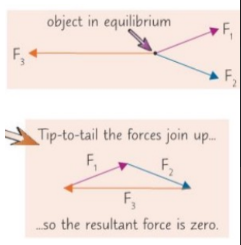
The object is in equilibrium if forces are balanced:
- If all forces on an object make a resultant force of 0 they are in equilibrium.
- On a scale diagram, the tip to tail tip of the force should meet the tail of the force ( in a triangle).
Finding a missing force
Step by step:
- Draw the known forces to scale.
- Join the end of the last known force to the start of the first force. This represents the resultant force.
- Ensure the direction of the missing force is opposite to the resultant force.
- The last drawn line represents the missing force.
- Measure its magnitude and direction using the scale and protractor.
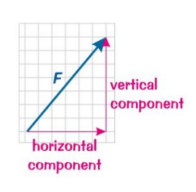
Splitting forces into components
- Not all forces act perfectly horizontally or vertically; some act at angles.
- To simplify these forces, split them into two components at right angles (horizontal and vertical).
- These components together have the same effect as the original force.
- You can work out the size of the components by drawing on a scale grid or using trigonometry.