Investigating elasticity (Edexcel GCSE Physics): Revision Notes
📚Revision Notes
Investigating elasticity
Investigating the link between force & extension
This investigation explores how the force applied to a spring affects its extension.
Steps for Investigation
Note
- Measuring Force:
- Measure the mass of each object (mass in kg) and calculate its weight, which is the force applied to the spring, using the formula:
- W = weight (force) in newtons (N)
- m = mass in kilogrammes (kg)
- g = gravitational field strength (9.8 N/kg on Earth)
Note
Optional Pilot Experiment
Before conducting the full experiment, you may want to perform a pilot test to determine the best size of masses to use:
- Use a similar spring to the one being tested.
- Add masses one at a time and record both the force (weight) and the extension.
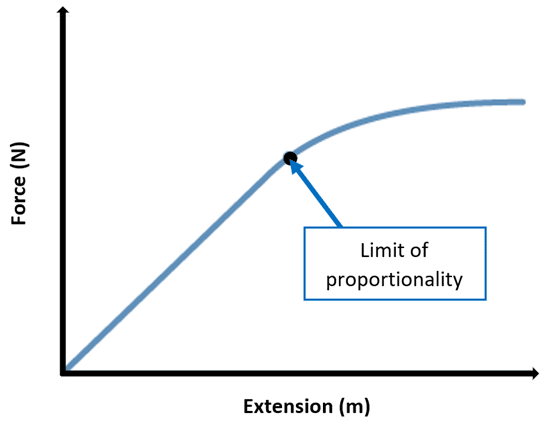
- Plot a force-extension graph. The graph should show a straight line at least for the initial points, which indicates the relationship is proportional.
- If the graph curves too early, it means you're using masses that are too large. Reduce the size of the masses to stay within the limit of proportionality.
Key Findings
Larger Force = Bigger Extension: As more force is applied to the spring, the extension increases proportionally (up to the limit of proportionality).
Note
The force causing this extension is due to the gravitational force acting on the masses, and the extension follows Hooke's Law:
- F = force (N)
- k = spring constant (N/m)
- x = extension (m)
Note
Steps for the Main Experiment
- Measure the Natural Length of the Spring:
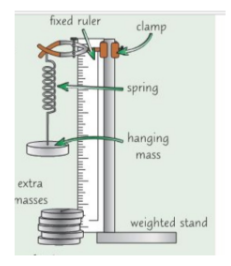
- Without any load, measure the spring's natural length using a millimetre ruler. Clamp the ruler to a stand and ensure the measurement is taken at eye level for accuracy.
- Attach markers (thin strips of tape) to the top and bottom of the spring for clear readings.
- Add Masses:
- Gradually add masses to the spring, allowing the spring to come to rest after each addition.
- Measure the new length of the spring after each mass is added. The extension is the difference between the new length and the natural length.
- Record Data:
- Record the weight (force) and corresponding extension for each mass.
- Repeat:
- Continue adding masses until you have collected at least 6 or more data points for reliable results.
- Plot the Force-Extension Graph:
- Plot the data on a graph with force on the y-axis and extension on the x-axis.
- The graph should show a straight line if Hooke's Law is obeyed. It will start to curve once the spring's limit of proportionality is exceeded.
Calculating Work Done
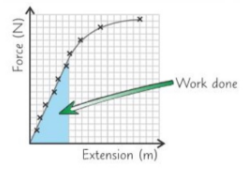
- Work Done: The area under the linear portion of the force-extension graph represents the work done in stretching the spring. This work is stored as elastic potential energy in the spring.
- For linear relationships (before reaching the elastic limit):
- As long as the spring hasn't been stretched beyond its limit of proportionality, the work done is equal to the energy stored in the elastic potential energy store (EPES).
- Elastic Limit: Beyond the elastic limit, the spring undergoes plastic deformation and will not return to its original shape.