Pressure (Edexcel GCSE Physics): Revision Notes
📚Revision Notes
Pressure
Note
Pressure is the force per unit area applied on a surface. It shows how much force is acting on a specific area.
Note
The formula for pressure is:
- Measured in pascals (Pa), where 1 Pa = 1 N/m² (1 pascal is 1 newton of force applied per square metre).
Fluid Pressure
Both gases and liquids are fluids because their particles can move freely.
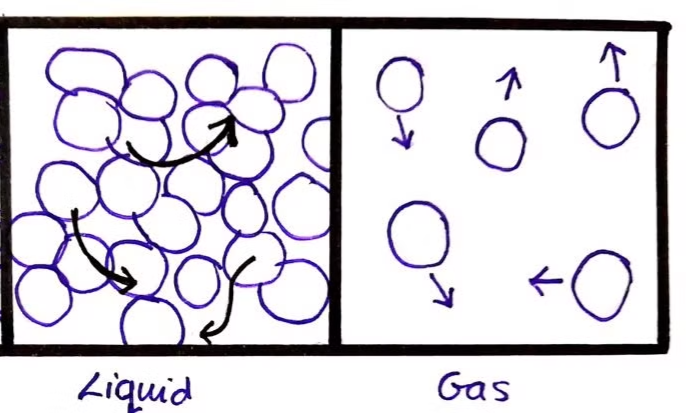
Fluid pressure is the result of collisions between particles in a gas or liquid and the surface they are in contact with.
- Increasing surface area decreases the pressure because the same force is spread over a larger area.
Factors Affecting Fluid Pressure
Fluid pressure depends on:
- Area: Larger surface areas reduce pressure as the force is distributed over more space.
- Properties of the Fluid:
- Density: Denser fluids exert more pressure because there are more particles in a given space, leading to more collisions.
- Temperature: Higher temperatures increase the speed of particles, raising pressure.
- Surrounding Atmospheric Pressure: This is the pressure exerted by the air around us. At higher altitudes, atmospheric pressure is lower because there are fewer air particles.
Pressure in Gases vs. Liquids
Liquids: The density is the same throughout a liquid, so pressure increases steadily with depth.
Gases: The density and pressure of gases can change based on temperature, volume, and surrounding atmospheric pressure.
Pressure and Depth
Pressure in a fluid increases with depth. This is because the weight of the particles above adds to the pressure at any given point. The deeper you go in a fluid, the more particles there are pushing down from above.
Note
Formula for pressure due to depth in a liquid:
Where:
- P is pressure in pascals (Pa),
- h is the depth of the fluid (in metres),
- ρ is the density of the fluid (in kg/m³),
- g is the gravitational field strength (usually 9.8m/s²).
Atmospheric Pressure
Note
Atmospheric pressure is the pressure exerted by the weight of the air in Earth's atmosphere.
Note
At sea level, atmospheric pressure is about 101,325 Pa (or 101.3 kPa). As you go higher in altitude, atmospheric pressure decreases because there are fewer air particles above you.
Applications of Pressure
- Hydraulics: Hydraulics use the principle of pressure in liquids to lift heavy objects. The pressure applied to one part of a hydraulic system is transmitted through the fluid, allowing a small force to create a larger force at another point.
- Aeroplanes: Aeroplanes rely on differences in air pressure above and below the wings to generate lift. The pressure below the wing is higher, pushing the aeroplane upward.
- Diving: Divers experience increasing water pressure as they go deeper. Specialised equipment is used to prevent the body from being crushed by the high pressure at great depths.