Animal & Plant Cells (OCR GCSE Biology A, Combined (Gateway Science Suite)): Revision Notes
📚Revision Notes
1.1.2 Animal & Plant Cells
Note
Sub-cellular structures inside cells each have a specific function.
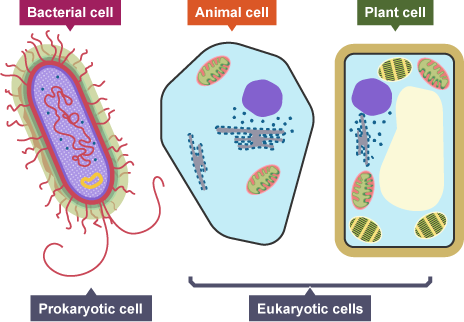
In Animal and Plant Cells:
| Structure | Function |
|---|---|
| Nucleus | • Contains DNA that codes for proteins needed to build new cells. • Enclosed in a nuclear membrane. |
| Cytoplasm | • Liquid substance where chemical reactions occur. • Contains enzymes (biological catalysts) that speed up reactions. • Organelles are found in it. |
| Cell Membrane | • Controls what enters and leaves the cell. |
| Mitochondria | • Site of aerobic respiration, providing energy for the cell. |
| Ribosomes | • Site of protein synthesis. • Found on a structure called the rough endoplasmic reticulum. |
Only in Plant Cells:
| Structure | Function |
|---|---|
| Chloroplasts | • Site of photosynthesis, providing food for the plant. • Contains chlorophyll, which captures light energy. |
| Permanent Vacuole | • Contains cell sap. • Found within the cytoplasm. • Improves cell rigidity. |
| Cell Wall | • Made from cellulose. • Provides strength to the cell. |
In Bacterial Cells:
| Structure | Function |
|---|---|
| Cytoplasm | • Same as in animal and plant cells. |
| Cell Membrane | • Same as in animal and plant cells. |
| Cell Wall | • Made of a different compound (peptidoglycan). |
| Single Circular DNA | • Floats in the cytoplasm as there is no nucleus. |
| Plasmids | • Small rings of DNA. |
Note
Exam Tip To calculate the size or area of subcellular structures, use shapes like circles or rectangles that resemble them. Apply the appropriate formulas for these shapes to find the size or area (e.g., length x width for a rectangle).