Trans National Companies in Zambia (OCR GCSE Geography B (Geography for Enquiring Minds)): Revision Notes
📚Revision Notes
Trans National Companies in Zambia
Introduction to TNCs in Zambia
Trans-national companies (TNCs) are large businesses that operate across multiple countries. They have their headquarters in one nation but run operations, factories, and offices around the world. In Low Income Developing Countries (LIDCs) like Zambia, TNCs often invest in industries where they can access natural resources, lower labor costs, and emerging markets. Understanding how TNCs operate in countries like Zambia helps us see both the opportunities and challenges they create for development.
Note
A TNC (Trans-National Company) is a corporation that has operations in multiple countries but manages them from a central headquarters in one home country. Examples include major companies in food production, manufacturing, mining, and technology sectors.
Zambia faces a key question about its development: Are LIDCs likely to stay poor when global connections influence their progress? The relationship between Zambia and TNCs illustrates this complex situation perfectly.
Case study: Associated British Foods in Zambia
What is Associated British Foods?
Associated British Foods (ABF) is a major trans-national company headquartered in the United Kingdom. The company has a global presence, operating businesses and factories in numerous countries across different continents. In Zambia, ABF owns and controls Zambia Sugar, the company responsible for producing the majority of the country's sugar output. Zambia Sugar not only supplies the domestic market but also exports sugar to international customers, making it a significant player in Zambia's agricultural economy.
Operations in Mazabuka
Zambia Sugar's main factory is located in Mazabuka, a town situated in the center of Zambia's primary sugar-growing region. This location is strategically important because it allows the company to process sugar cane grown in the surrounding agricultural areas efficiently. The company has become the largest employer in this region, providing jobs for thousands of workers in both the fields and the processing facilities.
Note
The strategic location of TNCs is crucial for their operations. By placing factories in the heart of sugar-growing regions, companies like Zambia Sugar minimize transportation costs and can process raw materials quickly before they deteriorate.
The presence of Zambia Sugar has transformed Mazabuka into one of the wealthiest towns in Zambia. The employment opportunities created by the company have brought income to local families, supported the growth of local businesses, and contributed to better infrastructure in the area. This demonstrates one of the potential benefits that TNCs can bring to developing regions: economic development through employment and investment.
Employment and economic contribution
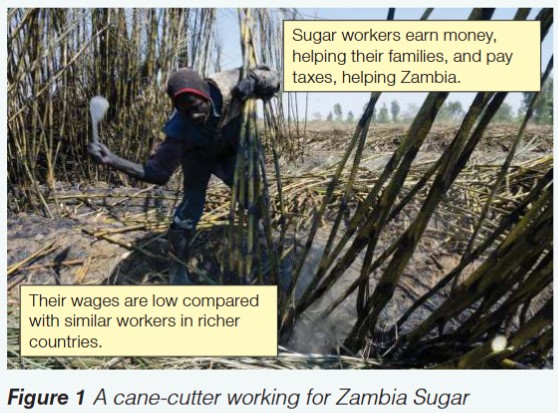
Sugar cane workers in Zambia earn wages that enable them to support their families and meet their basic needs. When these workers spend their earnings in local shops and markets, they contribute to the broader local economy. Additionally, the workers pay income tax on their earnings, which provides revenue for the Zambian government to fund public services.
Important
Wage Disparity Problem
While sugar workers in Zambia receive wages that support their families locally, there is a significant problem: when compared to workers doing similar jobs in wealthier countries, Zambian sugar workers receive considerably lower pay. This wage disparity reflects a common pattern with TNCs operating in LIDCs—while they create employment, the wages paid are often much lower than what would be paid for equivalent work in more developed nations.
This raises important questions about fair compensation and whether workers in developing countries are being adequately rewarded for their labor.
Tax avoidance strategies
The problem with profit transfers
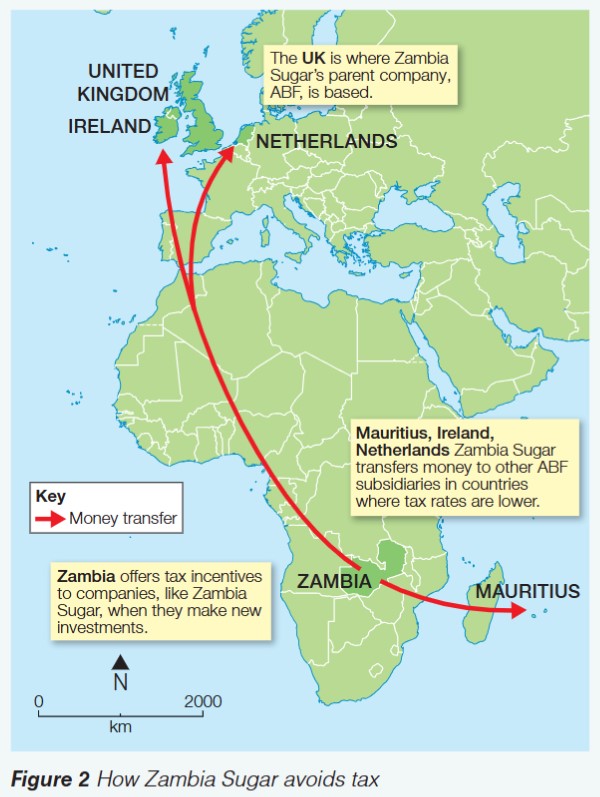
Despite the economic activity generated by Zambia Sugar, ABF contributes minimal tax revenue to the Zambian government. This occurs because the company uses a strategy called profit transfer, where the majority of profits made from operations in Zambia are moved to other countries that have lower tax rates. By doing this, ABF avoids paying significant taxes in Zambia, where the money was actually earned.
Important
How Profit Transfer Works
The process works through a network of subsidiaries (smaller companies owned by the parent company). Profits from Zambia Sugar are transferred through a complex route:
- Zambia (where profits are made) →
- Mauritius (low tax haven) →
- Ireland/Netherlands (favorable tax conditions) →
- United Kingdom (ABF headquarters)
Each of these countries has been chosen because they offer favorable tax conditions, either through low tax rates or special agreements that reduce the amount of tax companies must pay.
This tax avoidance is legal but controversial. While the company follows tax laws, the practice means that Zambia loses out on substantial tax revenue that could be used to improve the country's infrastructure, healthcare system, and education services.
The tax that should benefit Zambian citizens instead benefits other countries' treasuries. This represents a significant loss of potential government revenue that could transform public services in Zambia.
Zambia's development dilemma
The challenge of balancing priorities
Zambia finds itself in a difficult position that many LIDCs face when dealing with TNCs. The country has two competing needs that create a challenging policy dilemma.
On one hand, Zambia desperately needs to increase its tax income. Tax revenue is essential for funding critical public services such as hospitals, schools, roads, and other infrastructure. Without adequate tax collection, the government cannot provide the services its citizens need to improve their quality of life and break out of poverty. Therefore, the government should ideally be collecting substantial taxes from profitable companies like Zambia Sugar.
On the other hand, Zambia wants to encourage TNCs to invest in the country. Foreign investment brings jobs, develops infrastructure, introduces new technologies, and can help modernize the economy. To attract these companies, Zambia offers various incentives, including low tax rates and tax holidays (periods where companies pay reduced or no tax). Companies like ABF are attracted to Zambia partly because of these favorable tax conditions.
Important
The Tax-Investment Paradox
This creates a fundamental paradox for Zambia:
- To attract investment, Zambia offers low taxes
- But this means the country collects less revenue from the companies it attracts
- If Zambia raised taxes to increase revenue, companies might choose to invest elsewhere
This dilemma is not unique to Zambia but affects many developing countries trying to balance economic development with the need for government revenue. It represents one of the core challenges of development in a globalized economy.
Benefits and problems of TNCs in LIDCs
Benefits that TNCs can bring
When TNCs invest in LIDCs like Zambia, they can create several positive impacts that contribute to economic development and improved living standards:
Employment creation: TNCs often become major employers in the regions where they operate. Zambia Sugar, for example, provides jobs for thousands of workers in Mazabuka and the surrounding area. These jobs provide regular wages that allow families to afford food, housing, education, and healthcare.
Skills and training: TNCs typically bring modern business practices and technologies. Workers gain experience and skills that can improve their future employment prospects, even if they later leave the company.
Note
When workers develop new skills through TNC employment, they become more valuable to other employers. This can improve the overall skill level of the workforce in the region, benefiting the economy even beyond the TNC's direct employment.
Economic growth: The presence of a large company stimulates the local economy. Workers spend their wages in local businesses, creating a multiplier effect that benefits shops, services, and other enterprises in the area.
Infrastructure development: TNCs may invest in local infrastructure such as roads, electricity supply, and telecommunications to support their operations. These improvements can benefit the wider community.
Export earnings: When companies like Zambia Sugar export products, they bring foreign currency into the country, which can help stabilize the national economy and fund imports of essential goods.
Problems that TNCs can create
Despite these benefits, TNCs can also create significant problems for host countries that can undermine development and perpetuate inequality:
Tax avoidance: As demonstrated by ABF's profit transfers, TNCs can use legal strategies to minimize their tax contributions. This deprives host countries of revenue that should be used for public services and development.
Low wages: Even when TNCs create employment, wages are often much lower than what workers would receive for similar work in developed countries. This can perpetuate poverty despite economic activity.
Important
The wage disparity between workers in LIDCs and developed countries doing similar work is one of the most criticized aspects of TNC operations. Critics argue that TNCs take advantage of desperate economic situations to pay wages that would be unacceptable in their home countries.
Profit repatriation: The majority of profits leave the country rather than being reinvested locally. This means that while economic activity occurs in the LIDC, the financial benefits accumulate elsewhere.
Limited technology transfer: While TNCs may bring some modern practices, they often keep their most advanced technologies and management expertise in their home countries or other developed nations.
Environmental concerns: TNCs may not always adhere to the same environmental standards they would follow in their home countries, potentially causing damage to local ecosystems.
Economic dependency: When a region becomes heavily dependent on a single TNC for employment, the local economy becomes vulnerable. If the company closes operations or moves elsewhere, the economic impact can be devastating.
Unequal power relationship: TNCs are often much larger and more powerful than the governments of LIDCs, giving them significant influence over economic policy and the ability to negotiate favorable terms.
Summary
Key Points to Remember
-
Associated British Foods (ABF) is a UK-based TNC that owns Zambia Sugar, producing most of Zambia's sugar in its factory at Mazabuka in the sugar-growing region.
-
ABF avoids paying significant tax in Zambia by transferring profits through subsidiaries in countries with lower tax rates (such as Mauritius, Ireland, and the Netherlands) before they reach the UK.
-
Workers benefit from employment as sugar workers earn wages to support their families and pay taxes, but their wages are significantly lower compared to similar workers in wealthier countries.
-
Zambia faces a difficult dilemma: it needs tax revenue to fund essential services like healthcare and education, but it also wants to attract TNC investment by offering low tax incentives.
-
TNCs bring both benefits and problems: they create employment, stimulate local economies, and bring investment, but they also avoid taxes, pay low wages, and transfer most profits out of the host country.