Providing Enough Water (OCR GCSE Geography B (Geography for Enquiring Minds)): Revision Notes
📚Revision Notes
Providing Enough Water
Understanding water supply infrastructure
Meeting the growing demand for water requires large-scale infrastructure projects. Two main approaches are used: building reservoirs to store water and creating water transfer schemes to move water from areas of surplus to areas of shortage. While these solutions help meet human water needs, they have significant environmental consequences that must be understood.
Note
Understanding both the benefits and environmental costs of water infrastructure is essential for sustainable water management. Every solution involves trade-offs between human needs and ecological health.
What are reservoirs?
A reservoir is a large body of water, either natural or man-made, that serves as a storage facility for water supplies. When reservoirs are constructed, extensive areas of land must be deliberately flooded to create the water storage area. This process permanently removes land from its previous use and dramatically changes the landscape.
The construction of reservoirs typically involves building a dam structure across a river valley. Once the dam is in place, water accumulates behind it, gradually flooding the land upstream. This flooded area becomes the reservoir, holding water until it is needed for human consumption, agriculture, or industry.
How reservoirs are created
Most modern reservoirs are formed by constructing a dam across a river channel. The dam acts as a barrier, preventing water from flowing naturally downstream. As water continues to flow into the area from upstream sources, it accumulates behind the dam wall, gradually filling the valley and creating a large artificial lake.
Note
The process of creating a reservoir is not instantaneous. It can take months or even years for a reservoir to fill completely, depending on the size of the valley and the volume of water flowing into it.
This process of dam construction and land flooding has profound effects on the natural environment. The ecosystems that existed in the valley before flooding are completely transformed, affecting both the areas upstream and downstream of the dam structure.
Environmental impacts of reservoirs
Building reservoirs and dams creates two distinct zones of environmental impact: the area upstream of the dam and the area downstream. Each zone experiences different types of ecological disruption.
Upstream impacts
The land behind the dam experiences the most dramatic changes. When the valley floods to create the reservoir:
- Habitat destruction occurs on a massive scale. The flooding completely submerges existing ecosystems, eliminating the living spaces where plants and animals previously survived. Entire communities of organisms lose their homes permanently.
- Human settlements and industrial areas may be inundated. If floodwaters reach towns or industrial facilities, pollutants from these areas can contaminate the reservoir water, affecting water quality and requiring expensive treatment.
- Deep water zones become oxygen-depleted. The deepest parts of the reservoir often develop into "dead zones" where oxygen levels drop too low for most species to survive. This happens because sunlight cannot penetrate to great depths, preventing photosynthesis and oxygen production, while decomposition of organic matter consumes available oxygen.
- Fish migration is permanently blocked. The dam creates a physical barrier that prevents fish from travelling along their traditional migration routes. Species that need to move between different parts of the river system to breed or feed cannot complete their life cycles, leading to population declines.
Important
Dead zones represent one of the most serious ecological impacts of reservoir creation. These oxygen-depleted areas cannot support most aquatic life, effectively creating underwater deserts where biodiversity collapses. The deeper the reservoir, the more severe this problem becomes.
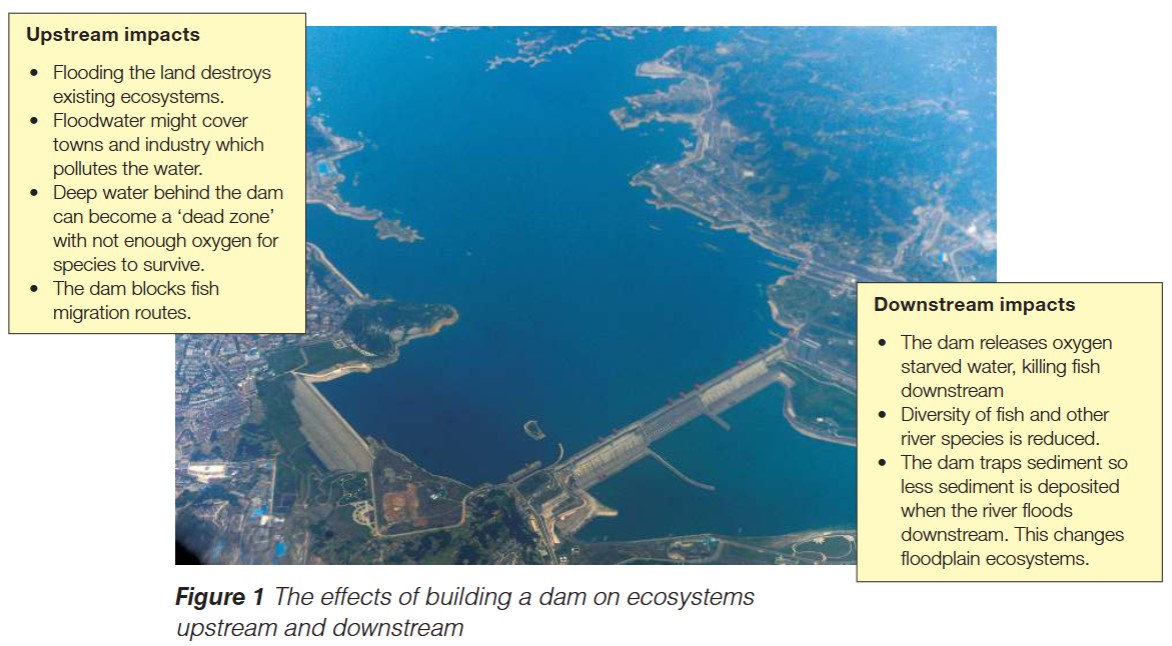
Downstream impacts
The river below the dam also experiences significant environmental changes:
- Oxygen-starved water is released from the dam. When water is released from deep within the reservoir, it contains very little dissolved oxygen. This oxygen-depleted water flows downstream, killing fish and other aquatic organisms that require higher oxygen levels to survive.
- Biodiversity decreases. The altered river conditions below the dam cannot support the same variety of species that lived there before. Fish populations decline, and the diversity of other river species diminishes as the ecosystem becomes less complex and resilient.
- Sediment flow is disrupted. The reservoir traps sediment that would naturally flow downstream. Without this regular sediment supply, downstream areas receive less deposition when the river floods. This changes the character of floodplain ecosystems, affecting the plants and animals adapted to natural sediment patterns.
Note
Sediment trapping can have consequences far beyond the immediate downstream area. Rivers that naturally deposited sediment in coastal deltas may no longer deliver this material, leading to coastal erosion and loss of valuable wetland habitats hundreds of kilometers away.
Water transfer schemes
Water requirements can also be met by moving water between different regions. Water transfer schemes involve transporting water from areas where supply exceeds demand (donor areas) to areas experiencing water shortages (receiving areas). This transfer occurs through artificial channels, pipelines, or canal systems specifically constructed for this purpose.
While water transfer schemes help balance water availability across regions, they create their own set of environmental challenges.
Environmental impacts of water transfer
Moving water artificially between ecosystems causes ecological disruption in both the donor and receiving areas:
- Species are accidentally transferred between ecosystems. Water contains not just H₂O molecules but also living organisms, seeds, eggs, and larvae. When water moves from one ecosystem to another, these organisms travel with it. Species introduced to new environments may become invasive, outcompeting native species and disrupting established ecological relationships.
- Natural flooding patterns are reduced in donor areas. Extracting water from rivers or lakes in the donor area reduces the water volume available for natural processes. This means that natural floods become less frequent or less extensive. Species adapted to seasonal flooding patterns may struggle to survive without these regular events.
Important
Invasive species transferred through water schemes can cause devastating ecological and economic damage. Once established in a new ecosystem, invasive species are extremely difficult and expensive to control or eradicate. Prevention through careful water treatment is far more effective than attempting to manage invasions after they occur.
Summary
Key Points to Remember:
-
Reservoirs are large water storage facilities created by flooding land behind dams built across rivers
-
Dam construction destroys upstream habitats through flooding and creates oxygen-depleted "dead zones" in deep water, while blocking fish migration routes
-
Downstream ecosystems suffer from oxygen-starved water releases, reduced biodiversity, and disrupted sediment flow that changes floodplain characteristics
-
Water transfer schemes move water through artificial channels from donor areas to receiving areas, helping meet water demand where supplies are insufficient
-
Transferring water between regions causes species to be moved between ecosystems and reduces natural flooding in donor areas, both of which disrupt ecological balance