At Home in Istanbul (OCR GCSE Geography B (Geography for Enquiring Minds)): Revision Notes
📚Revision Notes
At Home in Istanbul
Learning objectives
Note
By the end of this topic, you should understand:
- Why Istanbul faces significant housing challenges related to rapid urbanization
- How poor migrants initially responded to housing shortages through informal solutions
- How housing conditions in the city have improved over time through redevelopment and gentrification
Istanbul's housing challenge
Rapid urbanization in Turkey
Turkey has experienced dramatic urban growth over the past six decades. During the 1960s, approximately 20% of the country's population lived in cities. By today, this figure has increased to around 70%, meaning that seven out of every ten Turkish people now live in urban areas. This rapid shift from rural to urban living has created a major housing challenge, particularly in Istanbul, Turkey's largest city.
The massive influx of people moving from rural areas to cities in search of employment and better opportunities meant that formal housing construction could not keep pace with demand. This left many poor migrants with no affordable legal housing options, forcing them to develop their own solutions to the housing crisis.
Important
Key Challenge
The rapid pace of urbanization meant that formal housing construction could not keep up with demand, leaving poor migrants with no affordable legal housing options. This forced them to develop their own informal solutions to survive.
Solutions to housing challenges
Gecekondu: squatter settlements
Poor migrants arriving in Istanbul developed creative responses to the lack of affordable housing. One major solution was the construction of squatter settlements around the edges of the city on vacant land. These informal settlements are known as gecekondu, a Turkish word meaning 'built overnight'.
The name reflects how quickly these structures were erected. Families would build simple shelters rapidly, sometimes literally overnight, to establish their presence on the land. These settlements were not planned by the city authorities and were built without formal permission. Over time, some gecekondu settlements have been improved or rebuilt to become permanent parts of the city.
Note
Characteristics of Gecekondu
The original gecekondu structures faced several challenges:
- Not built to high construction standards
- Lacked proper foundations and adequate materials
- Missing basic services such as running water, electricity, or sewage systems
- Living conditions were initially very poor
Despite these problems, they provided essential shelter for migrants who had no other affordable options.
Transforming old homes into apartments
A second solution involved converting existing old homes in the city centre into apartment blocks. Property owners would add new storeys to existing buildings, creating multiple dwelling units where previously there had been single-family homes. This process allowed more people to be accommodated in the same footprint of land.
Like the gecekondu settlements, these conversions were often carried out without proper building regulations or high construction standards. The resulting apartment blocks were poorly built and sometimes structurally unsafe, but they provided housing for migrants who had few other options.
Urban improvement and redevelopment
From informal to formal housing
Over time, many of the original squatter settlements and poorly built apartment conversions have undergone transformation. Some gecekondu areas have been demolished and redeveloped as high-rise housing estates with better construction standards and improved facilities. This has created more formal, permanent housing in areas that were once informal settlements.
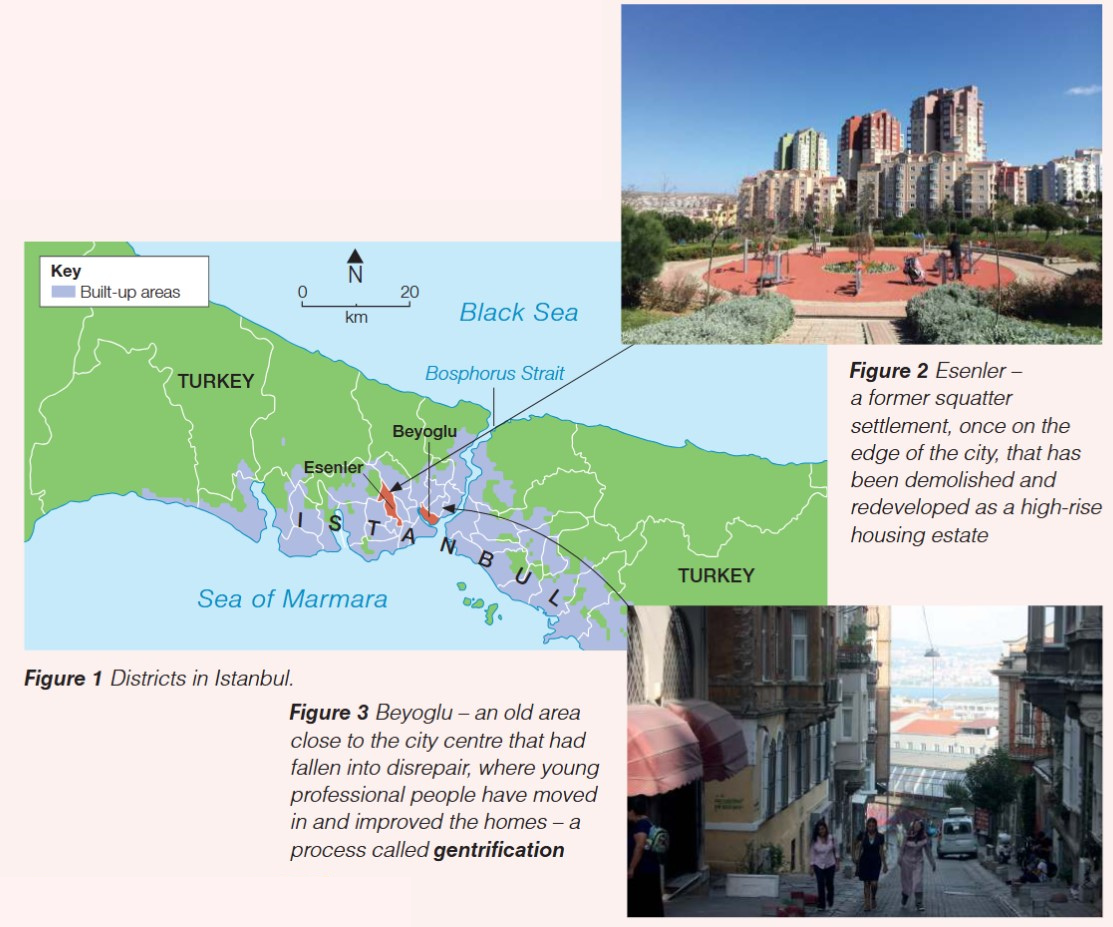
Example
Case Example: Esenler's Transformation
The image above shows Esenler, a district that was once located on the edge of Istanbul as a squatter settlement. The transformation demonstrates how informal housing can be formalized:
Before: Gecekondu settlement with poor-quality, informal housing built on vacant land
After: Modern high-rise housing estate featuring:
- Better construction standards and structural safety
- Public parks and green spaces
- Recreational facilities including playgrounds
- Improved access to basic services
This represents a complete transformation from informal to formal housing.
Gentrification of older urban areas
Another process affecting Istanbul's housing is gentrification. This occurs when old, run-down areas close to the city centre become fashionable and desirable. Young professional people with higher incomes move into these districts and invest money in improving the properties. They renovate old homes, upgrade facilities, and improve the overall appearance of the neighbourhood.
Beyoğlu is an example of a district in Istanbul that has experienced gentrification. This area, which had fallen into disrepair, has been transformed as wealthier residents moved in and modernized the housing stock. While gentrification improves the physical quality of housing and the urban environment, it can also make areas unaffordable for the original, lower-income residents.
Note
The Double-Edged Impact of Gentrification
Gentrification brings both benefits and challenges:
Positive impacts:
- Improved physical quality of housing
- Better urban environment and facilities
- Increased property values
Negative impacts:
- Rising costs make areas unaffordable for original residents
- Displacement of lower-income communities
- Loss of original neighborhood character
Case studies: Beyoğlu and Esenler
These two districts illustrate different approaches to addressing Istanbul's housing challenges:
Beyoğlu is located close to the city centre. It contains older housing stock that had deteriorated over time. The area has undergone gentrification, with young professionals moving in and renovating properties. This has improved housing quality but changed the social character of the district.
Esenler was originally a gecekondu settlement built on vacant land on the edge of the city. It has been demolished and completely redeveloped as a modern high-rise housing estate. This represents a more dramatic transformation from informal to formal housing.
| District | Location in the city | What was housing like? | Who lived there? | How was it improved? |
|---|---|---|---|---|
| Beyoğlu | Close to city centre | Old homes that had fallen into disrepair | Originally lower-income residents; now increasingly young professionals | Gentrification - residents renovated and improved properties |
| Esenler | Former edge of city (originally vacant land) | Gecekondu (squatter settlement) with poor-quality, informal housing | Poor migrants from rural areas | Demolished and redeveloped as high-rise housing estate with better facilities |
Exam guidance
Important
Command Words to Watch For
Understanding command words is essential for exam success:
- Describe: State the characteristics of something (e.g., "Describe the features of gecekondu settlements")
- Explain: Give reasons why something happens (e.g., "Explain why migrants built gecekondu in Istanbul")
- Assess/Evaluate: Weigh up the advantages and disadvantages or consider different viewpoints (e.g., "Evaluate the impacts of gentrification on urban communities")
Important
Exam Tips for Success
- When discussing housing solutions in Istanbul, always link them to the context of rapid urbanization (20% to 70% urban population)
- Use specific place examples: Beyoğlu for gentrification, Esenler for redevelopment
- Remember that housing challenges have multiple solutions - both informal (gecekondu, apartment conversions) and formal (redevelopment, gentrification)
- Be prepared to discuss both positive and negative impacts of urban improvement schemes
Remember!
Summary
Key Points to Remember
Major Trends:
- Turkey's urban population increased from 20% in the 1960s to 70% today, creating housing challenges in cities like Istanbul
- Poor migrants developed informal housing solutions including gecekondu (squatter settlements built overnight) and converting old homes into apartments
- Later, many informal settlements were redeveloped into high-rise housing estates with better facilities (e.g., Esenler)
- Gentrification has improved some older urban areas, where young professionals renovate properties, though this can displace lower-income residents (e.g., Beyoğlu)
Key Terms:
- Gecekondu: Turkish word meaning 'built overnight'; informal squatter settlements built rapidly on vacant land
- Gentrification: The process where wealthier, often younger professionals move into run-down urban areas and improve properties, leading to neighbourhood transformation
- Squatter settlement: Informal housing built on land without legal permission or ownership
Critical Processes:
- Rapid urbanization creating housing demand
- Informal housing development (bottom-up solutions)
- Urban redevelopment and improvement (top-down solutions)
- Gentrification changing the social and economic character of neighbourhoods