Crimes and criminals in industrial Britain (OCR GCSE History B (Schools History Project)): Revision Notes
📚Revision Notes
Crimes and criminals in industrial Britain including the increase in crime in the first half of the nineteenth century
Note
The emergence of the industrial and agricultural age in Britain brought economic and social changes in the nature of crimes during this period. Crimes involving trade and transport such as smuggling and highway robbery became common.
SMUGGLING
This type of crime which existed many centuries before the Industrial Revolution, and involved the secret trade in goods to avoid paying customs duties. Compared to other parts of Britain, smuggling was common in settlements near the coastline. Smugglers sold goods at much cheaper prices. In addition to smuggling communities in Cornwall, as depicted in the series 'Poldark', West Wales including Brandy Cove near Swansea was known for smuggling.
In order to increase government revenue and fund foreign wars, authorities hunted down smugglers in the 18th century. During this time, government income primarily came from customs and excise duties on imported goods such as tea, wine, chocolate, salt, leather and soap.
The 18th century became known as the golden age of smuggling in Britain. Most smugglers were funded by venturers. Smuggling gangs were usually composed of about 100 members, all playing different roles.
- In the 1700s, smuggling of salt between New Quay and Fishguard in Wales was common.
- Manorbier, Solva and St. Brides Bay became centres of smuggling, while Skomer and Skokholm islands were infamous for smugglers.
- In 1747, William Owen, who was arrested for smuggling brandy and salt from the Isle of Man to Cardigan Bay, was executed.
- Despite high penalties, smuggling did not stop. By the late 18th century, this illegal trading declined when the government reduced tax on imported goods, particularly tea.
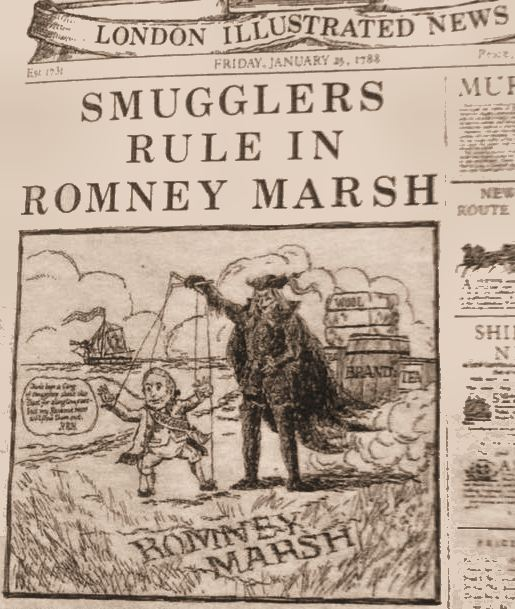
Smugglers political cartoon
In 1784, tax on tea was reduced from 119% to 12%. By the 1840s, the British government adopted a free trade policy on exported goods.
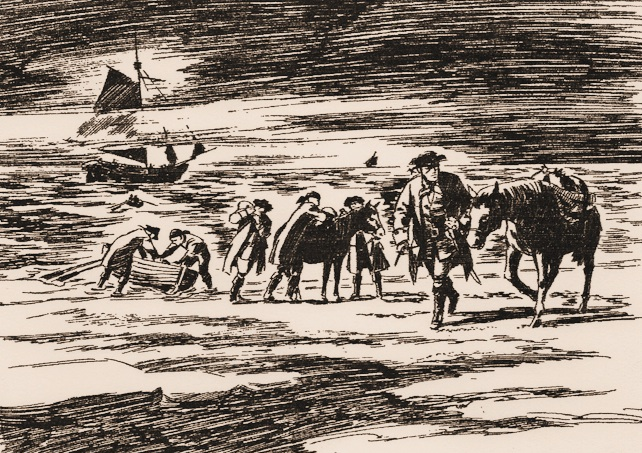
Depiction of smugglers and a ship
Note
It was estimated that there were 20,000 active smugglers by the middle of the 18th century.
HIGHWAY ROBBERY
Highway robbery was a mediaeval crime which increased in the 18th century. Similar to smuggling, this crime was not a major worry, yet was greatly associated with changes in trade and transport. It is believed that highway robbery grew in the 18th century due to the following reasons:
- Increase in transportation and travel for business
- Improvement in roads which allowed for greater volume and frequency of travel
- More money was carried by road due to limited banks Robbers were frequently reported in London as it was the most prosperous part of Britain.
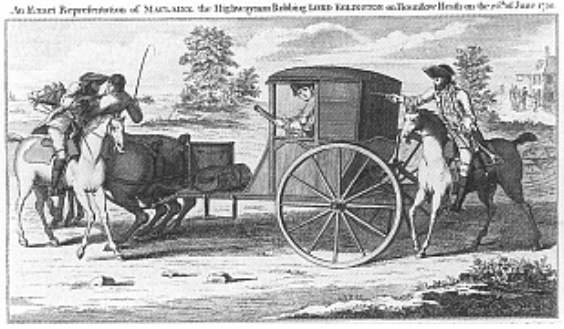
Representation of Maclane the Highwayman Robbing Lord Eglinton, 1750
Until the roads became safer, travellers lived in fear of highwaymen targeting them on the lonely, quiet tracks along which coaches travelled. Highwaymen would demand money with catch phrases such as 'Stand and deliver!' and 'Your money or your life!'
-
A footpad was a robber on foot who robbed travellers on foot. Most were members of a gang.
-
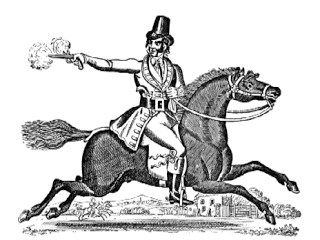
Robbers who were on horseback were called highwaymen who typically worked alone or in small groups. They robbed travellers in carriages or on horseback.
Most robberies by highwaymen, who were often armed with pistols, did not result in violence, unlike footpad attacks.
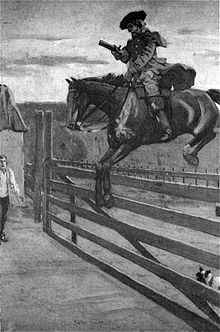
Depiction of Dick Turpin
A former butcher turned highwayman, Dick Turpin, was probably the most infamous in his group. He joined a gang of robbers who burgled houses and stole cattle. With his partner Tom King, he became a highwayman in Lincolnshire. He changed his name when he fled to Yorkshire. Charged of horse theft, he was gaoled and hanged in York, in 1739.
Other prominent highway robbers included:
- John Rann, who was arrested six times, but was never convicted. He was hanged in 1774 after robbing a chaplain.
- Thomas Jones, also known as Twm Sion Cati, was a Welsh highwayman who was tagged as the Welsh Robin Hood for robbing the rich and giving it to the poor in Cardiganshire.
By the nineteenth century, attacks by highwaymen were becoming much more infrequent.
- The number of banks increased and more people deposited cash, gold and jewellery in banks rather than carrying it around with them.
- The roads became much busier as surfaces improved. Open land began to be built upon as London and other towns increased in size, and more and more fields were enclosed, making it harder to freely ride across the countryside.
- Justices of the Peace stopped giving licences to taverns where highwaymen were known to be customers. This made it more difficult for the robbers to sell stolen goods.
- Mounted patrols were set up around London and high rewards were offered to encourage informers to give information on highwaymen.
Note
Rapid industrialisation in Britain between 1700 and 1900 led to changes in working patterns, and fears that machinery would take away people's jobs increased. Working-class people also began to think about their common interests. These developments led workers into conflict with their employers, leading to new crimes being defined.
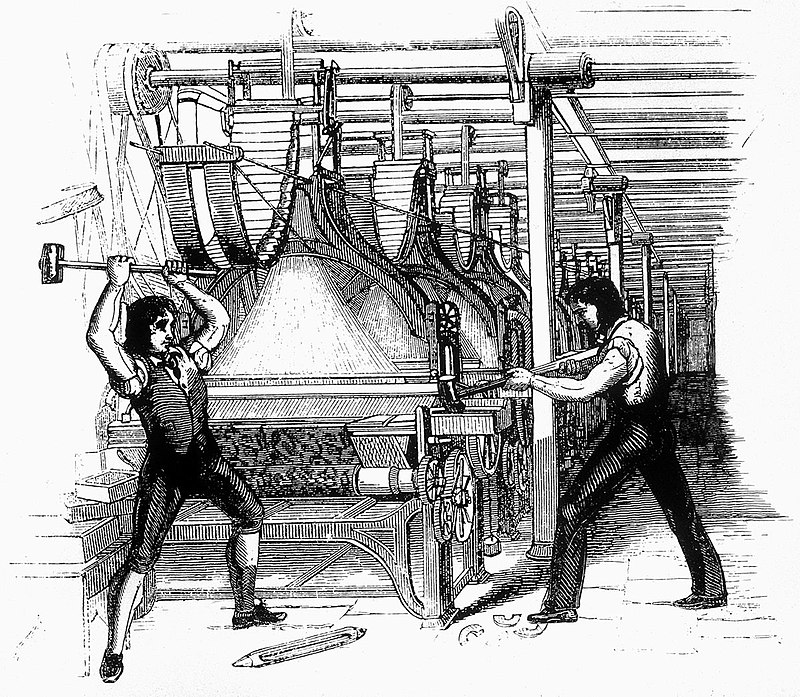
Depiction of Luddites destroying machinery
Clashes between Luddites and the British Army occurred on a number of occasions. So problematic were Luddites that at one point there were more British Army soldiers fighting them than in the Iberian Peninsula against Napoleon!
In response to the Luddite's destruction, the government undertook mass trials. Those with sufficient evidence against them faced execution or transportation. The government also criminalised machine breaking and classed it as industrial sabotage. In 1812, the Frame Breaking Act 1812 made the death penalty available for breaking machines.
ROOKERIES
In addition to stealing and assault, crimes related to the new railway system emerged. The majority of reported crimes were theft. Places such as St. Giles and King Street became known as rookeries where criminal activities became common. There were thimble skewers who stole pocket watches, prop nailers who targeted pins and brooches, and drag sneaks who stole goods from carts.
The most common type of theft in industrial towns and cities was pickpocketing. Pickpockets, mostly the young, worked in large crowded areas. They typically stole purses, watches, pins and brooches. Stealing water through pipelines was a type of theft in squalid cities.
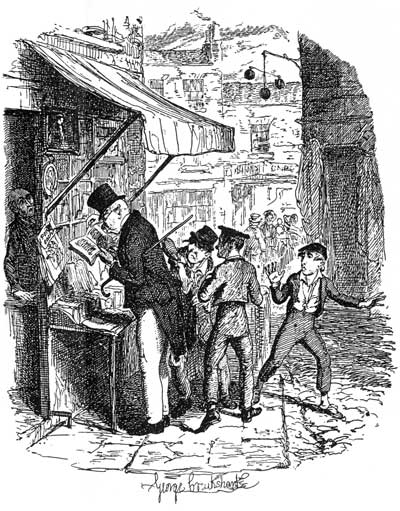
Depiction of Charles Dickens's Oliver Twist and Criminology
In rural areas, many farm labourers were put out of work. Those who were employed received low wages, while working long hours. Out of poverty, many resorted to poaching.
Note
POACHING also became a problem for the authorities at this time. Poaching had been a fact of life in England for centuries, despite harsh laws against it. In the 18th century, however, the nature of poaching changed as large gangs began to illegally take animals from estates.
As a result of the growing rural poor, many resorted to machine breaking and rioting in the south-east area of England. In south-west Wales, groups of farmers dressed as women assaulted toll gates between 1839 and 1843. These groups particularly resented Poor Laws, tithes and high rents.
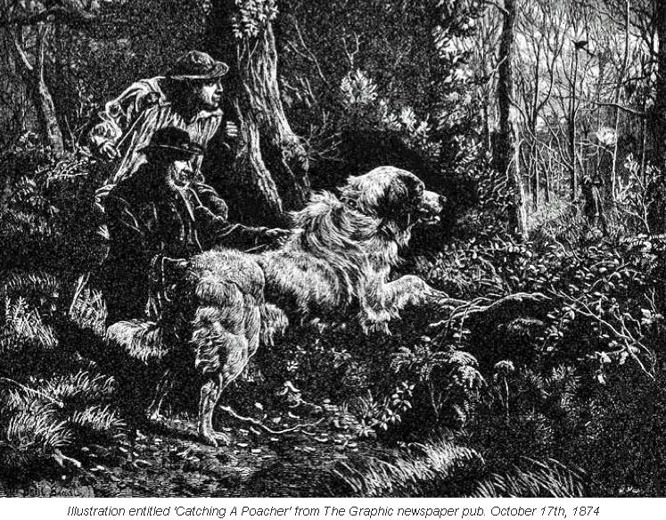
Catching a Poacher illustration, 1874
PROSTITUTION
Although prostitution existed since ancient times, greater exploitation of women in brothels and streets in London occurred. In 1882, a Select Committee report found that prostitution of young girls in London had become common.
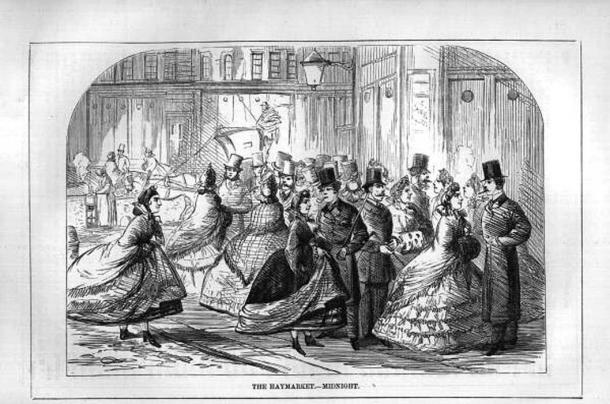
Depiction of Haymarket as a place of prostitution in London
MURDER
In the 19th century, murder was not a common crime. However, between the 1850s and 1860s, people's interest in such crime increased after a series of garrottings. This event led to public panic and curiosity over murder trials.
In the 1880s, the killing and mutilation of women by a serial killer, who the people called Jack the Ripper, increased the public's interest in murder. The victims were from the East End of London. Marked as the 'evil square mile', the slum areas of Whitechapel, Aldgate and Spitalfields were believed to be the target areas of the killer, who is still unidentified today.
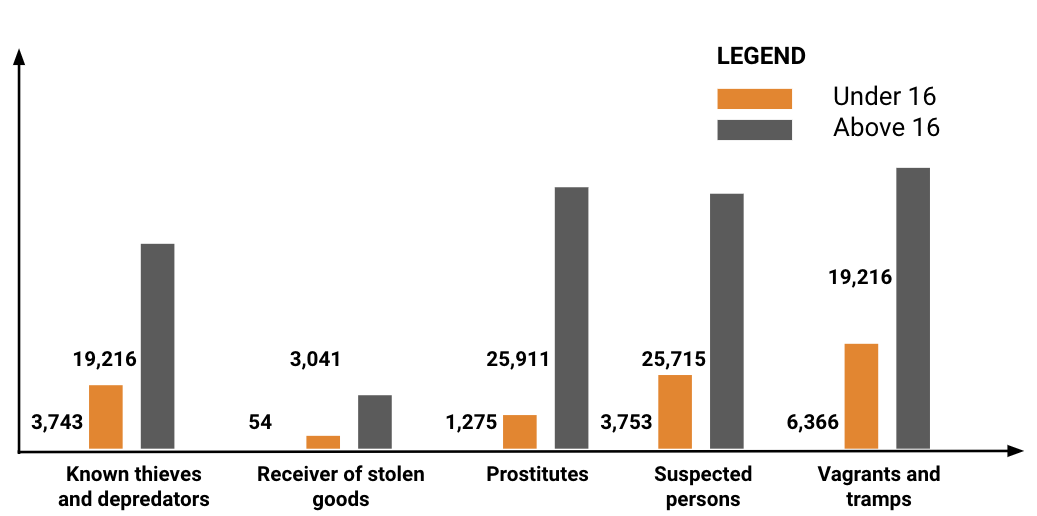
Criminal classes at large at England and Wales in 1868 according to the Judicial Statistics