Industrialisation, the growth of major cities and political change (OCR GCSE History A (Explaining the Modern World)): Revision Notes
📚Revision Notes
Industrialisation, the growth of major cities and political change
Note
As the Industrial Revolution mainly began in Great Britain, the leading commercial power in the 18th century, its most profound effects were first felt on the isles. While population numbers did grow exponentially in the late 18th and 19th centuries, it was difficult for even rapid industrialising processes to keep up with the increases in demand for food and housing.
The key public health issues during the Industrial Revolution included widespread epidemics of infectious diseases like cholera, typhoid, typhus, smallpox and tuberculosis. These can all be traced back to overpopulated cities, poor housing and living conditions, mass pollution, and a lack of a public infrastructure to care for people's health.
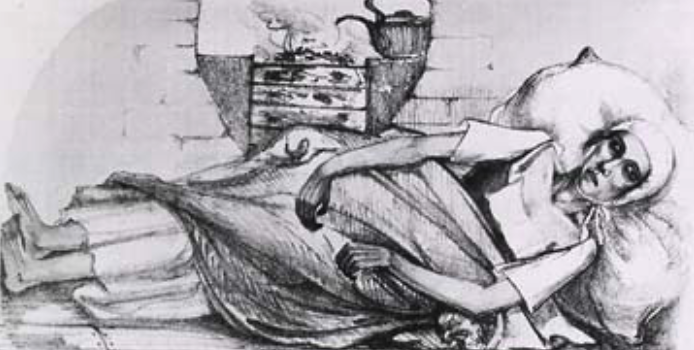
Image depiction of one of the first cholera victims in Sunderland, Britain, in November 1831
The Industrial Revolution directly led to the population growth in towns and cities. From about 5 million people in 1700, the population increased to about 9 million in 1801. Many people from the countryside sought job opportunities in industrial cities. Moreover, the influx of migrants from Ireland, Scotland and Wales also contributed to Britain's population. By the turn of the 19th century, about 1 in 10 of the entire British population lived in London, making it the most populous city.
In addition to London, migrants also moved to the industrial cities of Manchester, Leeds, Birmingham, Liverpool, Edinburgh and Glasgow.
Note
The map shows the population growth in Britain during the Industrial Revolution. It specifies the location of iron and coal fields relevant to the growth of industrial cities.
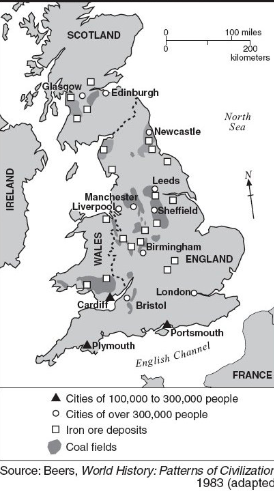
Map showing industrialisation in Britain in 1830
Why did people migrate to industrial cities?
- Existence of factories
- Establishment of market centres catering for new goods
- Emergence of banking and commerce

Note
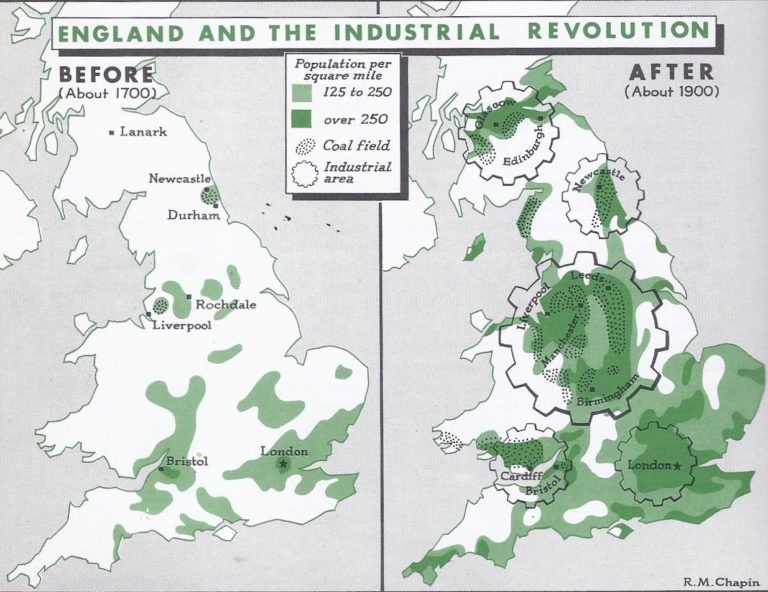
Carefully examine the map of England in the pre- and post-Industrial period.
Notice the increase in population and location of industrial areas, such as Glasgow, Edinburgh, Newcastle, Liverpool, Leeds, Manchester, Birmingham, London, Cardiff and Bristol.
Industrialisation in Britain did not only cause the migration of rural workers to towns and cities. This demographic change also shifted political influence from rural areas to urban centres. As a result of many workers seeking jobs in industrial cities, the old landed aristocracy declined. The use of land for agriculture diminished, thus lowered the influence of the wealthy landed class. The rapid movement to cities created a new working class, as well as a new political consciousness.
Diagram showing the impact of industrialisation on urbanisation and politics

Note
New working class and political power of the Proletariat The new working class believed that they should have influence in politics. Aside from poor living conditions in filthy slums, they were also exposed to unprotected working conditions and long working hours. Such political ideas rapidly spread in dense industrial cities.
Prior to the Education Acts of 1870 and 1872, members of the upper and middle class viewed the new working class as less civilised people. With the emergence of skilled workers or the artisan class, the degrading view began to change.
In 1832, Whig leader Charles Earl Grey led a campaign to make Parliament more representative of the people. Despite the Conservative opposition and rejection of the House of Lords, the Reform Bill was passed on 13 April.
→ This gave industrial cities such as Liverpool and Manchester representation in Parliament.
→ But even so, only 14% of British males were given the right to vote.
→ Those working in factories were still not allowed since they had a limited amount of property.
→ Moreover, women were not allowed to vote.
Despite the failure of the Reform Bill to give factory workers the right to vote, this change in legislation led to another politico-economic issue.
The Sadler Report
In 1832, Michael Sadler, a member of the House of Commons, held a hearing on child labour. The report was published the following year which stated the following results:
- Long hours of work (12 hours or more)
- Low pay
- Dangerous working conditions
The Factory Act of 1833
In support of the Sadler Report, Lord Ashley Cooper led the passage of the Factory Act which set standards for child labour, particularly those working in textile factories. The act specified the following:
- Children aged 12 to 18 could not work for more than 12 hours a day
- Children aged 9 to 12 could not work for more than 9 hours a day
- 90-minute meal breaks should be provided
- No child could work between 8:30 pm and 5:30 am