Types of number (OCR GCSE Maths): Revision Notes
📚Revision Notes
Types of number
1. Integers
Definition: Integers are whole numbers. They can be positive, negative, or zero.
Note
📑Examples:
- Important Note: Numbers like or are not integers because they are not whole.
Note
📑Worked Example:
2. Rational Numbers
Definition: A rational number is any number that can be written as a fraction , where a and b are integers, and .
Note
📑Examples:
Note
📑Worked Example:
3. Irrational Numbers
Definition: An irrational number cannot be written as a simple fraction. These numbers have non-repeating, non-terminating decimal expansions.
Note
📑Examples:
Note
📑Worked Example:
4. Square Numbers
Definition: A Square Number is the result of multiplying any whole number (integer) by itself.
Note
📑Examples:
Visual Representation:
You can visualise square numbers by arranging dots in square patterns:
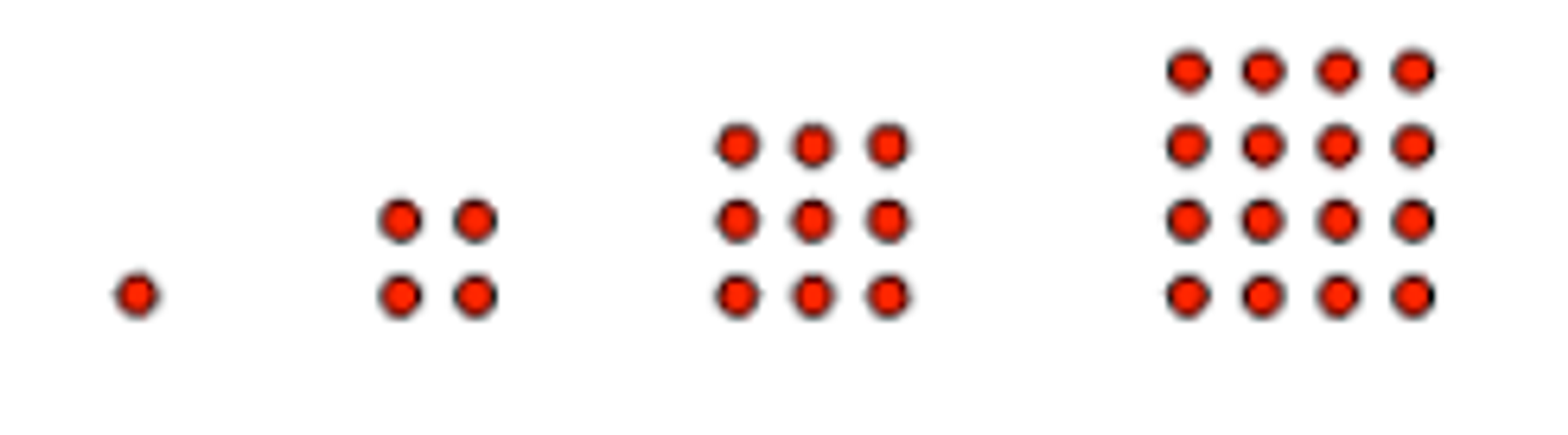
- 1 dot forms a square.
- dots form a square, and so on.
Note
📑Worked Example:
5. Triangle Numbers
Definition: A Triangle Number is a number that can be arranged in the shape of an equilateral triangle. You can obtain these by starting with and then adding the next whole number each time.
Formula:
- The th Triangle Number can be calculated using the formula:
Note
📑Examples:
- The first triangle number is
- The second triangle number is .
- The third triangle number is .
- The first ten triangle numbers are:
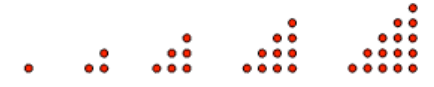
Visual Representation:
Triangle numbers can be represented by dots arranged in a triangular shape:
Note
📑Worked Example:
Note
📝Challenge Question:
6. Cube Numbers
Definition: A Cube Number is a number obtained by multiplying a whole number (integer) by itself twice. For example, and so on.
Formula:
-
If is an integer, then the cube number is given by:
${Cube Number} = n \times n \times n = n^3$
Note
📑Examples:
- The first cube number is because .
- The second cube number is because .
- The first ten cube numbers are:
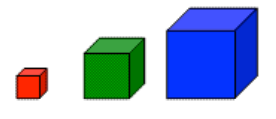
Visual Representation:
- Cube numbers can be visualised by arranging dots in a cubic pattern, where each dimension of the cube corresponds to the integer being cubed.
Note
📑Worked Example:
7. Factors
Definition: The Factors of a number are all the whole numbers (integers) that divide exactly into the given number without leaving a remainder.
Important Points:
- is a factor of all numbers, and any number is a factor of itself.
Note
📑Examples:
- The factors of are: and .
- The factors of are: and .
Observation:
- Notice that square numbers (like ) have an odd number of factors. Can you think about why that might be?
Note
📑Worked Example:
Note
📝Challenge Question:
8. Multiples
Definition: The Multiples of a number are all the numbers you get by multiplying that number by the whole numbers (integers).
Important Points:
- You must include the number itself as its first multiple.
Note
📑Examples:
- Some multiples of are: and so on.
- Some multiples of are: and so on.
Note
Worked Example: Problem: Find the first five multiples of .
Solution:
-
Multiply by the integers from to :
$9×3=27$ $9×4=36$ $9×5=45$ -
Therefore, the first five multiples of are and .
9. Prime Numbers
Definition: A prime number is a number that has exactly two distinct factors: and the number itself. This means that it can only be divided by and itself without leaving a remainder.
Important Notes:
- is NOT a prime number because it only has one factor (itself).
- is the ONLY even prime number because it has two factors ( and ). All other even numbers are divisible by and at least one other number, making them not prime.
Note
📑Examples of Prime Numbers:
- is a prime number because it has exactly two factors: and .
- is NOT a prime number because it has four factors: , and .
- is a prime number because it has exactly two factors: and .
List of Prime Numbers Between 1 and 100**:**
Note
Worked Example: Question:
Is the number a prime number?
Solution:
- List Factors: We start by listing the factors of .
- The factors of are and because no other numbers divide without leaving a remainder.
- Check the Definition:
- According to the definition, a prime number has exactly two factors.
- Conclusion:
-
Since only has the factors and , it is a prime number. Step-by-Step Explanation:
-
First, try dividing by all integers less than itself (except ).
-
(Not an integer, so is not a factor)
-
(Not an integer, so is not a factor)
-
Continue this process until you reach (approximately ).
-
None of these divisions result in an integer, confirming that is only divisible by and .
-
Therefore, is prime.