Resultant Forces (OCR GCSE Physics A (Gateway Science Suite)): Revision Notes
📚Revision Notes
5.1.6 Resultant Forces
Resultant Forces
Resultant Force
Note
A single force that has the same effect as all of the original forces acting together.
Note
These values are achieved by calculating the total force acting in each direction.
Resultant Force
Note
Definition:
- A single force represents the sum of all the forces acting on an object.
- If more than one force acts along a straight line, the resultant can be found by adding (acting in the same direction) or subtracting (acting in opposite directions) them.
Note
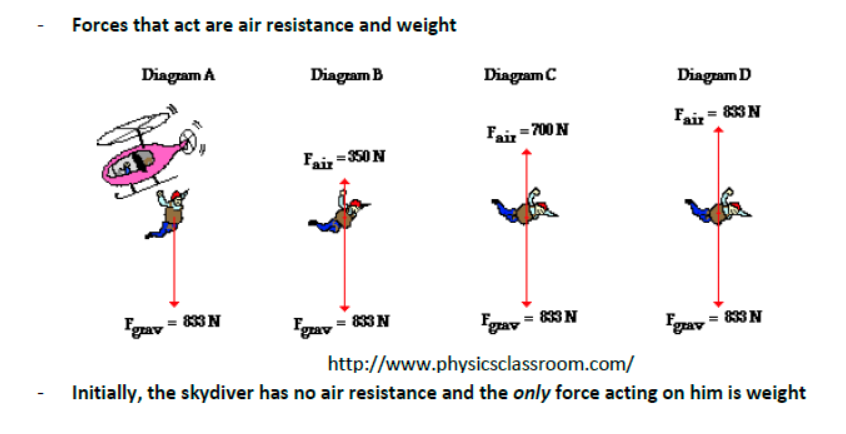
Skydiver Example
- Forces acting: Air resistance and weight.
Note
Stages of Skydiving
- Diagram A:
- Initially, the skydiver has no air resistance, and the only force acting is weight.
- The resultant force is 833N down.
- Diagram B:
- As he falls, he accelerates, increasing his speed.
- As air resistance increases, the resultant force from weight decreases.
- The resultant is 833 - 350 = 483N down.
- Diagram C:
- So acceleration decreases, and he is not speeding up as quickly.
- The resultant is 133N down.
- Diagram D:
- Eventually, they are equal and balanced, so there is no resultant force.
- Resultant = 0.
- No acceleration when the resultant force is 0; they travel at terminal velocity.
Note
Free Body Diagrams: Show the forces (and their directions) acting on an object.
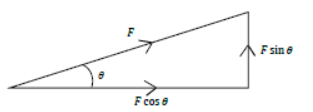
Resolving Forces
Note
A force at angle to the ground can be resolved parallel and perpendicular to the ground.
Note
Using Pythagoras' rule, the two components are shown: