Seismic Waves (OCR GCSE Physics A (Gateway Science Suite)): Revision Notes
📚Revision Notes
6.1.14 Seismic Waves
Seismic Waves
Note
Seismic waves are generated by earthquakes and volcanic eruptions. Scientists use these waves to explore and understand the Earth's internal structure.
Measuring Seismic Waves
Note
When an earthquake or volcanic eruption occurs, seismic waves are produced and travel through the Earth. These waves are detected by instruments called seismometers.
Note
Scientists study seismic waves by measuring:
- The time it takes for the waves to reach various points on the Earth's surface.
- Locations where the waves do not reach, indicating they were reflected or refracted by different layers within the Earth.
Types of Seismic Waves
- P waves: Longitudinal waves that can travel through both solids and liquids at different speeds.
- S waves: Transverse waves that cannot travel through liquids, only through solids.
Note
These properties allow scientists to gain insights into the Earth's internal layers.
The Internal Structure of the Earth
Because P waves and S waves have different properties, we can detect their paths after an earthquake or volcanic eruption to determine the inner structure of the Earth.
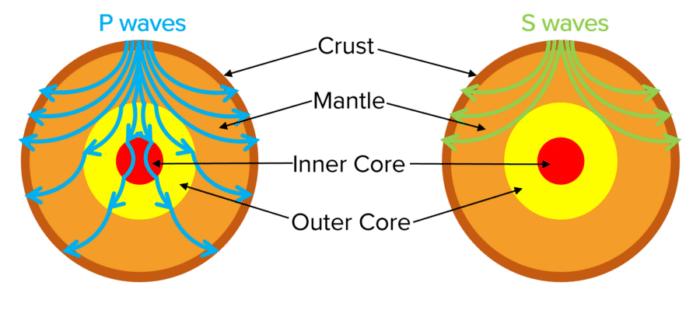
The main layers in the Earth are:
- Crust – solid
- Mantle – almost solid
- Outer Core – liquid
- Inner Core – solid
P waves are refracted at the boundaries between different layers of the Earth. S waves only travel through the crust and the mantle. This means that P waves reach more distant locations.