Reflection from Surfaces (OCR GCSE Physics A (Gateway Science Suite)): Revision Notes
📚Revision Notes
6.3.5 Reflexion from Surfaces
Note
Reflection occurs when a wave hits a surface and bounces back into the original medium instead of passing through the surface. This is similar to how a ball bounces off a wall.
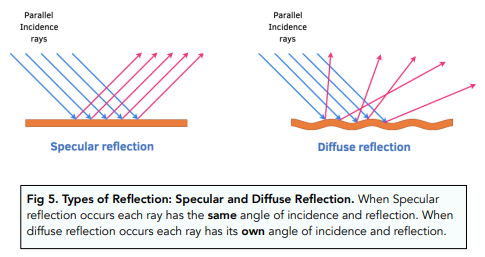
- There are 2 types of reflexion. When we talk about reflexion, there can be two types. They are called specular reflexion and diffuse reflexion. Specular reflection occurs when waves hit a smooth surface, whilst diffuse reflection occurs when the waves hit a distorted, uneven surface.
- The 2 types of reflected waves are different. When there is specular reflexion, the reflected wave will have the same angle of reflexion as the angle of incidence. When there is diffuse reflexion, the reflected wave will have a different angle of reflexion compared to the angle of incidence.
Ray Diagrams
Note
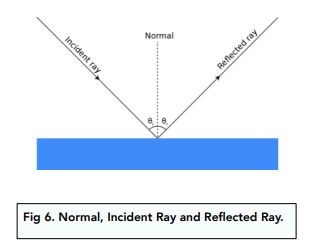
For the AQA exams, you should be able to draw out ray diagrams to show the reflections of waves at a surface. To do this, you will need a sharp pencil, a ruler and a protractor.
Note
Method
- Draw on the 'normal'. The 'normal' is simply another word for a line that is at 90 degrees to the boundary.
- Draw the incident ray. Using a protractor, measure out an angle. Using a ruler, draw a straight line along the angle to create the incident ray.
- Draw on the reflected ray. Again, take your protractor and measure out the same angle as before. This time, you should be measuring the angle on the opposite side. Draw a straight line along this angle, ensuring that it touches the normal.