Cadences (Junior Cert Music): Revision Notes
📚Revision Notes
Cadences
What is a Cadence?
- A cadence is a pair of chords that usually comes at the end of a musical phrase.
- It is made up of two chords played one after the other.
- It acts like punctuation in a sentence – it can pause the music or bring it to a clear ending.
- Different types of cadences create different feelings in music.
- Cadences are divided into two main groups:
- Finishing cadences
- Non-finishing cadences
- A cadence is made up of: 3. An approach chord (the first chord) 4. A final chord (the second chord)
Note
Review**: what is a** phrase? A musical phrase is like a short sentence in music.
It is a series of notes that sound complete even when played apart from the main song.
Finishing Cadences
Note
A finishing cadence is used in the phrase that ends a piece of music, a section or a pair of phrases that belong together.
- For finishing cadences, the approach chord can be:
- Chord V (the dominant), or
- Chord IV (the subdominant)
- The final chord is always chord I (the tonic chord).
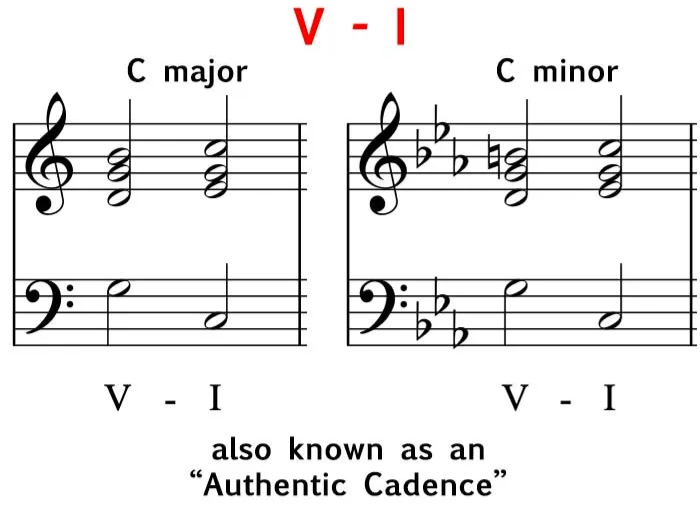
1. Perfect Cadence (V → I)
- Chord pattern: V → I (Dominant to Tonic)
- Makes the phrase sound fully complete.
- Known as a "full stop" in music
- In C major: G major (V) → C major (I)
2. Plagal Cadence (IV → I)
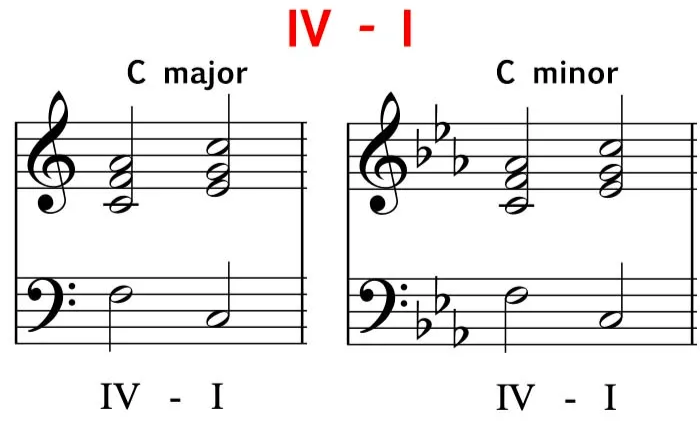
- Chord pattern: IV → I (Subdominant to Tonic)
- Makes the phrase sound complete, but softer than a perfect cadence.
- In C major: F major (IV) → C major (I)
Note
A perfect cadence is created when the final two chords of a phrase are chord V followed by chord I.
A plagal cadence is created when the final two chords of a phrase are chord IV followed by chord I.
Non-Finishing Cadences
- A non-finishing cadence does not end on chord I, so it sounds unfinished or like the music needs to continue.
- These cadences are used at the end of phrases that are not final.
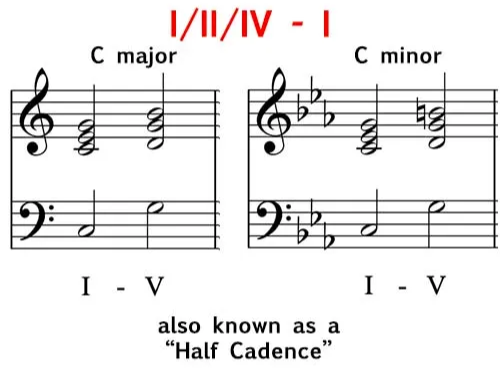
3. Imperfect Cadence (→ V)
- Chord pattern: → V (Ends on the Dominant chord)
- Sounds like a pause, not a full stop.
- The approach chord can be:
- Chord I (Tonic)
- Chord ii (Supertonic)
- Chord IV (Subdominant)
- In C major:
- C major (I) → G major (V)
- D minor (ii) → G major (V)
- F major (IV) → G major (V)
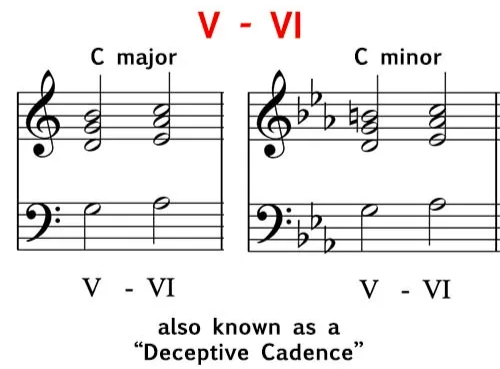
4. Interrupted Cadence (V → vi)
- Chord pattern: V → vi (Dominant to Submediant)
- Starts on chord V, but instead of finishing on chord I, it moves to chord vi (the relative minor).
- This is also called a 'surprise' cadence.
- It tricks the listener into expecting a perfect cadence, but interrupts it by going to a minor chord instead.
- It creates a surprising, unfinished feeling.
- In C major: G major (V) → A minor (vi)
How to Identify a Cadence
- Cadences occur at cadence points — the end of a musical phrase.
- To identify a cadence:
5. Listen for the last two chords.
6. Ask yourself:
- Does it sound finished or unfinished?
- Can you hear if it ends on chord I (finished), chord V (imperfect), or chord vi (interrupted)?
- Try naming the chords or their Roman numerals.
Tips for Composing:
- Always end on chord I if you want the music to sound finished.
- Use longer notes in the melody at the cadence point to help it stand out.
- Cadence chords must match the melody notes — they should share notes with the final melody line.
- Check the key signature to know which chords you should use.
Cadence Overview Table
| Cadence | Chords | Explanation |
|---|---|---|
| FINISHING | ||
| Perfect | V – I | Ends on the tonic chord (I) after the dominant (V); sounds complete and strong. |
| Plagal | IV – I | Ends on the tonic (I) after the subdominant (IV); sounds complete but softer — the "Amen" cadence. |
| NON-FINISHING | ||
| Imperfect | I – V ii – V IV – V | Always ends on the dominant (V), so it sounds unfinished. |
| Interrupted | V – vi | A "surprise" cadence; ends on chord vi instead of I, so it sounds incomplete. |