Elements, Compounds, and Mixtures (Junior Cert Science): Model Answers
📚Model Answers
Compounds, States of Matter, Combustion, and Subatomic Particles
Sample Answer
Question 4
(a)
Answer
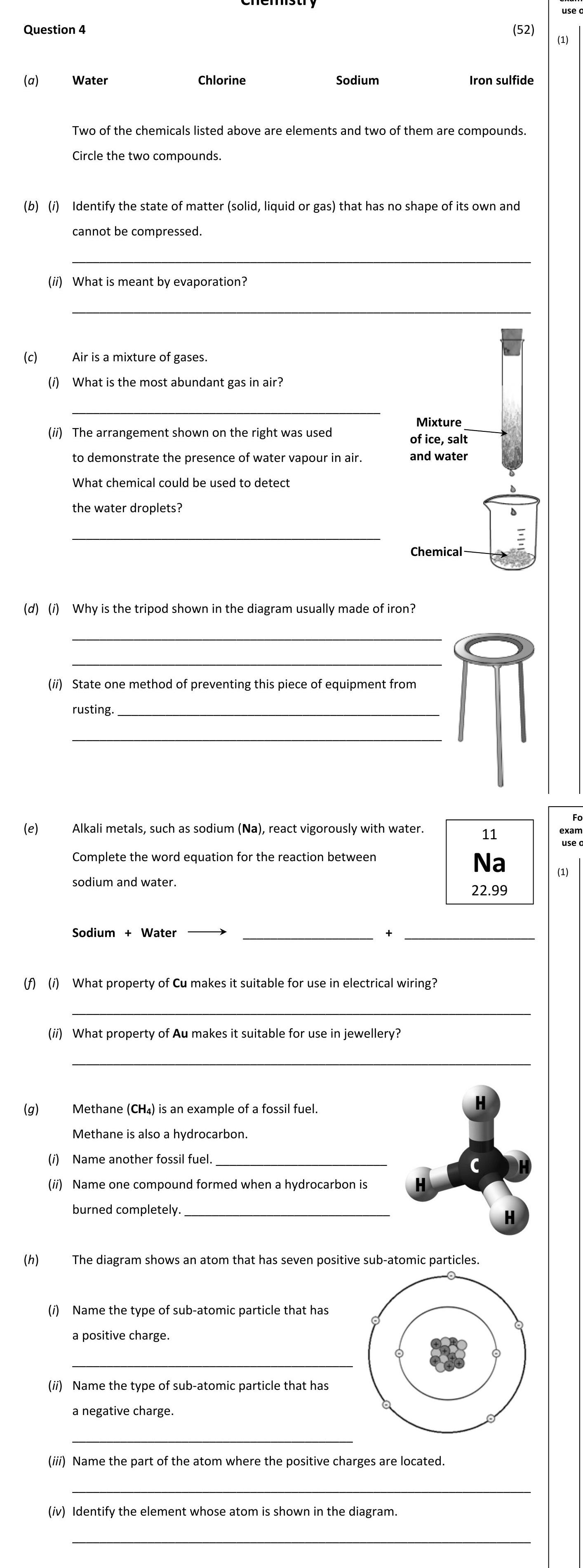
The two compounds are Water (H₂O) and Iron sulphide (FeS).
The two elements are Chlorine (Cl₂) and Sodium (Na).
Note
[2/2 Marks] Correctly identified water and iron sulphide as compounds, which are substances made up of two or more different elements chemically bonded together.
(b)(i)
Answer
Liquid is the state of matter that has no shape of its own and cannot be compressed.
Note
[1/1 Marks] Correctly identified liquid as the state that flows and takes the shape of its container but cannot be significantly compressed.
(b)(ii)
Answer
Evaporation is the process where a liquid changes into a gas at a temperature below its boiling point. It occurs only at the surface of the liquid.
Note
[1/1 Marks] Complete definition that includes the key concept of phase change below boiling point and mentions it's a surface phenomenon.
(c)(i)
Answer
Nitrogen is the most abundant gas in air.
Note
[1/1 Marks] Correct identification of nitrogen which makes up approximately 78% of air.
(c)(ii)
Answer
Anhydrous cobalt(II) chloride paper could be used to detect the water droplets. This chemical changes from blue to pink when it comes into contact with water.
Note
[1/1 Marks] Correctly identified a chemical that reacts visibly with water. Anhydrous copper(II) sulphate (white to blue) would also be an acceptable answer.
(d)(i)
Answer
The tripod shown in the diagram is usually made of iron because iron has a high melting point, good strength, and can withstand the high temperatures from a Bunsen burner without deforming.
Note
[1/1 Marks] Answer correctly identifies the key property of iron (heat resistance) that makes it suitable for laboratory equipment exposed to flames.
(d)(ii)
Answer
One method of preventing this piece of equipment from rusting is to paint or coat it with a protective layer that prevents contact between iron, oxygen, and moisture.
Note
[1/1 Marks] Correctly identified a valid method of preventing rust formation on iron. Other acceptable answers include galvanising, applying oil/grease, or making it from stainless steel.
(e)
Answer
Sodium + Water → Sodium hydroxide + Hydrogen
Note
[2/2 Marks] Correctly completed the word equation showing both products of the reaction between sodium and water.
(f)(i)
Answer
Copper has high electrical conductivity, which makes it suitable for use in electrical wiring.
Note
[1/1 Marks] Correctly identified the key property of copper that makes it valuable for electrical applications.
(f)(ii)
Answer
Gold is resistant to corrosion and tarnishing, which makes it suitable for use in jewellery as it maintains its appearance over time.
Note
[1/1 Marks] Correctly identified a key property that makes gold valuable for jewellery. Other acceptable properties could include its attractive appearance or malleability.
(g)(i)
Answer
Another fossil fuel is petroleum (crude oil).
Note
[1/1 Marks] Correctly named another fossil fuel. Other acceptable answers include coal, natural gas, or propane.
(g)(ii)
Answer
Carbon dioxide (CO₂) is formed when a hydrocarbon is burned completely.
Note
[1/1 Marks] Correctly identified one of the products of complete combustion. Water (H₂O) would also be an acceptable answer.
(h)(i)
Answer
The type of sub-atomic particle that has a positive charge is a proton.
Note
[1/1 Marks] Correctly identified the proton as the positively charged subatomic particle.
(h)(ii)
Answer
The type of sub-atomic particle that has a negative charge is an electron.
Note
[1/1 Marks] Correctly identified the electron as the negatively charged subatomic particle.
(h)(iii)
Answer
The nucleus is the part of the atom where the positive charges are located.
Note
[1/1 Marks] Correctly identified the nucleus as the location of protons in an atom.
(h)(iv)
Answer
The element whose atom is shown in the diagram is nitrogen (N).
Note
[1/1 Marks] Correctly identified nitrogen, which has 7 protons (atomic number 7) as shown in the diagram.
Marking Scheme